Within this post, I talk about my experience(s) visiting the Aga Khan Museum, focusing on their commitment to accessibility.
Background
The Aga Khan Museum is a relatively new museum, established in 2014. They have a (very) brief history on their website (available here) and make their annual reports available here. The museum history nerd in me loves to see this content so easily available (but would love a more complete history).
From a cultural policy perspective, the Aga Khan Museum is unique. It is the first museum dedicated to the arts of Muslim civilizations in North America (AKDN).
Within the Canadian context, it also stands out due to its budget for two reasons. First, it has one of the largest operating budgets that I have seen for a Canadian museum that is not a government institution. Most Canadian non profit museums (and municipal ones!) have budgets well under a million dollars. The Aga Khan Museum’s Canadian Revenue Agency report from 2024 shows revenue exceeding 19 million and expenses exceeding 18 million. Although other factors contribute to institutional capacity (e.g., volunteer labour), they started with and have maintained a comparatively high budget. As such, they have a lot more capacity than typically seen in non profit museums in Canada. Second, according to their 2024 annual report, grants only form 5% of their budget. The majority of their budget (74%) comes from “donations, sponsorships, patrons, and friends.” In my experience, this is also atypical within the Canadian museum landscape and I am curious about the ways their funding structure shapes their activities.
As a frequent museum goer, I also find the Aga Khan Museum operates differently then other institutions (particularly art museums in the same region, such as the Art Gallery of Ontario or the McMichael Canadian Art Collection). The differences relate to the accessibility of their content, which I will discuss in my reflection below.
I go to the Aga Khan Museum multiple times a year, but I have only been once in 2026. During our January visit, we explored the Aga Khan Museum’s permanent collection, spent time in the Bellerive Room, and walked through the temporary exhibit As the Sun Appears from Beyond. I had visited all of these spaces previously, but continue to learn each time due to the breadth of information provided.
The January visit involved less engagement with written content because we went with four children, using the Museum as a space to meet up and hang out. I focused on following the two toddlers and facilitating their experience. As a result, my reflections on our visit focus almost entirely on accessibility and not any specific content.
Reflection
The Aga Khan Museum is accessible in a number of ways.
The art is intellectually accessible due to the education provided. Rather than assume the objects displayed are actively speaking for themselves (why do art spaces do this?!?!), the curators provide the context people need to more fully understand what they are seeing. For example, the temporary exhibition included education about medium, technique, content and historical context in addition to the blurbs on individual pieces. During a previous visit, I read a lot. I learnt about technique and historical context. As a result, on this visit, I had a greater appreciation for the art surrounding me as I followed (chased?) toddlers around the space.
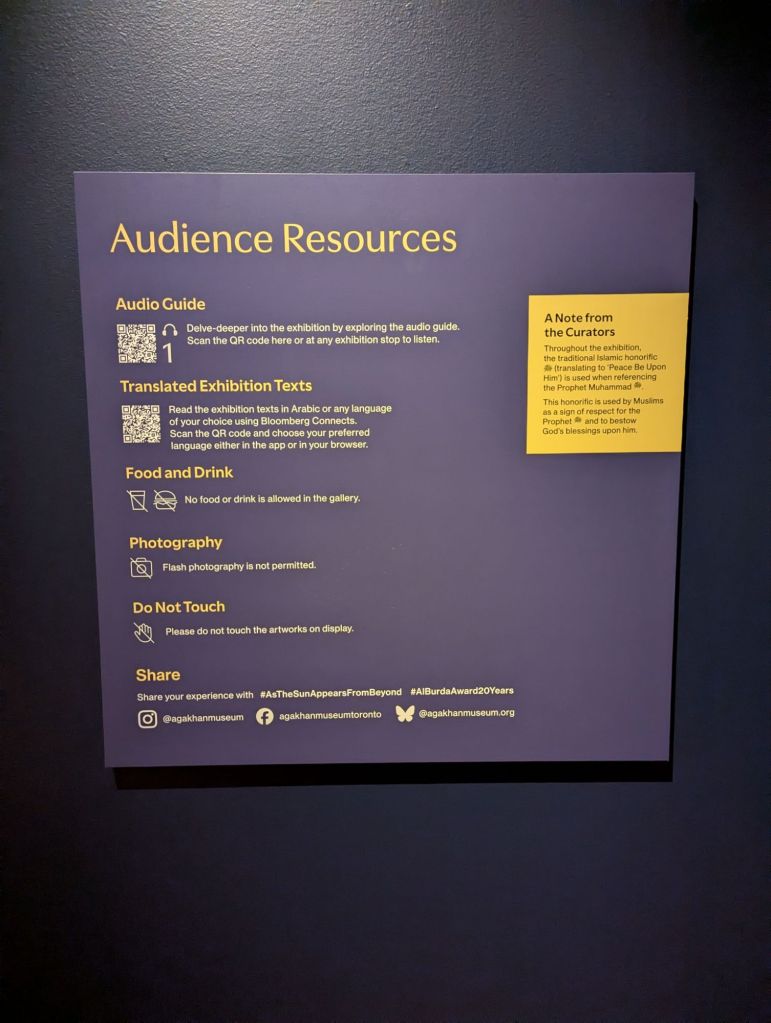
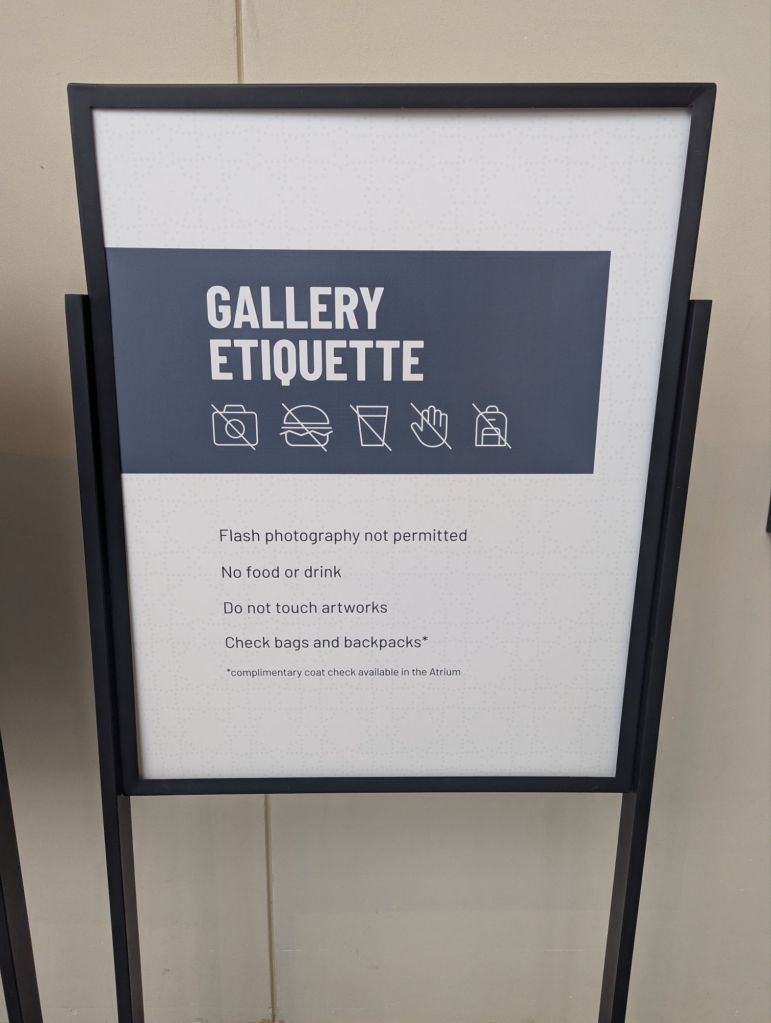
The exhibits are made more accessible to people less familiar with museum spaces. There is a Gallery Etiquette panel in front of the permanent exhibit, which outlines expectations for the space. The temporary exhibition had an Audio Resources panel that explained the different symbols used in the space, including those seen in most museums like the do not touch symbol or no flash photography. There was also a note from the Curators that I appreciated because it provided some cultural context I did not have.
The Aga Khan Museum designs exhibits in ways that remove physical barriers as well. When we have strollers, we appreciate the availability of an elevator at both the start and end of the temporary exhibit. The toddlers like that they can see the artifacts without adult adult intervention because (usually) nothing blocks their view. The speakers are also easy and intuitive to use. The youngest children were able to access auditory content on their own.
Design elements throughout the Museum make the content more accessible to families. Within all of the exhibit spaces, there are activities that reflect exhibit themes and can be interacted with in different ways. We appreciate the spaces provided to eat and rest. The Bellerive Room, for example, has a quiet area at the back with comfy seating, activities for kids, and books for a variety of readers. These activities and books connected to the museum’s themes, encouraging additional reflection on what we saw.
It’s telling that the Aga Khan Museum is (currently) my toddler’s favourite. It is one of mine too.
Is it perfect?
No. I have complaints.
For example, there are some persistent staff behaviours that I find odd and / or that make me uncomfortable. In particular, the front desk staff has a tendency to respond to questions as if the hallway exhibit on the basement level isn’t an exhibit worth checking out. The gift shop staff tends to follow and watch me. They stroll oddly close in such a small space as if they are expecting me (my child?) to very suddenly steal or break something, but then they almost never talk to me. So, I feel oddly observed and I never buy anything despite loving some of the content.
That being said, I will continue to visit the Aga Khan Museum due to accessibility and connection.
The design prioritizes accessibility in ways that diverge from my expectations for art museum spaces. I believe their mission – to spark “wonder, curiosity, and understanding of Muslim cultures and their connection with other cultures” – clearly informs design. They have created a space that different people from different backgrounds and with different experiences in museum spaces can come to learn. Despite knowing almost nothing about Muslim civilizations the first time that I went, I wasn’t confused. They provided the information I need to understand what I see.
They have also provided a space for social connection that I really appreciate. We enjoy going to the museum as a group. The space isn’t just providing context to look, listen, and explore. It also provides space to sit, reflect, and connect. I love it.
Questions
Why don’t more art museum focus on the intellectual / cultural accessibility of their content?
How does the Museum’s unique history and funding structure within the Canadian museum context shape their work?
I have not been to an event yet, but they look amazing. Any recommendations?


One thought on “Accessibility and Connection at the Aga Khan Museum”