I am almost at the end of my January visits! Within this post, I am going to talk about my visit to the Wellington County Museum and Archives.
Background
In my experience, museums with both an archive and affiliated historical society often have a more accessible history. In this case, the Wellington County Museum and Archives’ digitized collection includes publications from the Wellington County Historical Research Society, which founded the Museum. The museum nerd in me = excited to spend more time perusing the database.
A group of Women’s Institute members met and formed the Wellington County Historical Research Society in 1928 to “preserve the remnants and artifacts of the pioneer period” (Thorning 1981, 80). Their programming included papers, talks, exhibitions of artifacts, demonstrations, and historical plays. Following a period of reduced activity due to the second world war (Ibid.), they founded the museum in 1954 and then promptly sold the collection to the county in 1957 (Callen 1981). In the 1970s, the County moved the Museum to its current location.
Side note: I think provincial granting requirements likely contributed to County involvement in the Museum. At the time, the province gave $1,000 to municipal councils that appropriated funds for a museum they owned and opened to the public.
I visited the Wellington County Museum and Archives alone on a weekday in January, which is a rare treat for me. Despite not bringing a toddler, I am still not an ideal visitor that reads every panel or engages with every exhibit. At the time, the exhibits within the space include: Wildlife Rescue, Domestic Elegance, Ephemera, Destination Wellington, If These Walls Could Speak, The Jewel Classic Movie Theatre, Far from Home, and the Children’s space. There was also an exhibition on an archaeological dig and Indigenous Peoples titled “First Story: The Neutrals in Wellington County,” which at the time that I write out this reflection is notably absent from their list of current exhibitions.
I really enjoyed most of the Museum and thought it was a delightful way to spend the morning. In particular, Ephemera is an excellent exhibit theme.
However, I stopped thinking about the experience due to the colonial narratives reinforced in the space.
Reflection
The Wellington County Museum and Archives exhibits “First Story” and “Destination Wellington” contribute to and reinforce a specific colonial narrative that is far too popular in Ontario’s community museums. They legitimize settlement and current colonial constructions while historicizing Indigenous Peoples. Historicization is most visible in the exhibit purporting to be about the Neutral Nation.
Side note: They were called Attawandaron by the Huron-Wendat and Neutrals by the French. I am using Neutral Nation because that is the term used in the exhibit and we do not know what they called themselves.
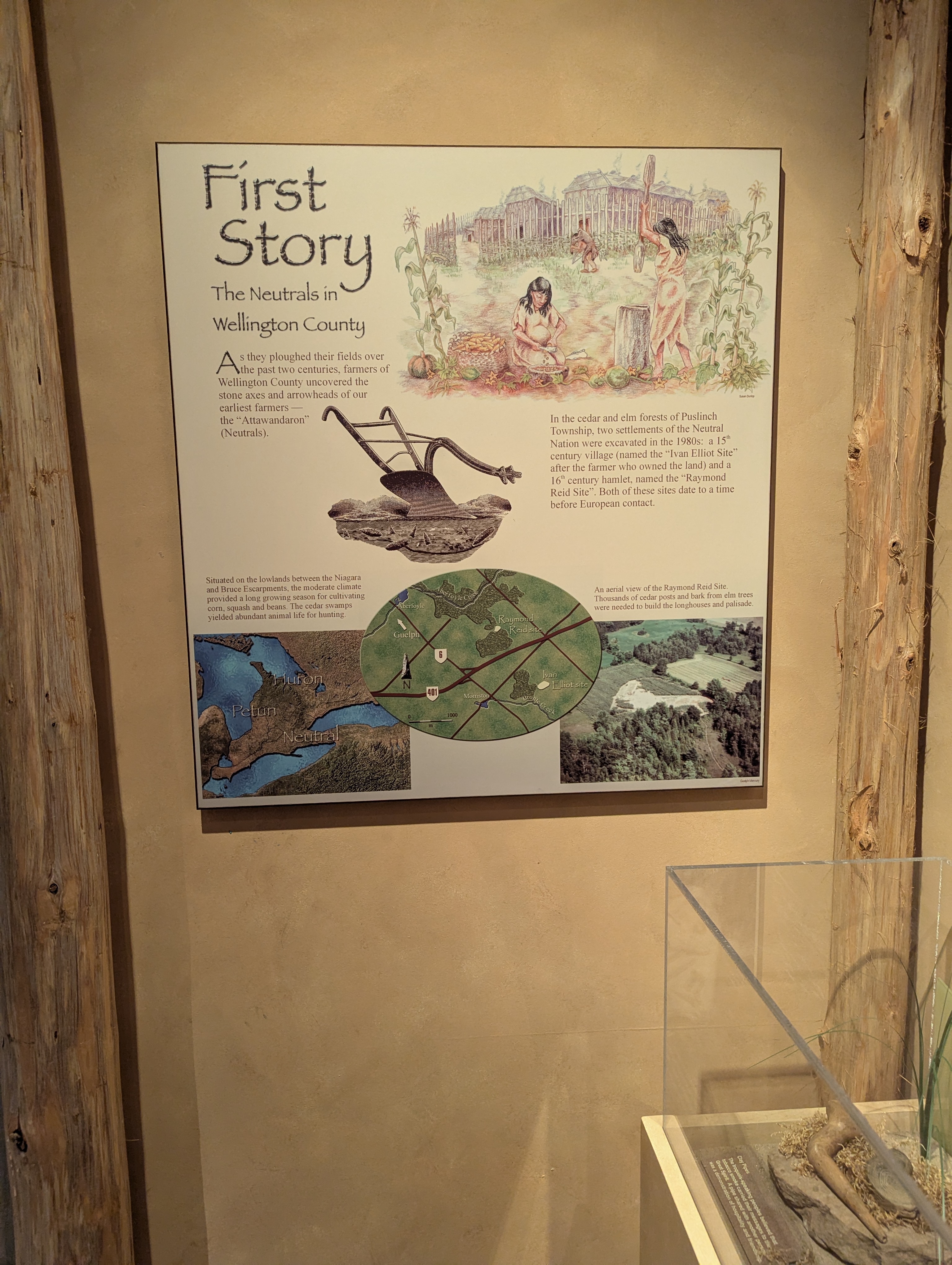
The first panel titles the exhibit, “First Story: The Neutrals in Wellington County” and outlines the actual topic of the exhibition – that is, two archaeological digs:
a 15th century village (named the “Ivan Elliot Site” after the farmer who owned the land) and a 16th century hamlet, named the “Raymond Reid Site.” Both of these sites date to a time before European contact.
Panel One
There are several issues with this introduction. Notably, the title conflicts with the actual topic – that is, archaeology. The story told through archaeology is a colonial construction as immediately evident in the site names. It positions a specific Nation as having the “first story” but only dates the story to the 15th century.
The second and third panels focus on archaeology with display cases underneath holding artifacts from the digs. The panels are rife with colonial language, continuing to indicate a focus on archaeology rather than Indigenous Peoples. The panels identify the archaeologist by name multiple times and emphasize student involvement with images. They state the Neutrals “chose a site away from the flowing waters of Puslinch Township…” Notably, what is now Puslinch Township did not exist at the time and the waters only belong to the township within a colonial understanding.
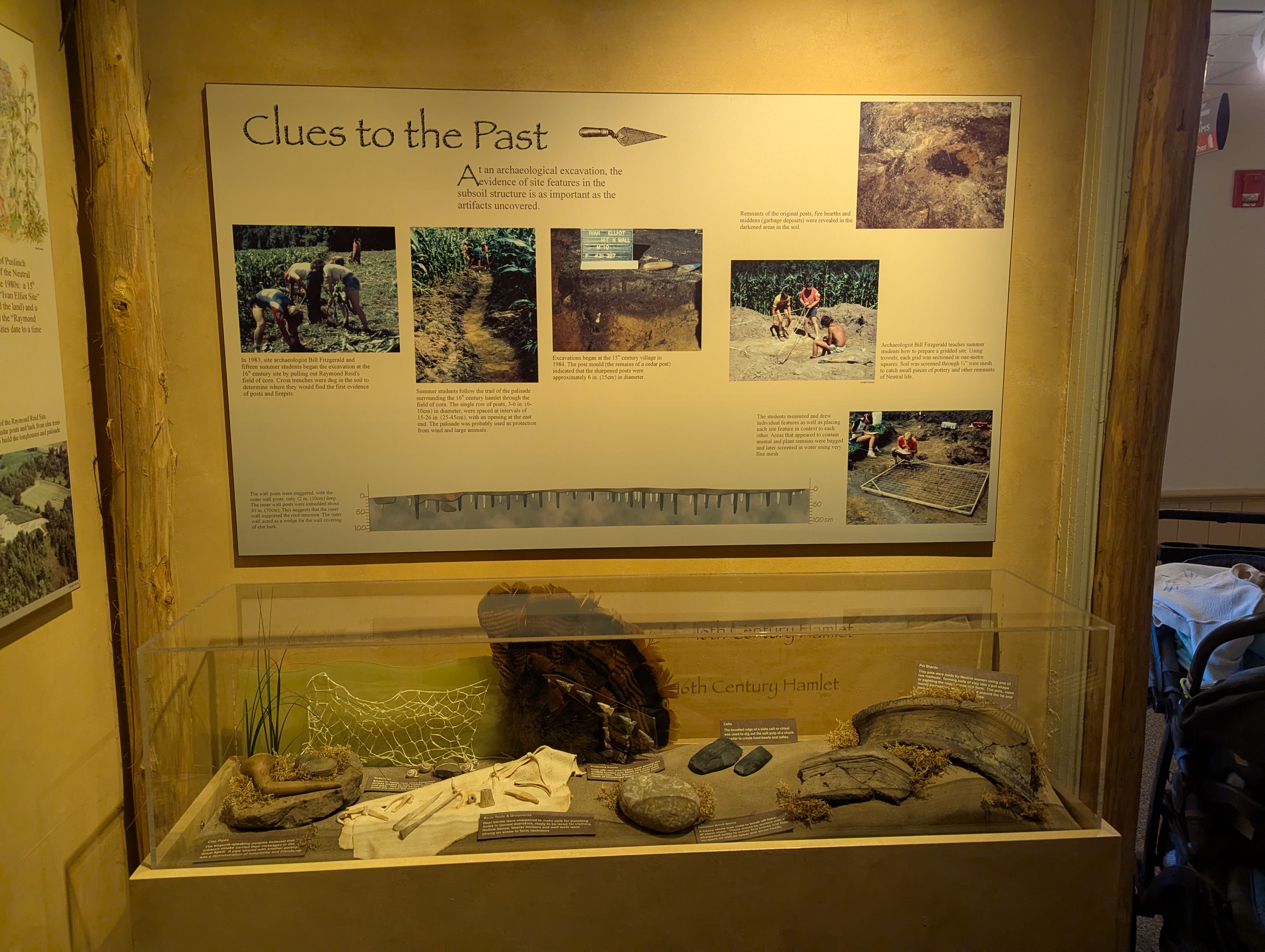
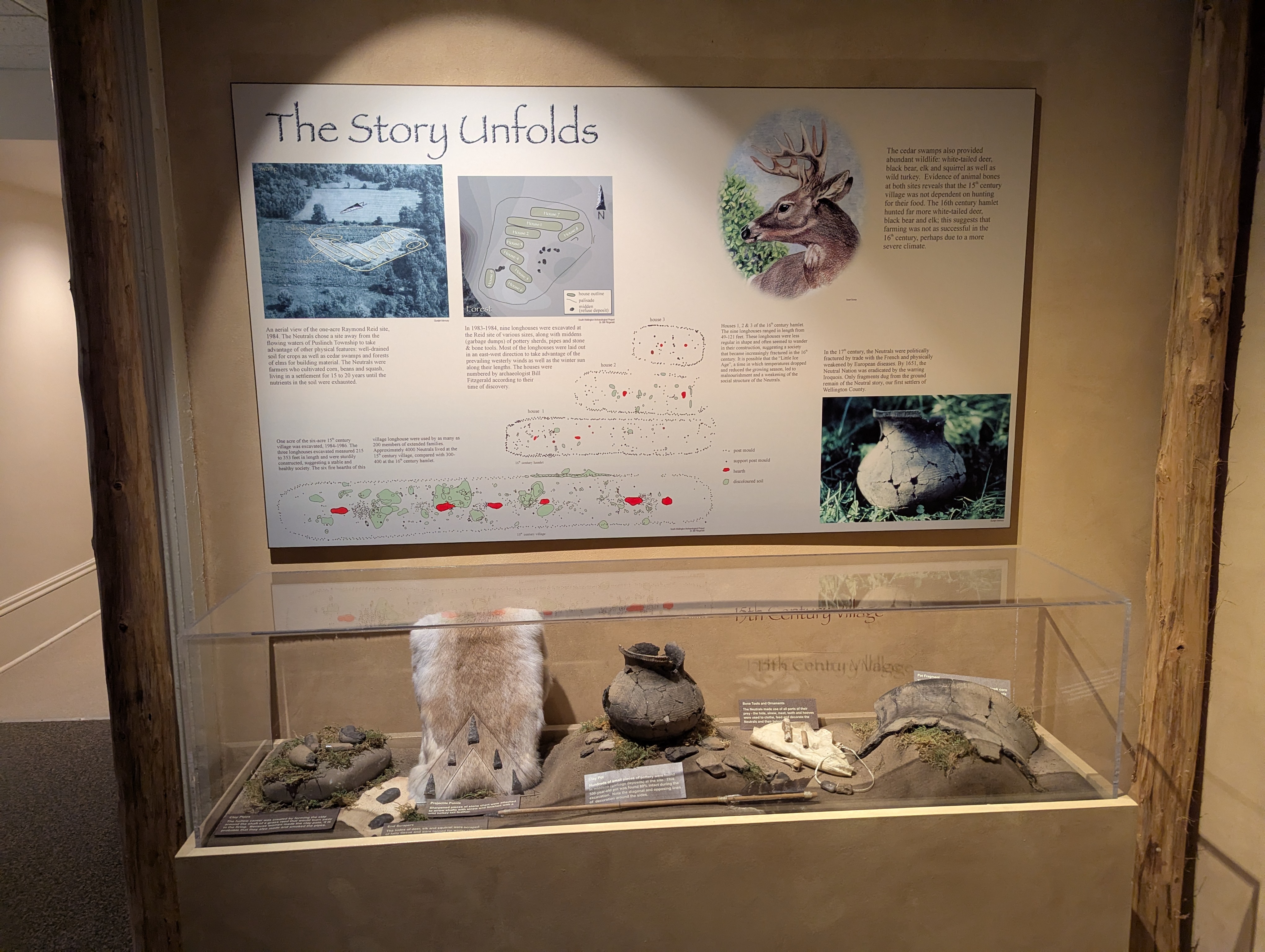
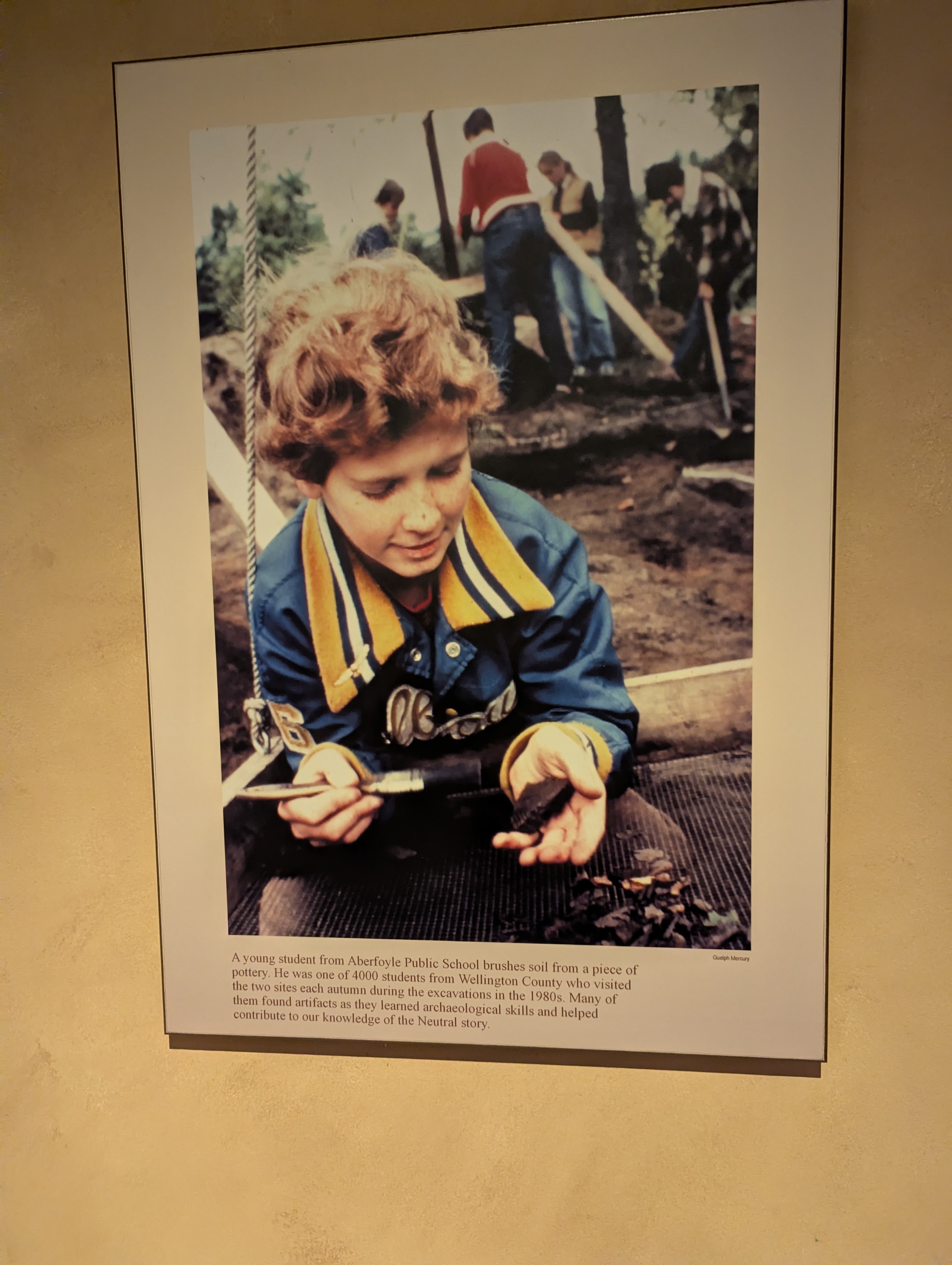
There is a final panel that provides more information – (I think) referencing Indigenous Peoples longstanding relationship to the land. It’s titled “Fragments of History: The First 10,000 years” and seems to outline periods of time in relationship to artefacts found. However, I did not stay to read it and I don’t have a clear picture because I stopped at the third panel (reminder: I am not a perfect museum goer).
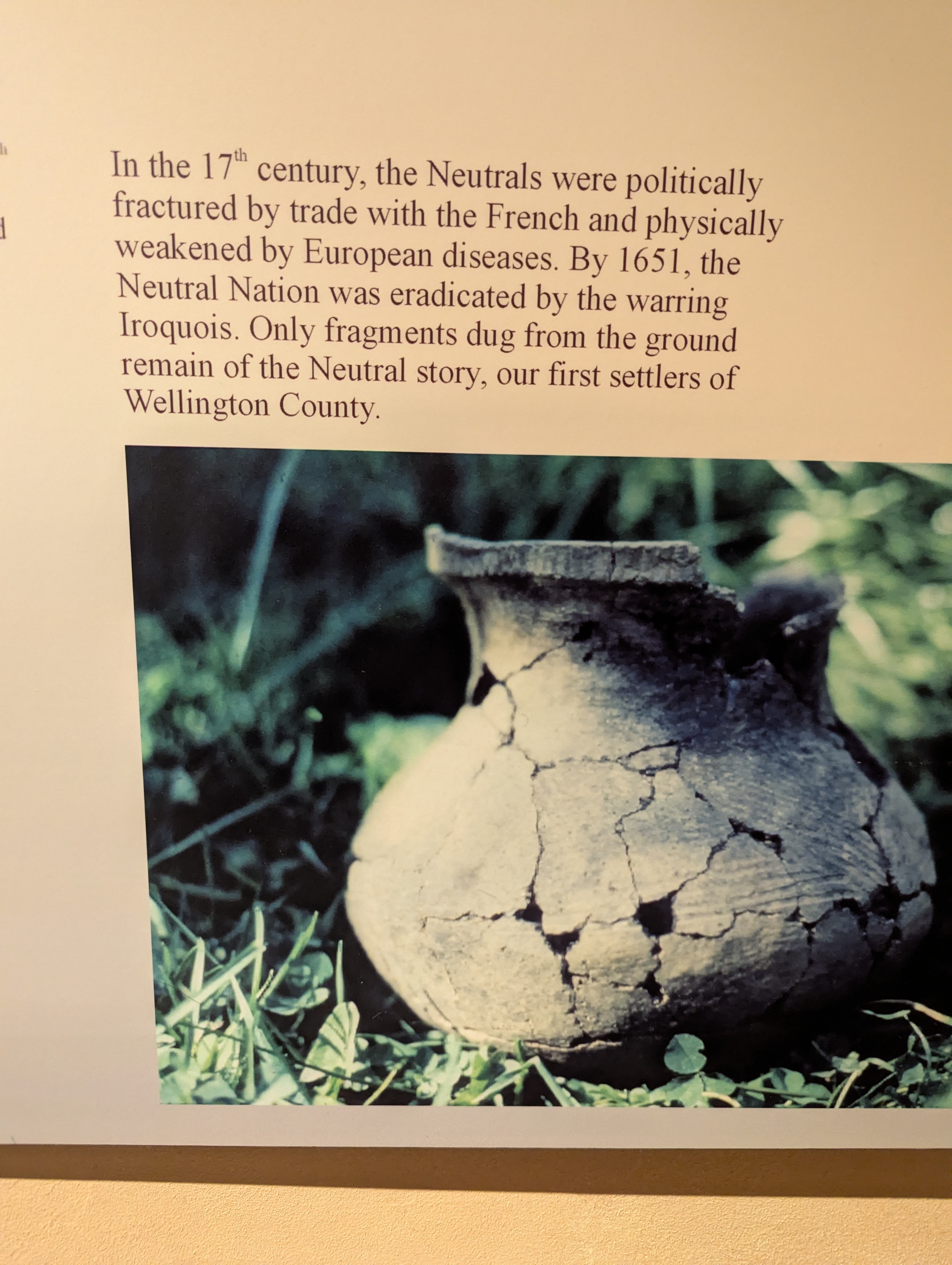
I needed time to reflect on the blatant colonial messaging in the third panel, which states:
In the 17th century, the Neutrals were politically fractured by trade with the French and physically weakened by European diseases. By 1651, the Neutral Nation was eradicated by the warring Iroquois. Only fragments dug from the ground remain of the Neutral story, our first settlers of Wellington County.
Panel Three
There are a lot of issues with this paragraph. I am not an expert by any means so I may be missing something or have a misunderstanding. Here are the issues that I can see:
- Stating the Nation was eradicated implies the People died. They did not. They dispersed.
- The panel acknowledges trade and disease had an effect on weakening the Nation, but blames their so-called eradication on “warring Iroquois.” Using the term “waring Iroquois,” mitigates European responsibility in the deaths and disbursement of Indigenous Peoples in the area. Notably, the 17th century “Iroquois Wars” were a fight for resources as the economy had become dependent on European Fur trade.
- The assertion – only fragments dug from the ground remain – gives archaeologists the singular authority to speak for the Neutral Nation.
I think the exhibit aimed to share artifacts and information about an archeological dig that occurred in the region. However, in practice, the exhibit reinforces a colonial narrative that sees certain kinds of land use, such as the creation of a so-called village or hamlet, as legitimate. The narrative villainizes some Indigenous Peoples (e.g., “waring Iroquois”), undermining their longstanding and ongoing relationships to the land. It fails adequately to acknowledge subsequent or previous relationships to the territory now known as Wellington County.
Initially, I considered the colonial narrative in the archaeology exhibition in isolation from the others, which I enjoyed at the time. However, as I reflected, I realized I did not experience the exhibitions in isolation and the narratives presented are complimentary.
The “Destination Wellington” exhibit ignores the reality that what is now called Wellington County was not empty. The messaging is also part of the colonial narrative.
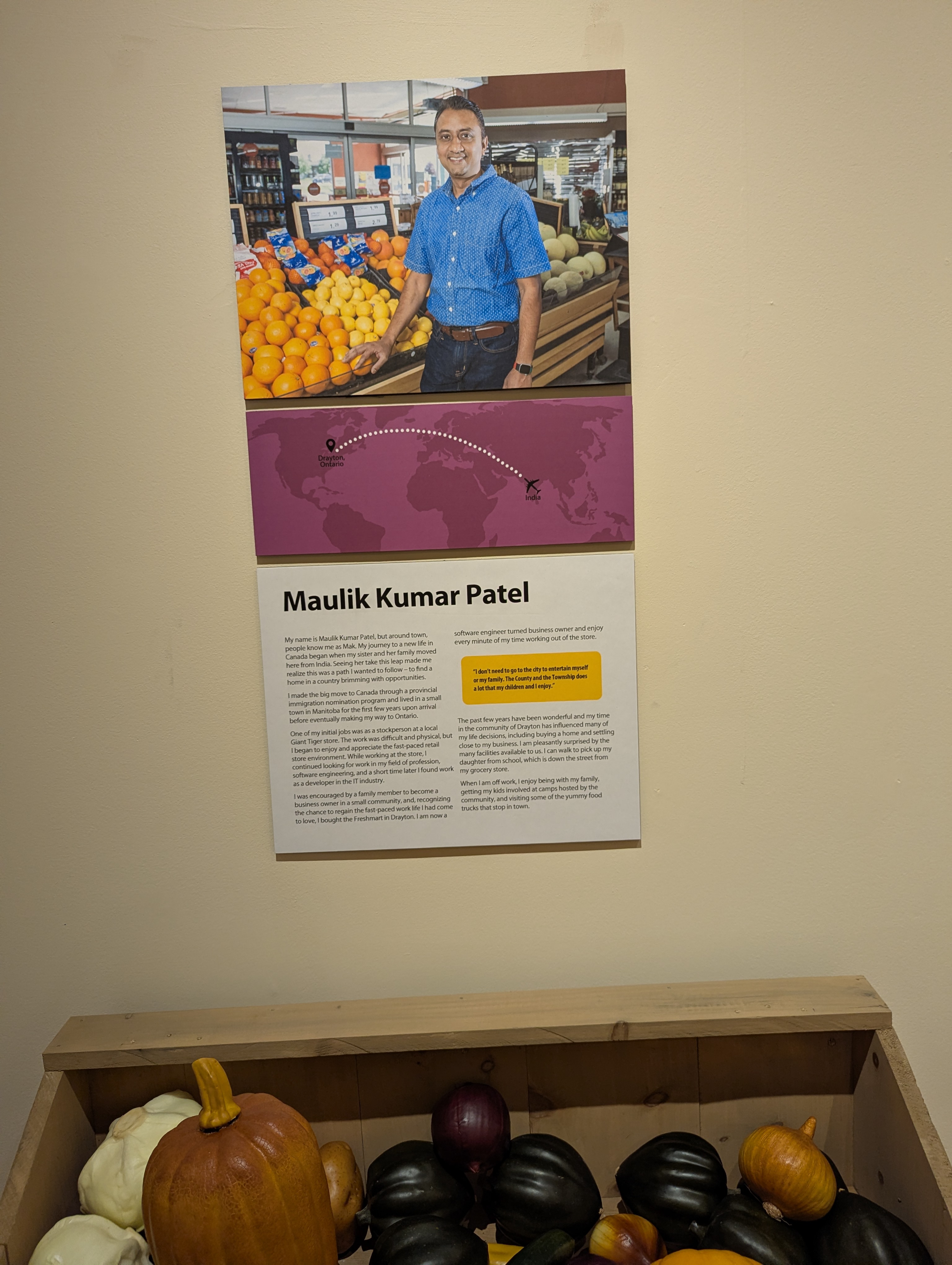
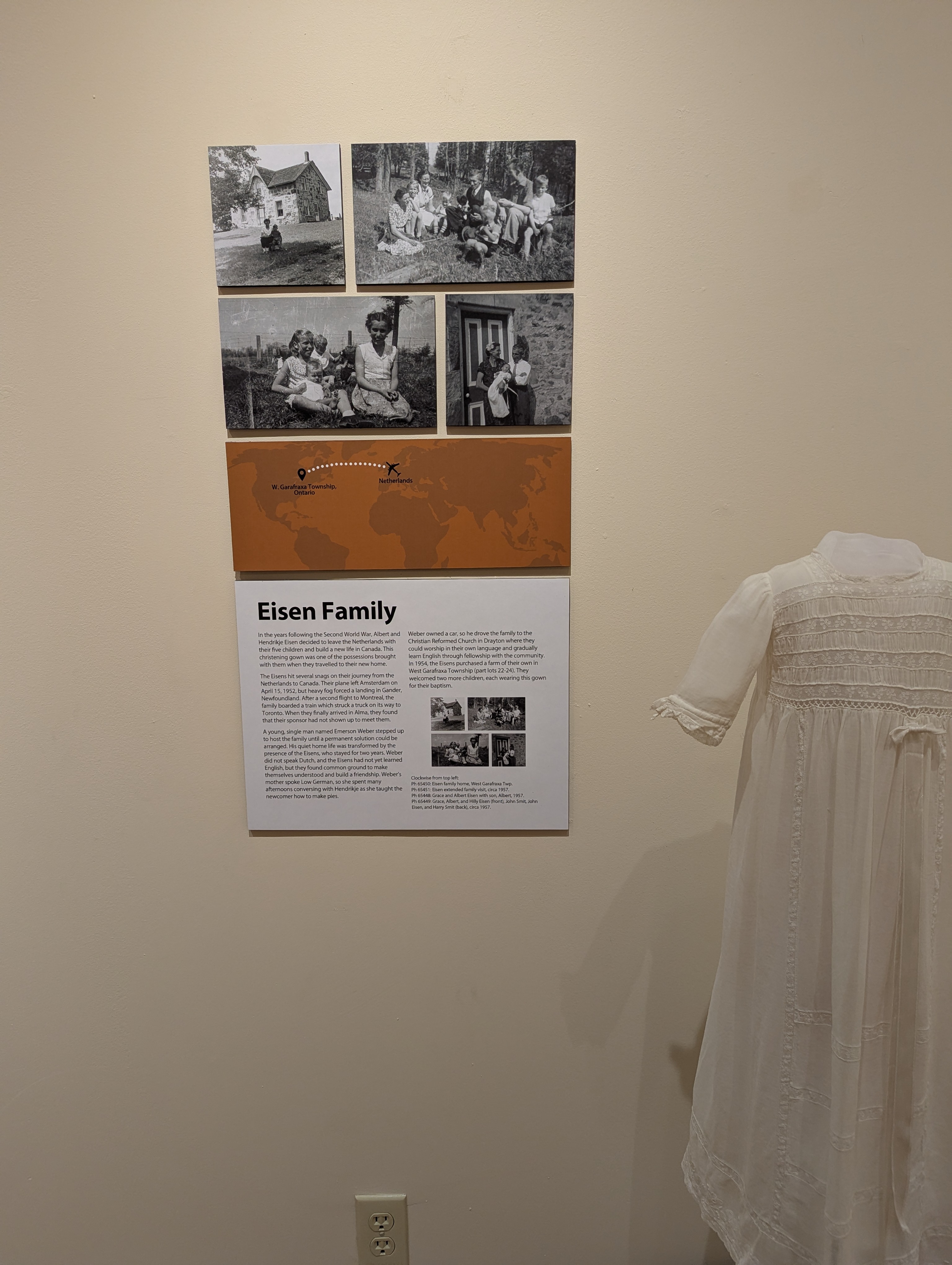
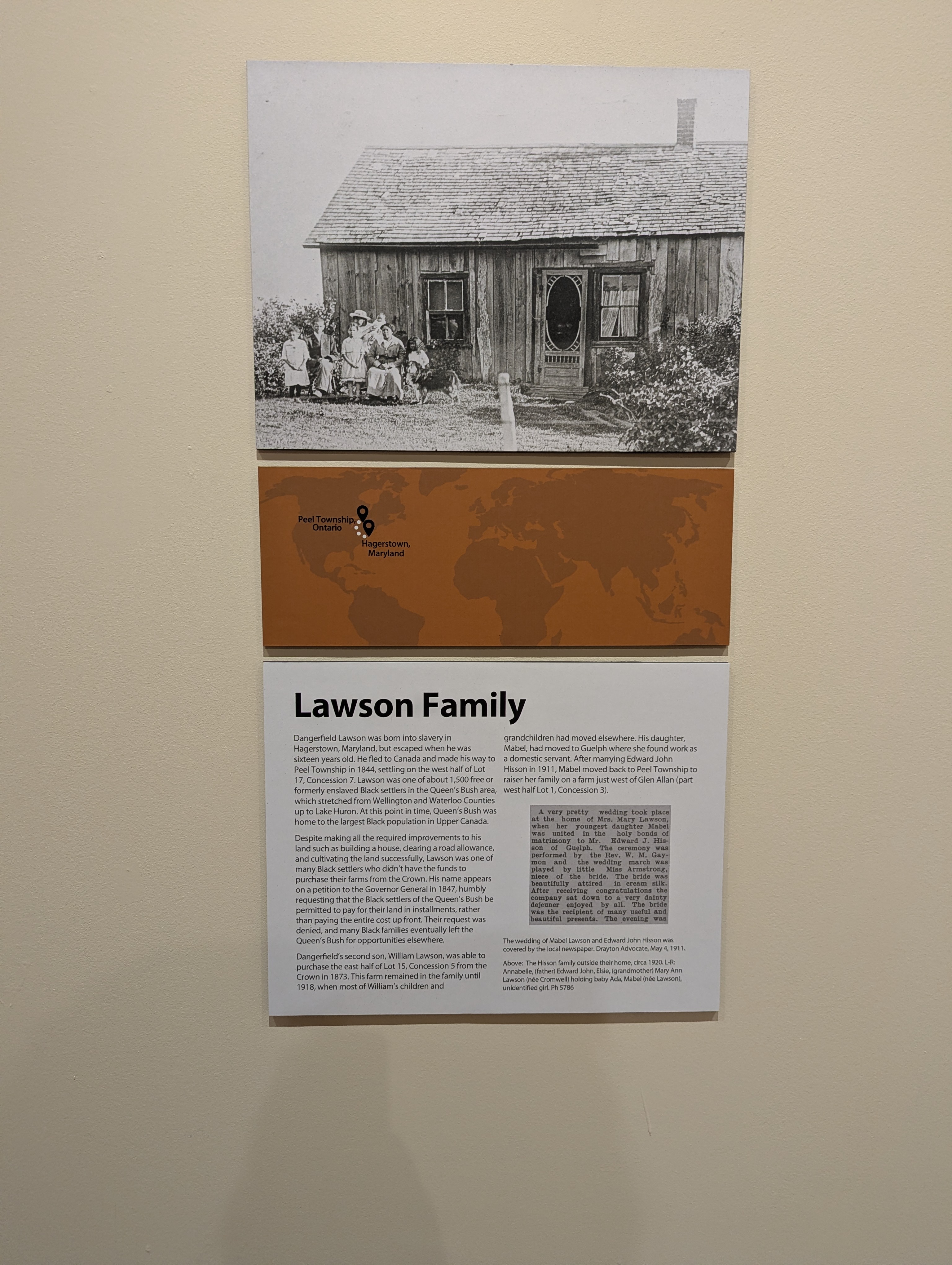
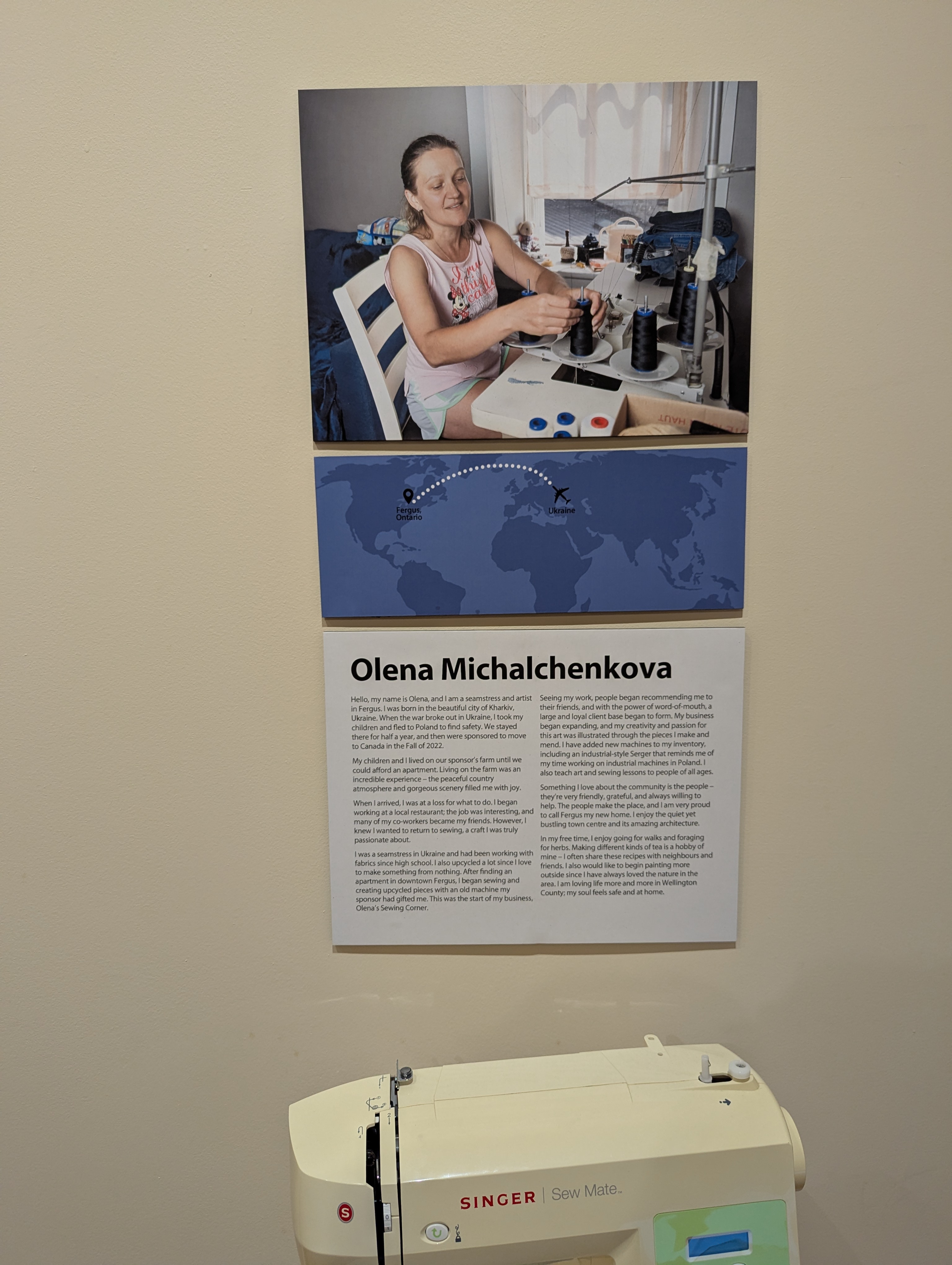
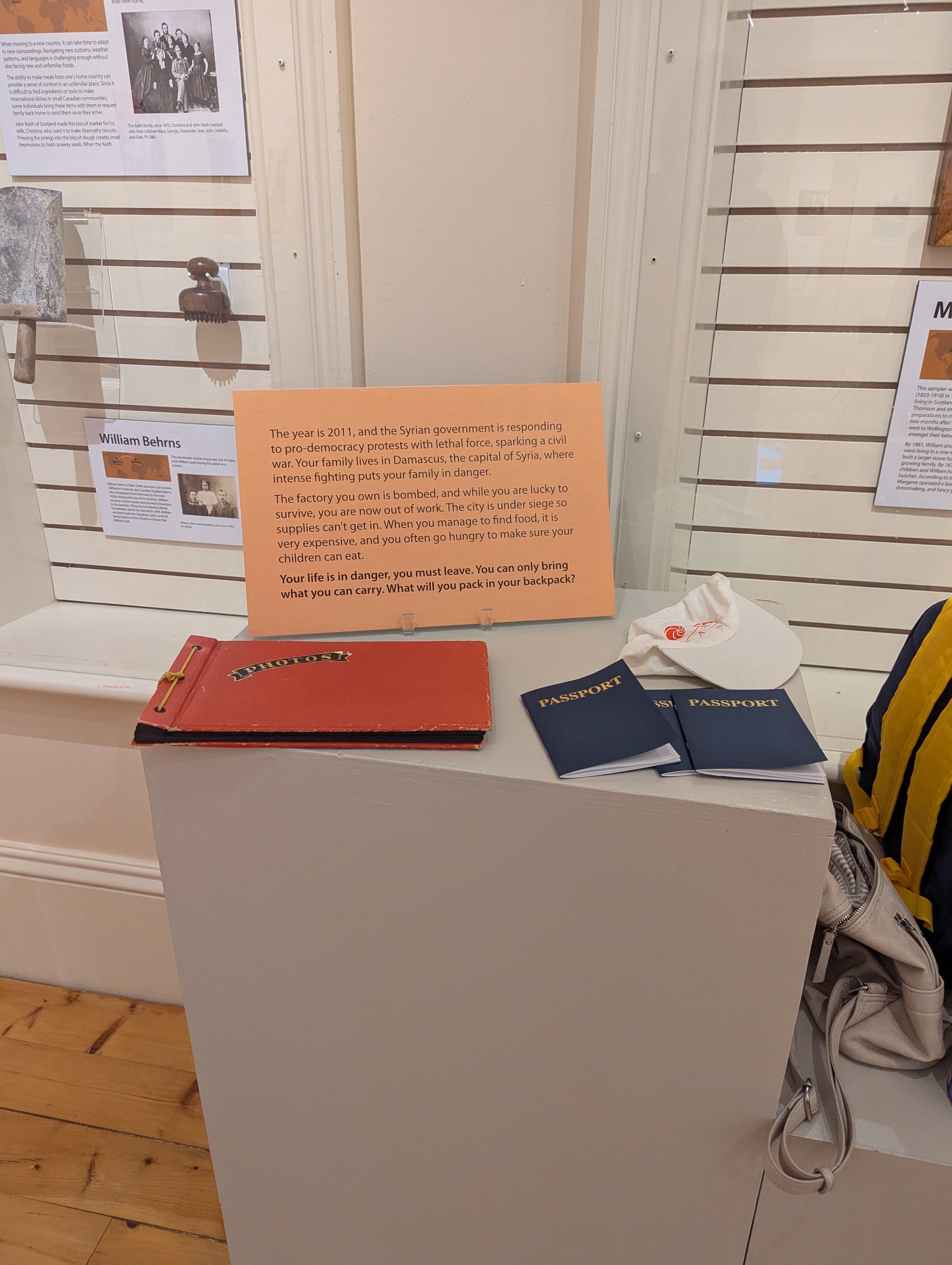
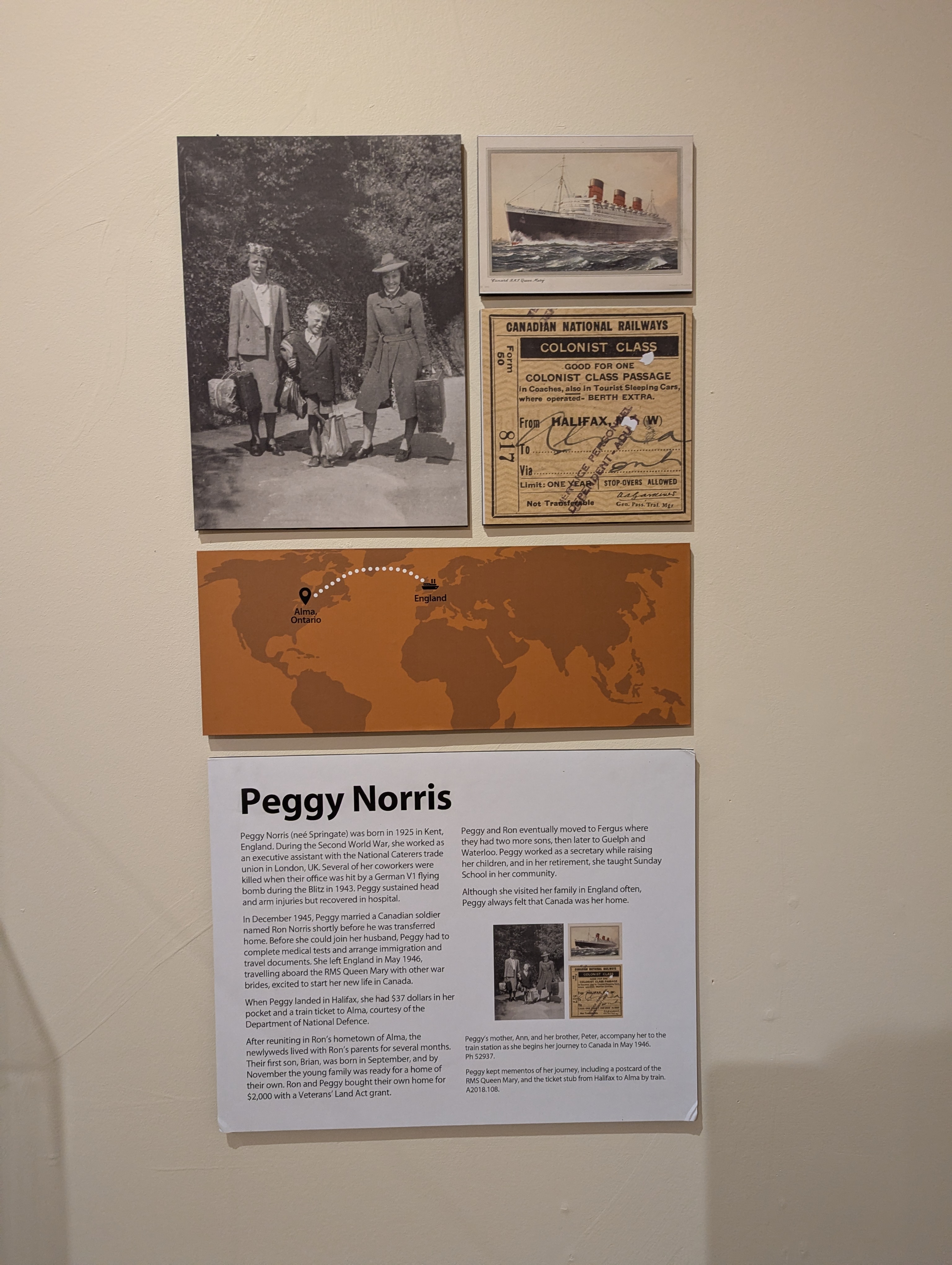
The exhibit depicts a variety of people and families that emigrated from other countries to Wellington County over time. It is not chronological. Panels about families or people that came to the region in the late 19th or early 20th century are placed alongside panels about more recent immigration. At first, I liked the exhibition because the placements counter xenophobic narratives about who is Canadian and focuses on welcome.
Importantly, the implication becomes – we’re all immigrants here, which is a common narrative within Ontario’s community museums. The reality is: we aren’t. Indigenous Peoples were here before those who emigrated from other countries and are still here. Failing to visibly and clearly include them in narratives about the past, present, and future of a region is an act of colonialism. It historicizes Indigenous Peoples and legitimizes colonial constructions.
Questions
What have I missed?
Why do these narratives continue to be common in Ontario’s community museums? Does it relate to the pioneer focus in their origins? Is it a lack of funding to change past exhibits?
References
Callen, Bonnie. 1981. “Report from the Archives.” Wellington County History. vol1: 92-94
Thorning, Steve. 1981. “Historical Writing on Wellington County.” Wellington County History. vol1: 71 – 87

