Despite not living in Guelph, I enjoy driving to the Guelph Civic Museum due to their Families Gallery, affordability, and partnership with an EarlyON. While there are many awesome things to discuss at the Museum, this reflection post focuses on the exhibit “Where the Rivers Meet.” The exhibit stands out as an important example of shifting museum practices to more actively work on decolonizing place narratives. It differs from other municipal museum exhibits because it positions the founding of the municipality as part of colonialism and centers the Original Peoples with relationships to the territory.
Background
Museum Background
Guelph Civic Museum’s history is interesting because it demonstrates broader trends in Ontario community museum development. For example:
Historical societies provided the foundation for Ontario’s community museums.
Within Ontario, many community museums began as historical society collections with the encouragement of the Ontario Historical Society. Guelph Civic Museum began as the Guelph Historical Society collection and the Museum’s first curator was also a founding member of the historical society (Doud 1991).
Many historical societies transferred their collections to the municipality due (in part) to provincial policy at the time.
Until the 1970s, provincial operating grants for community museums were unavailable to nonprofit organizations. In order to access funding, many societies transferred ownership of their collections to the municipality. While I cannot find a stated reason, the Guelph Historical Society donated their collection to the City in 1962 and the municipality formed a Museum Board of Management in 1964 (Guelph Civic Museum n.d.).
Community museums were popular centennial projects in the lead up to Canada’s 100th anniversary in 1967.
During the 1960s, the federal government partnered with provincial governments to provide municipalities with funding for centennial projects, including the construction or restoration of museums. As a result, the number of community museums across the country increased. For example, the number of museums in the Government of Ontario’s museum support program, receiving an operating grant and advisory services, increased from 27 museums in 1959 to 101 museums in 1969 (Nelson 2021).
The Guelph Civic Museum was part of that increase. They opened in 1967 in former stables (currently the Farmer’s Market) as one of Guelph’s centennial projects.
After contributing to a rapid rise in the number of community museums, federal and provincial governments became concerned about the quality and professionalism of those receiving funding. Many museums used intersecting provincial and federal project grants to meet standards and become eligible for additional support.
Guelph Civic Museum’s building did not meet emerging expectations for museum spaces. They faced two common problems – limited space for the collection and limited environmental controls (most notably, they did not have heat). During the 1970s, the City purchased an 1847 stone building and used intersecting grant programs to renovate a new museum space. The Ontario Heritage Foundation recognized the building as significant and provided funding to restore the exterior. The National Museums of Canada contributed to interior renovations and displays. The City also received funding from Wintario – that is, a provincial grant program funded through the relatively new lottery earnings – to contribute to the internal project. The Wintario grant was conditional on local support, which led to a building fund campaign (Crowley and Partridge 1978).
Established municipal museums that benefited from these intersecting funding programs available in the 1970s and 1980s developed capacity. They were then better positioned to grow (or maintain operations) and professionalize through subsequent funding cuts at the provincial and federal levels.
Due in large part to the federal and provincial support they received, Guelph Civic Museum reopened in their new space in 1980 with a Director that had museum specific education (Ian Vincent’s thesis as part of his Master’s in Museum Studies is available here). The Museum added a children’s museum in 2000 and moved again to their current location in 2012 (Guelph Museums 2026a). They began a major renovation of their space in January 2026 (City of Guelph 2026).
While federal and provincial programs often inform the development of municipal museums, theses institutions (typically) receive the majority of their operational funding from the municipality and as municipal institutions are more closely tied to local policies. Municipal museums both reflect and inform municipal government priorities.
In 2024, the City of Guelph released an Indigenous Relations Framework to provide practical steps that would guide reconciliation efforts (City of Guelph 2024). Within the 2025 progress report, the City acknowledge that stories of Guelph often focus on Joseph Galt and other colonial figures, contributing to an erasure of Indigenous Peoples’ rich history with the land. They position the Guelph Civic Museum as central to efforts to learn together and re-story Indigenous erasure in local narratives. In particular, they mention the Museum’s:
- Ongoing work to incorporate and center Indigenous history in permanent narratives.
- The temporary exhibit Weaving Cultural Identities (which I did not see)
The progress report also mentions a partnership, which includes the Museum, with the Decolonizing Place Narratives Research Collective. The Collective is creating exhibits to be installed along waterways and at the Guelph Civic Museum. For example:
- In 2024, they installed “Thatinatón:ni – Where the Rivers Meet” at John Galt Park created by Alex Jacobs-Blum, a Gayogo̱hó꞉nǫʼ (Cayuga) and German artist. The site-specific installation, which includes pictures of three grandmothers, asks: “How can Indigenous relationships with the Speed and Eramosa Rivers reshape our understanding of the City of Guelph as an Indigenous place?” (Guelph Museums 2026e). Behind the mural is a map that centralizes waterways created by Amina Lalor, a Vietnamese-Irish-Métis designer and researcher (Martin 2024).
- In March 2026, Guelph Civic Museum opened “Maawnjidyang Maa – We come together here,” which is also curated by the Decolonizing Place Narratives Research Collective.
I look forward to eventually seeing these exhibitions as well as additional sites that will be activated by Anishinaabe and Haudenosaunee knowledge carriers as part of the collaboration. If you would like to watch a video of people talking about the project, the Museum hosted an early conversation available here:
Visit information
When I visited the Guelph Civic Museum in January 2026, I saw:
- Revelations from the Collections (March 5, 2024 to March 22, 2026): “Guelph Museums has a growing collection of over 50,000 items, including objects, archival material, and photographs. This collection allows us to record the tangible and intangible history of the place we now call Guelph. Using large-scale photography, Revelations from the Collection showcases a diverse selection of artifacts and archival material from Guelph Museums’ extensive collection. It provides an opportunity for visitors to engage with artifacts in a unique way and enhance their knowledge and understanding of Guelph’s history and community” (Guelph Museums 2026b).
- Portraits – Stories of Black Canadian Military Service (August 23, 2025 – February 22, 2026): “a new travelling exhibition circulated by the Canadian War Museum, celebrates the contributions of Black Canadians in the military through compelling accounts of service and sacrifice from across the country. The exhibition highlights the contributions and experiences of Black men and women from Nova Scotia and southern Ontario — two historic centres of Black migration — as well as from other parts of Canada” (Guelph Museums 2026c).
- Where the Rivers Meet (September 28, 2021 – December 31, 2026): “Where The Rivers Meet is a display within the City Gallery that centers the Original Peoples who have been on this land since time immemorial. It includes information about migration, land relationship, treaties, impacts of colonization, and past and present-day perspectives. The display also considers the founding story of Guelph within the context of a longer history lens. This display is a living exhibition that reflects the truth as we understand it today. We continue to learn from our treaty partner, the Missisaugas of the Credit First Nation, and from Indigenous people who call Guelph home today. The display will continue to be updated as our knowledge grows” (Guelph Museums 2026d).
- The Families Gallery: The gallery is currently closed for renovations. It was a hands-on learning space that addressed a variety of themes connected to the Guelph region.
- City Gallery: The gallery is currently closed for renovations. It was a fairly typical civic museum exhibit that presented history thematically rather than chronologically.
I have praised the Guelph Civic Museum extensively in instagram reels. However, I have not gone into detail about my thoughts on “Where the Rivers Meet” because it has taken a while for them to develop. I saw the exhibit twice, in two different configurations (May 2025 and January 2026) and it’s been sitting at the back of my mind as an example of a critical shift in museum practice.
Positionality
Before beginning my reflection, I want to provide context as to why I think the exhibit “Where the Rivers Meet” is so important. I do not have an accurate / clear family history, but I know we have lived in what we now call Canada for generations and I am of European descent. I was raised to think of myself as “Canadian” rather than European. My education in the New Brunswick French immersion program did not leave me with a good understanding of colonial history or the histories of Indigenous Peoples. Even when we learned about the Mi’kmaq, the Acadian perspective was always centered.
As I moved to different provinces in adulthood (Alberta, Ontario, Quebec), my understanding of both regional and Canadian history was shaped through museum visits. Unfortunately, I believed what I was told (or, in some cases, made inferences based on what was not said). For example, the relative absence of Indigenous Peoples (or the relegation of their stories to archaeology) in museum narratives contributed to an incorrect belief that there were few, if any, Indigenous People in New Brunswick after the Acadian’s returned following the expulsion. Within Ontario, the pervasive “we’re all immigrants here” narrative contributed to a mistaken impression that Indigenous Peoples do not have ongoing relationships with this space.
Some people (like me), rely on museums for ongoing education. Museums are not solely responsible for the creation of place narratives. However, what they say and don’t say both reflects and informs discourses about the place. I believe re-storying these narratives to include and center Indigenous perspectives is valuable for everyone. I want to learn. I do not want my child to grow up believing the same false narratives.
Reflection
The first time I saw “Where the Rivers Meet,” I assumed the exhibit provided the same information that I’ve seen many times in municipal community museum spaces. I was wrong. It differs in a number of important ways.
The biggest difference is that the exhibit makes the connection between founding a municipality (Guelph) and colonialism explicit. The City of Guelph is one of six present day municipalities on land described in the Between the Lakes Treaty No. 3. Within Ontario community museums, acknowledging treaty territory is becoming more common. However, “Where the Rivers Meet” does not stop at noting the municipality’s presence on treaty territory. Information on treaties and the founding of a municipality are part of the same exhibition.
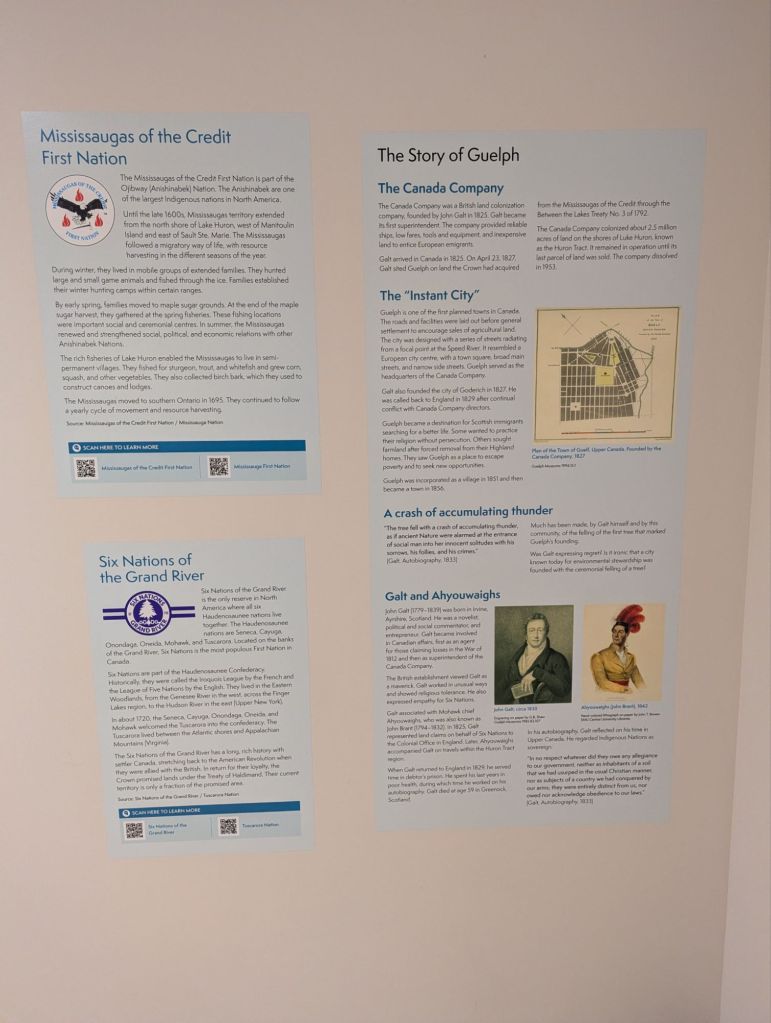
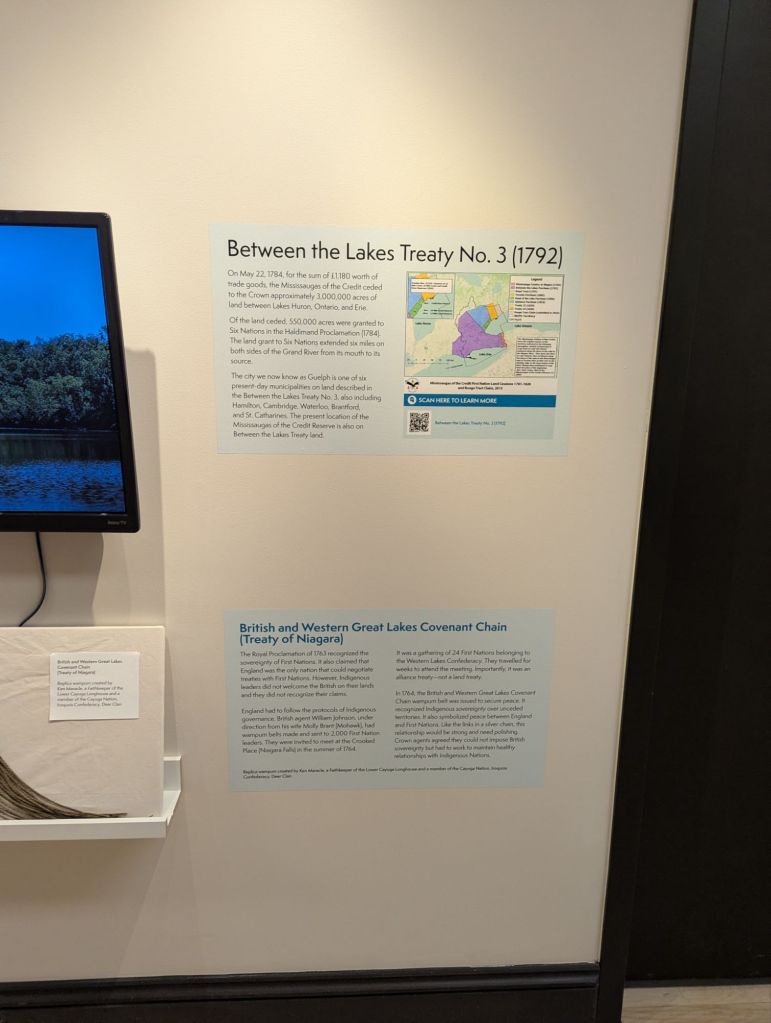
There is a panel on the “Story of Guelph,” which clearly positions the founding of Guelph as part of colonization. It starts (and ends) with key information that makes the connections explicit. Joseph Galt founded a British land colonization company (the Canada Company), which sited Guelph on the land acquired from the Mississaugas of the Credit through Treaty No. 3. The company operated from 1825 until 1953, colonizing around 2.5 million acres of land. Importantly, the description of the company does not shy away from using the language of colonialism or hide colonialism behind the language of settlement.
The middle section of this panel gives information that would typically be the emphasis in a municipal museum’s narrative. Guelph is described as one of the first planned towns in Canada that became home to many Scottish immigrants escaping poverty and religious persecution. However, the panel on the story of Guelph does end there. Instead, there is a section on Galt’s relationship with Indigenous Peoples specifically (Mohawk Chief Ahyouwaighs) and broadly. It finishes with a quote from Galt’s autobiography in which he described Indigenous Nations as sovereign.
A description of Indigenous Nations, including the Six Nations of the Grand River and the Mississaugas of the Credit First Nation, are visible to the left of the story of Guelph, which places them first when reading from left to right as many people do. The exhibit centers Indigenous Peoples’ histories rather than the Euro-Canadian colony. The shift in focus leads to other notable differences in the exhibit when compared to the stories I have come to expect in municipal museums.
“Where the Rivers Meet” presents a view of history that emphasizes the longevity of Indigenous Peoples past, present and future relationship to land. For example, there is a timeline without a clear beginning or ending. It starts with an arrow labeled “for time immemorial,” noting Indigenous People’s ancestors “have lived here for at least 12,000 years and probably much longer.” It ends with an arrow in the opposite direction labeled “today and for all time” with information about the number of Indigenous people in what we currently call Canada and Guelph, observing Indigenous peoples will continue to live here for time immemorial.
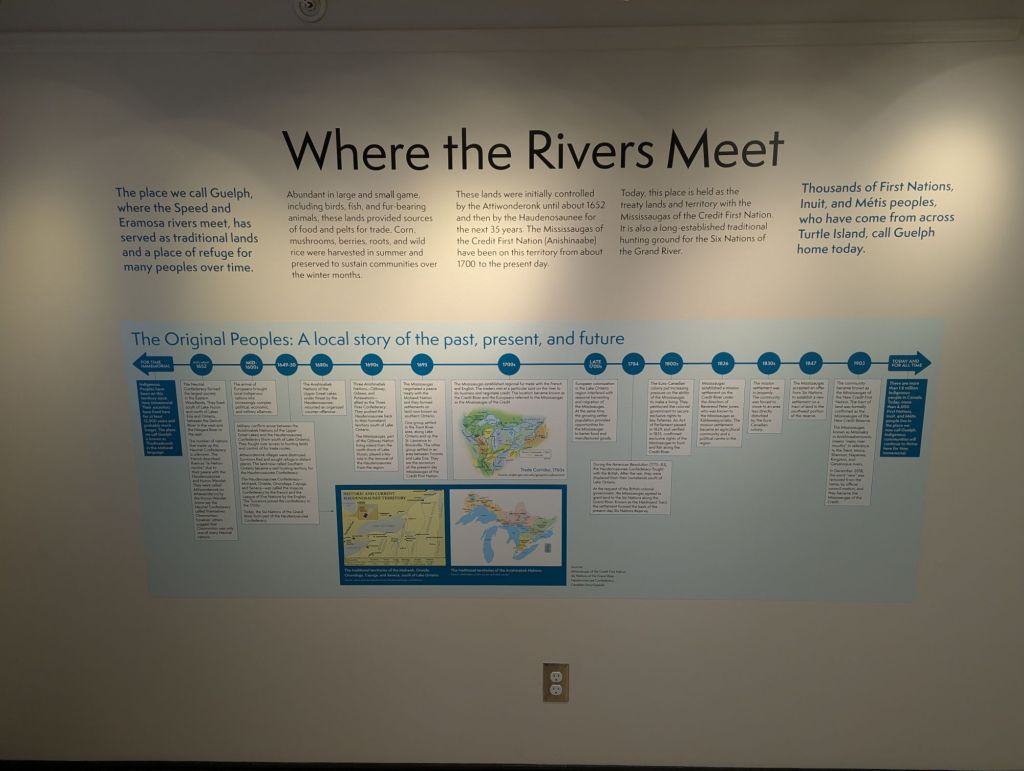
While I have seen many timelines that include the idea of time immemorial, the phrase is usually placed in one spot (at the start) on a line with a beginning and end. The use of arrows and the phrasing at both sides is narratively significant because it presents a view of the past, present, and future that includes Indigenous People. First Nations, Inuit, and Metis peoples are not historicized.
The timeline’s focus remains on Indigenous Peoples while noting the arrival of Europeans. Colonization and the Euro-Canadian colony is on the timeline as an explanation for specific changes. The arrival of Europeans “brought local Indigenous nations into increasingly complex political, economic, and military alliances.” The timeline shows colonial forces changed and influenced relationships, using words like forced, interfered, and put increasing pressure on. However, importantly, First Nations continued to have agency in their relationships, petitioning for specific rights and establishing settlements. The verb usage demonstrates complexity.
Further illustrating complexity, the timeline and other panels acknowledge different names for peoples and places with information about where those names come from. I first noticed this difference in how the exhibit discusses what most Ontario museums call the Neutrals or Neutral Confederacy. Although “Where the Rivers Meet” also use this nomenclature, the text provides information about where the name Neutral came from (French descriptions due to their peace with others), the Huron-Wendat name for them (Attiwonderonk or Attawandaron), and the name they may have called themselves (Chonnonton). The exhibit uses the term Haudenosaunee Confederacy, but also notes they were called the Iroquois Confederacy by the French and the League of Five Nations by the English.
When assessing what a museum / exhibit thinks is important, I often consider that information is repeated. Within the exhibit there is ongoing emphasis on First Nations as sovereign people with traditional territories and existing relationships with one another. For example, within text and maps, they provide information about the traditional territories of Haudennosaunee nations (specifically the Mohawk, Oneida, Onondaga, Cayuga, and Seneca) and Anishinabek Nations (Ojibway, Odawa, and Potawatomi). They repeat information about alliances that existed amongst First Nations, such as the Haudenosaunee Confederacy.
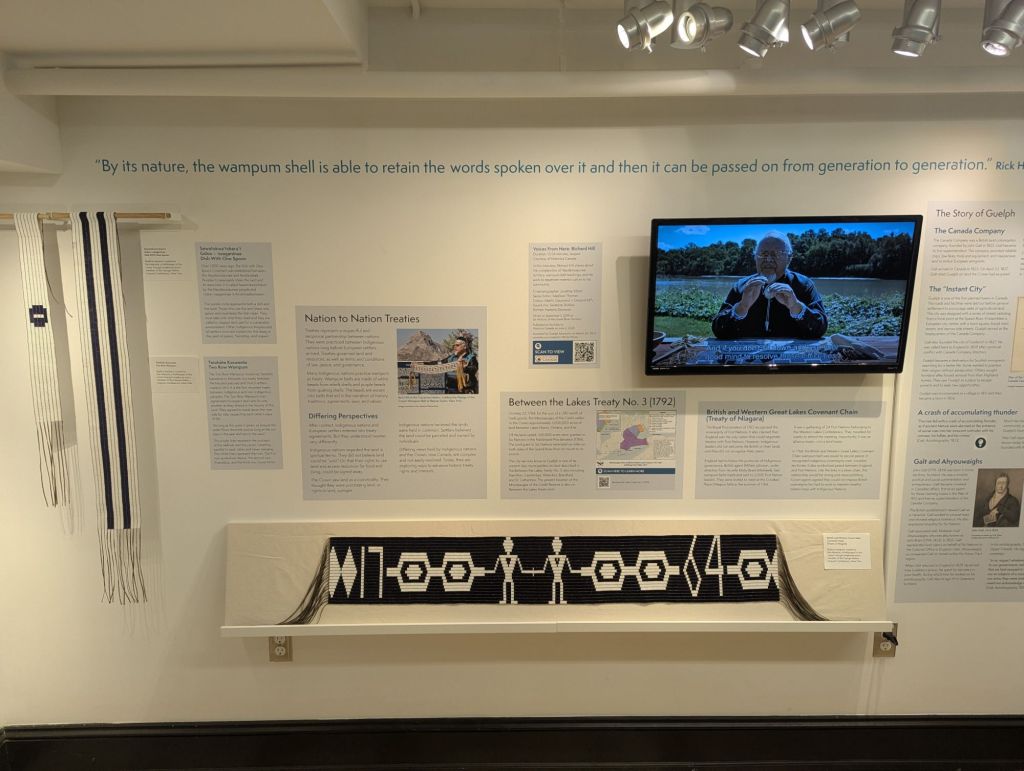
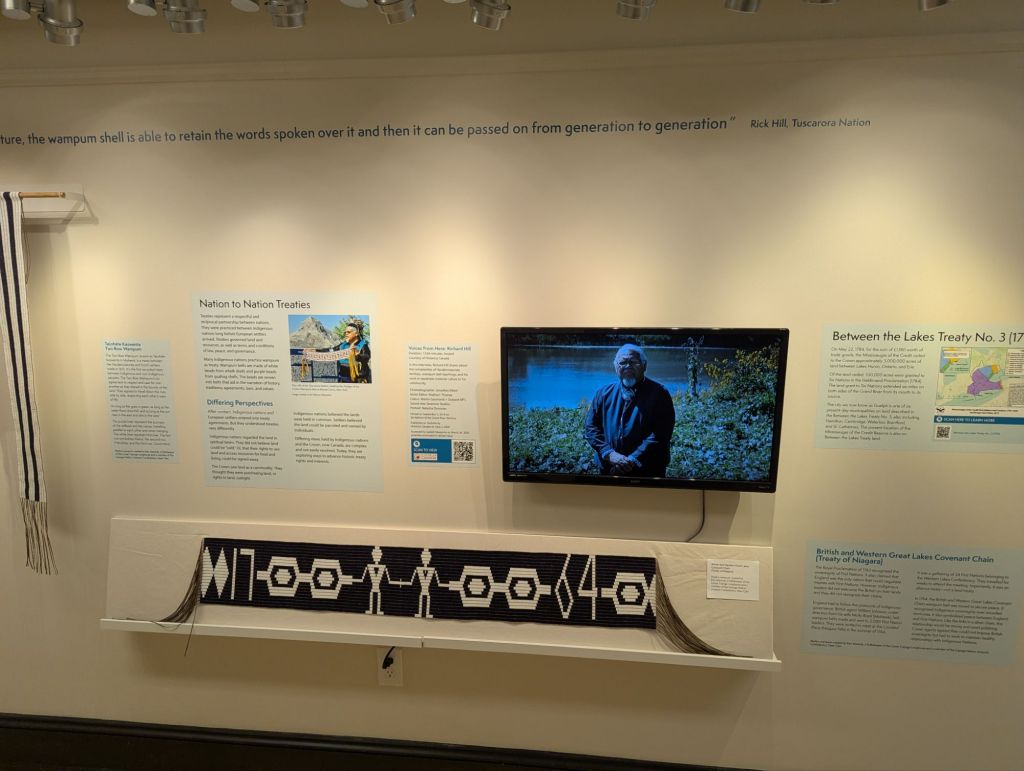
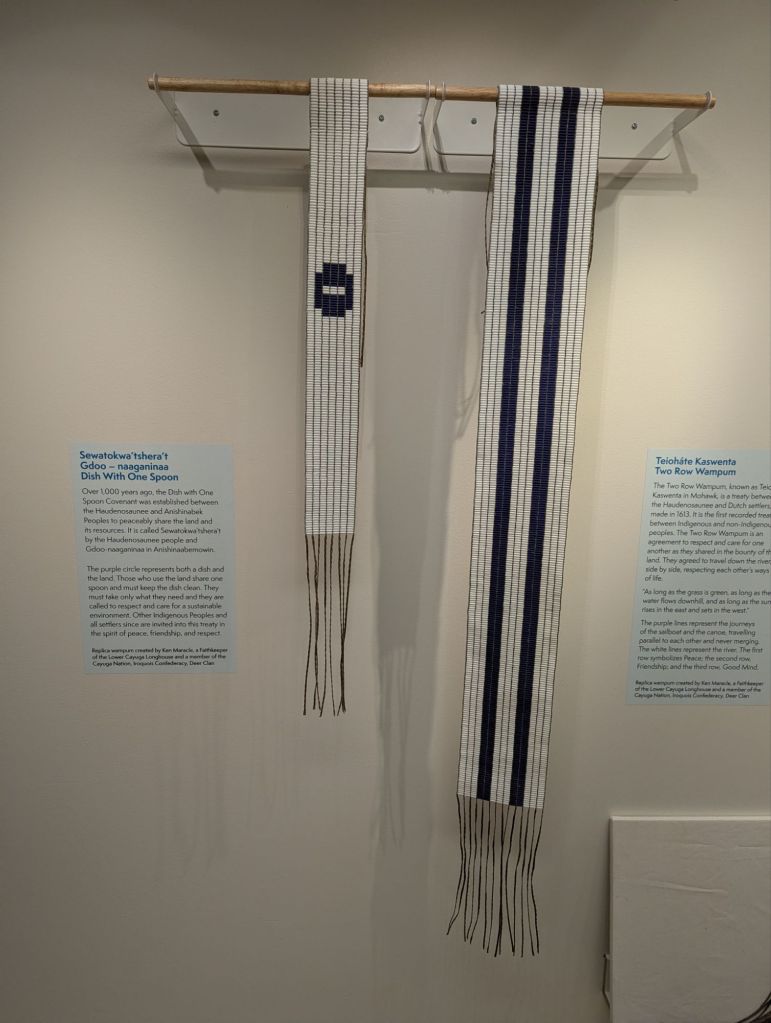
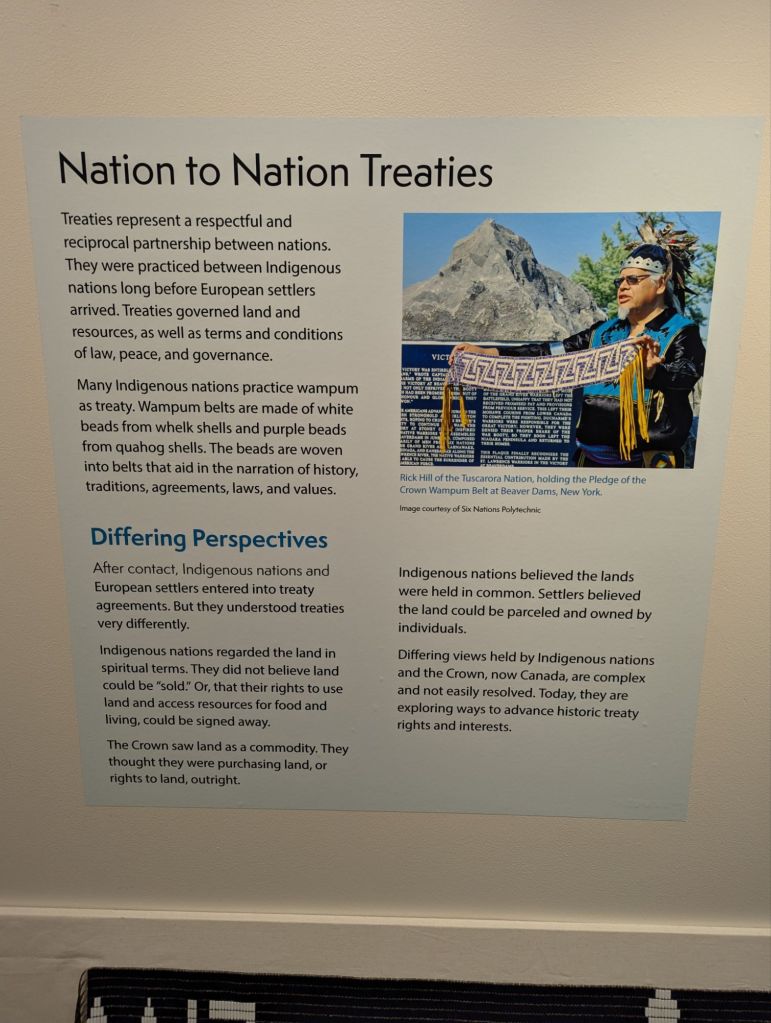
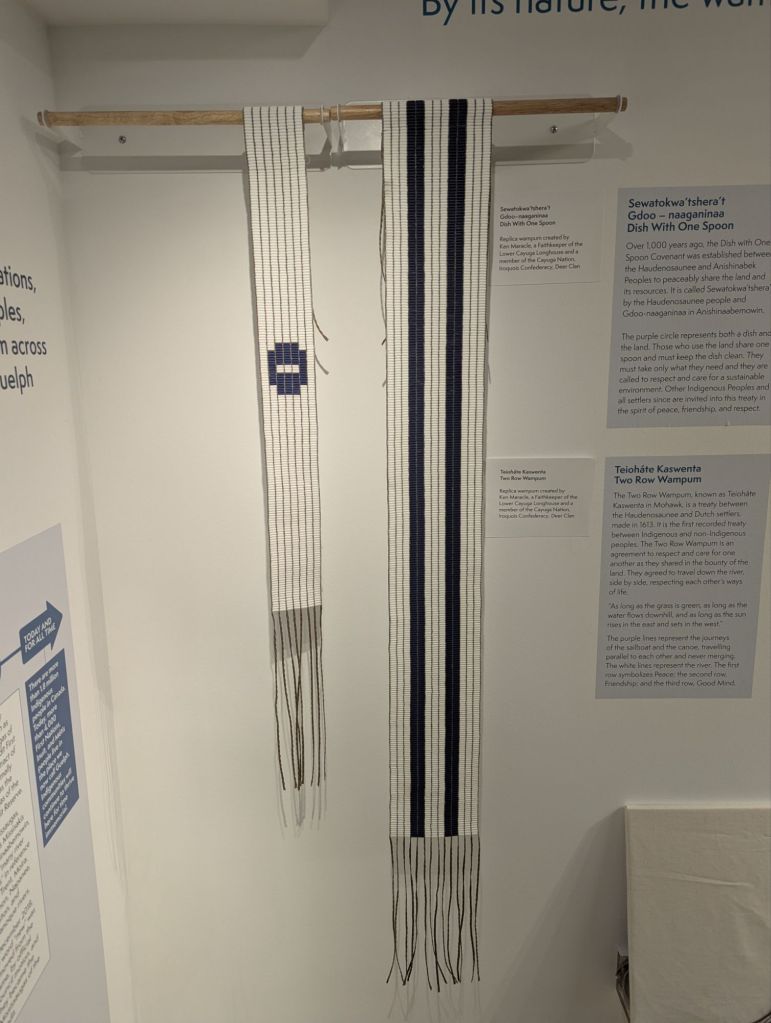
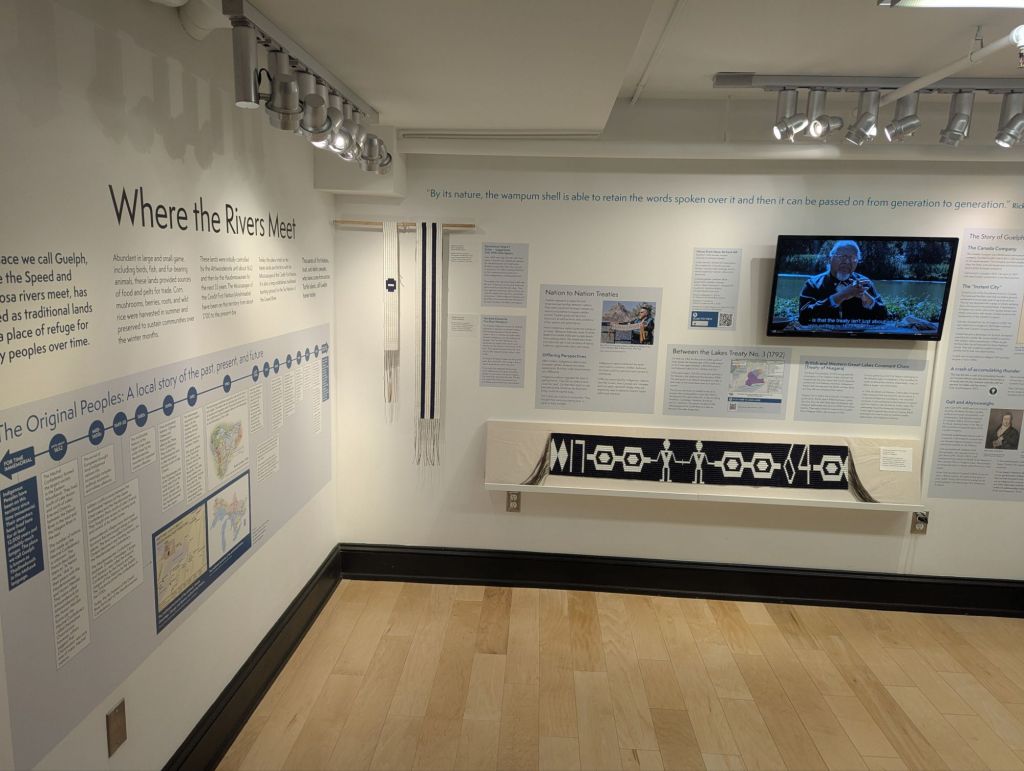
A main focus of the exhibit are Wampums, which reflect respectful and reciprocal partnerships practiced between nations long before the arrival of Europeans. The exhibit includes three replicate Wampums (Dish with One Spoon Wampum, Two Row Wampum, and the British and Western Great Lakes Covenant) with informative panels. These panels emphasize an Indigenous perspective on relationships based on friendship and respect. For example, the Dish with One Spoon Covenant (Sewatokwa’tshera’t / Gdoo-naaganinaa) was established over 1,000 years ago between the Haudenosaunee and Anishinabek Peoples to share land and resources peacefully.
There is a video playing Voices from Here: Richard Hill, which is a Historica Canada video where Richard Hill discusses “Haudenosaunee territory, wampum belt teachings, and his work to repatriate material culture to his community.” The video leads to my only complaint about the exhibit – that is, I wanted a chair or a bench to be able to engage properly, which was not available (or easily available – I never asked) in either configuration that I saw the exhibition in. Fortunately, the content is available online and I have since been able to watch the video. Here is is:
After watching the video, I have a greater appreciation for and understanding of the Wampums on display in the exhibit. For example, I have read simple descriptions of the Dish With One Spoon Covenant in many museums, including the an invitation into this Covenant. However, I did not understand the invitation as a possible framework for relationships now and in the future where we consider resources within a shared dished.
I am looking forward to visiting future (and current) exhibits at the Guelph Civic Museum and those curated by the Decolonizing Place Narratives Research Collective.
Questions
Are there other museums with exhibits reflecting work to re-story place narratives that you would recommend?
References
Thank you to the Guelph Civic Museums for some of the resources below! I reached out looking for a source and received a great response. They did not have the document I was looking for, but had some great recommendations.
City of Guelph. 2008. Strategic Plan for Guelph Museums. Accessed June 28, 2026. Archived November 13, 2011. http://www.guelpharts.ca/guelphmuseums/documents/guelphmuseums/Guelph_Museum_Stategic_Plan_08_low_res_final_document.pdf
City of Guelph. 2026, January 8. Guelph Civic Museum renovations are underway. https://guelph.ca/2026/01/guelph-civic-museum-renovations-are-underway/
City of Guelph. 2024. Indigenous Relations Framework. https://pub-guelph.escribemeetings.com/filestream.ashx?DocumentId=51951
Crowley, T. A. and Florence Partridge. April 17, 1978. Letter. Guelph Museums Archives. 2016.42.17. https://guelph.pastperfectonline.com/archive/B30C4FE5-33D5-4C23-B831-313975183032
Doud, Charlotte. 1991. The Guelph Civic Museum: The Definition and Portrayal of a Community’s History. Thesis.
Guelph Civic Museum. n.d.Building Fund Prospectus. Guelph Museums Archives.
Guelph Museums. Accessed June 29, 2026a. Civic Museum. https://guelphmuseums.ca/venue/civic-museum/
Guelph Museums. Accessed June 29, 2026b. Revelations from the Collection.https://guelphmuseums.ca/event/revelations-from-the-collection/
Guelph Museums. Accessed June 29, 2026c. Portraits – Stories of Black Canadian Military Service. https://guelphmuseums.ca/event/portraits-stories-of-black-canadian-military-service/
Guelph Museums. Accessed June 29, 2026d. Where the Rivers Meet. https://guelphmuseums.ca/event/where-the-rivers-meet-2/
Guelph Museums. Accessed July 13, 2026e. Thatinatón:ni – Where the Rivers Meet. https://guelphmuseums.ca/event/thatinatonni-where-the-rivers-meet/
Guelph Museums. Accessed July 14, 2026f. Maawnjidyang Maa – We come together here. https://guelphmuseums.ca/event/maawnjidyang-maa-we-come-together-here/
`
Martin, Janna. 2024. Decolonizing the place narrative of Guelph: A PhD student’s experience. University of Guelph. Accessed July 13, 2026. https://soprstories.ca/2024/11/19/decolonizing-the-place-narrative-of-guelph-a-phd-students-experience/
Nelson, Robin. 2021. “Community Museum Governance: The (Re)Definition of Sectoral Representation and Policy Instruments in Ontario.” https://ruor.uottawa.ca/server/api/core/bitstreams/726ff9ea-35bf-4e9f-bb17-c7de9a11a853/content
University of Guelph. Accessed July 15, 2026. Where the Rivers Meet: Decolonizing Place Narratives in the City. https://csahs.uoguelph.ca/where-rivers-meet-decolonizing-place-narratives-city

