After a very intensive week in the Dawson City Museum (DCM) archives, I am sorting, reading, and analyzing what I found. The documents scanned are interesting and contributing to the narrative(s) about the DCM’s development. In order to help with the analysis, the “Archival Research” series considers the stories archival materials tell, looking at the items I found most exciting.
Within this post, I am considering the importance of a person’s physical presence and availability when providing support to community museums. In particular, the Dawson City Museum’s (DCM) Board Minutes from the 1980s demonstrate that the territorial Heritage Branch’s Director and the Museum Advisor attended meetings, providing reactive support in response to issues.
Please note: unlike past archival research posts, I am not including a picture because there are a lot of names in these reports and I am respecting confidentiality.
Why are these meetings interesting?
The Minutes show tangible examples of the assistance that can be provided when government actors are physically present in a museum space to learn about problems. For example, the Heritage Branch’s Director attended a meeting in 1983 and offered the following assistance:
The Museum Board members were upset because the Canadian Conservation Institute (CCI) was only going to Whitehorse and would not visit Dawson. The Director agreed the Museum had a definite need and noted:
He will be seeing a woman from the CCI later this month and will see what he can do.
DCM Minutes May 3, 1983
He provided insider advice on how to be more successful in grant applications. The Minutes state:
It was suggested that when we apply for capital grants we should try to emphasize visible projects that will have more direct approval from politicians and the public.
DCM Minutes May 3, 1983
He agreed to try and send a bookkeeper to help museum staff who were struggling with bookkeeping.
He volunteered to help the Museum buy a second hand microfilm reader from the territory.
In 1984, the territorial Heritage Branch hired a Museum Advisor. This advisor also began attending occasional Dawson City Museum Board meetings. Examples of assistance provided include:
He worked with Museum staff on grant applications (DCM Meeting minutes June 12, 1984).
He provided unofficial information on granted amounts to help with planning (DCM Meeting minutes June 12, 1984).
He facilitated a better relationship with national funding agencies (DCM 1984 Annual General Meeting Minutes).
More importantly, the Minutes and the Museum’s reports indicate that he was also available by phone to regularly help Museum staff.
In short, during the 1980s both the Director of the Heritage Branch and Museum Advisor went to the Dawson City Museum (or were easily available by phone) and were able to assist the Museum in response to problems.
Is there broader relevance?
Presence facilitates support.
When the Director and/or Museum Advisor were present in the Museum, they were able to hear about problems and offer solutions. For example, in the microfilm reader example above, the Museum had already tried purchasing a used machine from government without success. As a government actor, the Heritage Branch’s Director was able to make the connections needed to be successful.
Sometimes, museum workers discuss a decline in support, but the number of advisory services remain the same. I think the change is actually in the accessibility of the government actor(s). Who is accessible? How accessible are they?
The next post will provide a contrasting example to show this difference.
Questions
What do you think? Have I fully understood the significance of presence?
After a very intensive week in the Dawson City Museum (DCM) archives, I am sorting, reading, and analyzing what I found. The documents scanned are interesting and contributing to the narrative(s) about the DCM’s development. In order to help with the analysis, the “Archival Research” series considers the stories archival materials tell, looking at the items I found most exciting.
Within this post, I am considering an instance of early federal influence on Yukon community museum policy. The federal government started a grant for operating funding to community museums in Yukon. When they stopped, the Yukon government stepped up. Here is a letter describing the change:
MacKenzie, K. 1961, December. Letter to the Dawson Museum & Historical Society. Correspondence Roy minister 1961-2. Box 39. Dawson City Museum Archives.
Why is this letter interesting?
The letter shows that the federal government originated operational funding to Yukon community museums. They gave the Dawson City Museum (DCM) and MacBride $500 each, starting in the late 1950s. However, the grant did not last.
When the grant ended in 1961-62, these museums began receiving funding from the territorial government as registered societies engaged in tourism related activities. In other words, the territory continued a source of funding originally established by the federal government.
Is there broader relevance?
Federal influence on Yukon community museum policy is a significant theme in my research. The operating grant provides an early example.
The Old Territorial Administration Building is another. When the Museum began occupying the space for 5$ a month, it was under federal jurisdiction. Then, when the territorial government became responsible for the building, the Museum was already there and continued to occupy the space. I discuss the issue of rent here.
Moving forward, I will continue to consider federal action when seeking explanations for territorial policy development. As this letter demonstrates, federal initiative seems to be critical to explaining the development of Yukon community museum policy.
Questions
What do you think? Do you know of other instances where federal action significantly influenced territorial activity?
After a very intensive week in the Dawson City Museum (DCM) archives, I am sorting, reading, and analyzing what I found. The documents scanned are interesting and contributing to the narrative(s) about the DCM’s development. In order to help with the analysis, the “Archival Research” series considers the stories archival materials tell, looking at the items I found most exciting.
Within this post, I am looking at the letter that gave the Dawson City Museum permission to occupy the Old Territorial Administration Building for 5$ a month after their first location burnt down. Here it is:
Correspondence Minister 1961-2, Box 39c. Dawson City Museum Archives.
Why is the letter interesting?
The Dawson City Museum (DCM) was housed in the old fire hall until it burned down in 1960.
The DCM began looking for a new building immediately because they wanted to open for the Gold Rush Festival in 1962. In an appeal to occupy the Old Territorial Administration Building (OTAB), a Museum representative wrote:
It is imperative to assist the Festival that we have accommodations. Until we can have assurance it is not possible to get going on this important project as we will need to start from scratch.
Shaw 1962
Fortunately, the federal Department of Public Works agreed to lease the space at a rate of $5 for the festival period.
In the late 70s Parks Canada planned to take over the space, but their budget for the Klondike National Historic Site program was cut from $1.5 to $1 million, meaning they were unable to include the OTAB in their renovations (Northern Times 1979). As such, it became a territorial building and the DCM continued to grow in the space.
The DCM did not pay rent or have a lease for most of its time in OTAB. In 1998, they entered into negotiations at the request of Yukon Property Management, which proposed a rent of $10,000 a year (DCM Minutes 14 January 1998). The Museum could not afford this, but began to pay $4,000 a year in 1999. Despite inflation, the Museum continues to pay the same rent for the space.
The Old Territorial Administration Building
Is there broader relevance?
Most obviously, the Museum never left. The original rental price referred to the period of the Festival. Then, there was no lease agreement but the Museum remained and eventually expanded into the unused rooms. In other words, the Old Territorial Administration Building has been the Museum’s home since 1962 thanks to a decision made by Public Works to provide the Museum with space in time for the Gold Rush Festival.
The low rental cost also reflects a form of support from the territorial government. The amount has not increased with inflation and the building’s operation and maintenance costs are between 135 thousand and 158 thousand a year. As such, we see the same path dependent effects with the rental costs. The Museum pays $4000 a year in rent because that is the cost established over 20 years ago.
Questions
What do you think? Do you find the document as interesting as I do? If so, what lessons do you think we can draw when talking about the history of the Dawson City Museum?
References
Shaw, G. 1962. Letter to the Superintendent of Buildings. Correspondence Minister 1961-62, Box 39c. Dawson City Museum Archives.
After a very intensive week in the Dawson City Museum (DCM) archives, I am sorting, reading, and analyzing what I found. The documents scanned are interesting and contributing to the narrative(s) about the DCM’s development. In order to help with the analysis, the “Archival Research” series considers the stories archival materials tell, looking at the items I found most exciting.
Within this post, I build on the centralization (support for a territorial museum) vs. decentralization (support for a network of museums) conversation in Yukon community museum policy. The first post on this topic is available here and the second here.
I am looking at the Minister of Tourism’s response to advocacy from the Yukon Historical and Museums association (YHMA). The YHMA articulated a concern that funding for new staffing positions at the Yukon Beringia Interpretive Centre, which is a territorial institution that opened in 1997 to exhibit natural heritage, would ultimately harm the community museums in the territory.
Here is an excerpt from the Minister’s letter:
Keenan, David. 1997, May 16. Letter to the Chair of the YHMA Committee. Correspondence director 1997 1998. Box 25. Dawson City Museum Archives.
Why is the letter interesting?
I find the letter interesting for two reasons:
First, the letter assumes that community museums are only hiring summer student staff and not permanent staff with the same “level of skills, training and experience” the government was looking to hire (Keenan 1997). It neglects the possibility that community museums, like the Dawson City Museum which has had a year round curator since 1975, may want to hire professional staff but struggle to compete with government positions due to their limited resources.
Second, the letter goes on to say:
Considering that Parks Canada has been hiring summer interpretive visitor service staff in Kluane National Park, Klondike National Historic Sites in Dawson, Chilkoot Trail National Historic Park and S.S. Klondike National Historic Site, year after year, with no impact on museum operations, it is extremely unlikely that Beringia Centre staffing would have any negative consequences.
Keenan 1997
The Minister assumed Parks Canada operations and staffing had not competed with community museum’s attempts to hire students. This assumption conflicts with my existing research. In Dawson City, the Museum does compete with Parks for staff and has less to offer in terms of salary and accommodations. I talk about that here.
In short, the letter shows little considerationof community museums’ concerns about a territorial center. In particular, the government representative does not seem to understand how a territorial centre may compete with the existing community museum program for funding and resources. Or, perhaps more accurately, community museums’ concerns were not a priority. As the letter stated:
I can appreciate your desire for more Yukon Government funding of museums activities but your interests have been and are consistently weighed against equally legitimate interests in all aspects of our Yukon Society. It is therefore important to recognize that Government of the Yukon has allocated additional O&M funds to community museums in the 1997/98 budget – particularly when many important non-governmental organizations either had reductions or saw no increases whatsoever.
Keenan 1997
Is there broader relevance?
I do not know if there is broader relevance. However, the creation of the Beringia Centre suggests a shift toward supporting centralized museums and museum-like institutions within Yukon. What is not clear is: Has that change been paired with a shift away from support for a decentralized system? Further, when considered with reference to government responses to museum problems in the 1980s (e.g., Government Relationships), was there a shift away from concern for and knowledge of community museums’ problems?
Questions
What do you think? Are these the same lessons you draw from the letter? Do you have potential answers to my questions?
References
Keenan, David. 1997, May 16. Letter to the Chair of the YHMA Committee. Correspondence director 1997 1998. Box 25. Dawson City Museum Archives.
After a very intensive week in the Dawson City Museum (DCM) archives, I am sorting, reading, and analyzing what I found. The documents scanned are interesting and contributing to the narrative(s) about the DCM’s development. In order to help with the analysis, the “Archival Research” series considers the stories archival materials tell, looking at the items I found most exciting.
Within this post, I continue to look at the tensions between centralization (support for a territorial museum) and decentralization (support for a network of museums) within Yukon community museum policy. The first post on this topic is available here.
I am looking at the Minister of Tourism’s response to advocacy against exhibitions within a territorial Historic Resources Centre in 1989. Here are some excerpts from the letter, which I find most salient:
The following excerpts are quotes in the letter from the Yukon Historical and Museums Association’s (YHMA) advocacy on the topic:
Webster, Art. 1989, December 19. Letter to the President of the YHMA. YHMA museums committee. Box 16. Dawson City Museum Archives.
Why is this letter interesting?
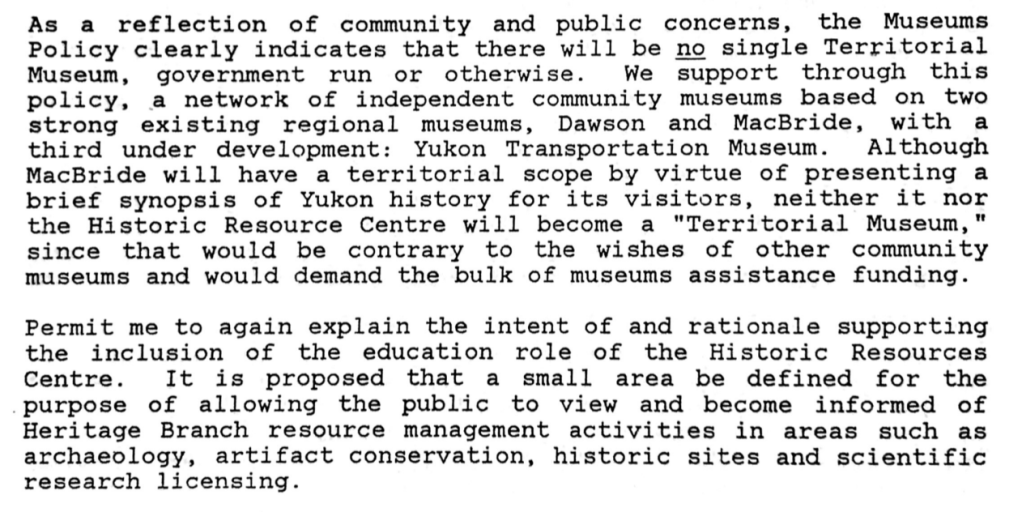
I find this letter interesting because it demonstrates that, like the Dawson City Museum, the Yukon Historical and Museums Association (YHMA) was arguing against the development of a territorial museum or related institution in the late 1980s.
The Yukon Museums Policy (1989) mentions a Historic Resources Service Center, which would support the community museum sector. It states:
One of the Historic Resources Service Centre’s functions would be to support community museums by providing specialized services or services which are more economical when centralized. Such services would include a specialized computer data base for artifact collection management, and conservation support programs.
The YHMA had advocated for a Centre with this function in 1984 as part of heritage legislation consultations, stating:
YHMA RECOMMENDS that Government of Yukon act on these recommendations at the earliest possible time and that a Heritage Resource Centre be constructed which would minimally include facilities for collections management of archaeological and paleontological materials, as well as the capability to provide advice and assistance to community museums, as requested by them.
YHMA 1984, 23
Importantly, they did not advocate for a public education and display function, which was added to the Museums Policy (1989). The Policy gives the Centre a second function, stating:
Another function would be to provide public display and educational facilities as a means of heightening public awareness of Yukon’s historic resources.
The YHMA advocated against this function, expressing surprise at its inclusion. As quoted in the letter above:
All of the sudden it is going to the House looking more like the seeds of a Territorial Museum than a service centre for the heritage community.
See letter above
At the time (as a result of advocacy perhaps?), plans for a historic resource centre were not implemented.
Is there broader relevance?
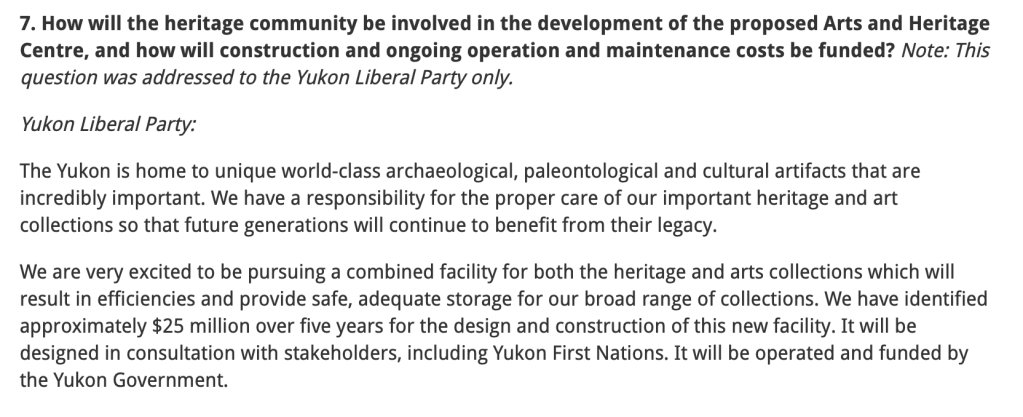
The advocacy’s relevance is most apparent when compared to the YHMA’s reaction to a contemporary proposal for a Heritage Center. The re-elected Liberal’s promised a centralized Centre for “maintaining, conserving, exhibiting and interpreting” the Yukon’s collection as part of their election campaign (source).
The YHMA included a question about this proposal in their questions for parties during the campaign period. Here is the question and response:
Despite the question, I have found no evidence (yet?) the YHMA is campaigning against the centre, leading to a few questions:
Is the YHMA still actively advocating for community museums?
Is the creation of a museum-like institution no longer a concern for Yukon community museums?
I do not know the answers, but think the questions are relevant because they speak to a broader question – Is there a community of community museums working together in Yukon? In 1989, the answer seems to be yes. Currently, the answer seems less clear.
Questions
What do you think? Are these the same lessons you draw from the letter? Do you have potential answers to my questions?
References
Webster, Art. 1989, December 19. Letter to the President of the YHMA. YHMA museums committee. Box 16. Dawson City Museum Archives.
Yukon Historical and Museums Association. 1984. A Submission to the Government of Yukon Concerning the Proposed New Heritage Legislation.
After a very intensive week in the Dawson City Museum (DCM) archives, I am sorting, reading, and analyzing what I found. The documents scanned are interesting and contributing to the narrative(s) about the DCM’s development. In order to help with the analysis, the “Archival Research” series considers the stories archival materials tell, looking at the items I found most exciting.
Within this post, I am looking at the Dawson City Museum’s submission to territorial museum policy consultations in 1986. In particular, I am considering their arguments against centralization – that is, the first two points in their submission. Here is an excerpt:
Dawson City Museum Board of Trustees. 1986, April 16. Letter to Lord Cultural Resources Planning and Management. Yukon museums planning study. Box 10. Dawson City Museum Archives.
Why is the submission interesting?
In order to understand why the submission is interesting, it is important to understand the history of territorial support to community museums up to the 1980s and how this support differed from other subnational governments.
When Yukon began museum policy consultations in 1986, it did not have any kind of territorial museum. However, it had supported community museums – that is, the Dawson City Museum and the MacBride Museum in Whitehorse – since the 1960s. The support was part of its tourism policy, which I discuss in the post: What rationale underlines and legitimizes government action targeting community museums in Yukon?
When the Yukon Historical and Museums Association formed in 1977, it began to advocate for a territorial museums advisor and policy. In particular, they commissioned the Kyte report in 1980, which called for the development of a museum policy.
As a result, the territorial government began to reorganize in 1981, forming a Heritage Branch for the first time in a short lived Department of Heritage and Cultural Resources. The Department and Branch were formed with the explicit intent to help museums access more federal funding. A Minister stated:
The department will hope to have a liaison function, and a facilitating function. For instance, through the Department, we hope that we will have more access to federal money.
The Northwest Territories had already opened a territorial museum with federal funds, leading to an opposition member remarking:
When I was last in Yellowknife, in the Northwest Territories, I went through a museum building that is an excellent building. It is obviously a multi-multi-million dollar complex, built with federal funds. I wonder if the Minister is negotiating with the federal a similar building in Yukon?
The Minister responded by describing a quandary in the Yukon – that is, should there be a centralized or dispersed system of museums. She responded:
I do not know. There is a quandary in the Yukon whether the museums should be as they are now, in different places, or whether there should be one, big Territorial Museum.
Importantly, the Minister in question represented the Klondike – that is, the Dawson City Museum’s jurisdiction. And, as stated above, the Dawson City Museum was very much against centralization, which they feared would re-direct support away from museums outside of Whitehorse.
The new Branch continued to support the dispersed museum system, developing museum programs to help existing institutions better access federal support in the mid 1980s. Community museums began receiving operational funding as community museums rather than one kind of tourist attraction.
The eventual Yukon Museums Policy (1989) affirmed this commitment to a network of museums, stating:
The Yukon Government is committed to the integrity of strong, independent community museums operated by local, non-profit volunteer boards.
In other words, in theory the Dawson City Museum got what it advocated for – a museum policy committed to a decentralized museum structure and no territorial museum.
Is there broader relevance?
In practice, Yukon has implemented a decentralized museum policy with staff mandated to support museums and funding for both operations and special projects. However, staff remained centralized in Whitehorse, despite the Dawson City Museum’s advocacy against this centralization. For example, a president’s report from 1993 stated:
Our efforts to decentralize parts of the Heritage Branch to Dawson City are continuing. In particular, we feel that the Territorial Registration Advisor’s position should be based in Dawson. With over half of the Yukon’s collection located here, and so much work to be done in registration and cataloguing of the collection, we believe that the Heritage Branch should be locating more resource people in Dawson.
DCM Newsletter, vol. 11 no. 2
The DCM’s efforts to decentralize staff were not successful.
Importantly, the Dawson City Museum’s concern that a centralized system may divert resources from decentralized community museums remains relevant. In the 1990s, Yukon began to develop museum-like territorial institutions. The Yukon Arts Center, which hosts exhibits, opened in 1992. The Beringia Interpretive Centre, which exhibits Yukon’s natural heritage, opened in 1997. During interviews, I heard concerns that these centers divert Heritage Branch resources and focus Yukon support on their own salaried positions.
More recently, re-elected Liberals promised a new Arts and Heritage Centre as part of their campaign (source). Further, there is no longer a true Museum Advisor position as the Manager of Museums and Manager of Heritage positions have become merged, meaning the responsible person has a broad range of responsibilities.
I do not have a conclusion here, but rather a concern. What does the creation of centralized heritage centers mean for the support of a decentralized community museum system?
Questions
What do you think? Are these the same lessons you draw from the submission? Do you think this is an important event in the development of the Dawson City Museum in relation to government policy?
After a very intensive week in the Dawson City Museum (DCM) archives, I am sorting, reading, and analyzing what I found. The documents scanned are interesting and contributing to the narrative(s) about the DCM’s development. In order to help with the analysis, the “Archival Research” series considers the stories archival materials tell, looking at the items I found most exciting.
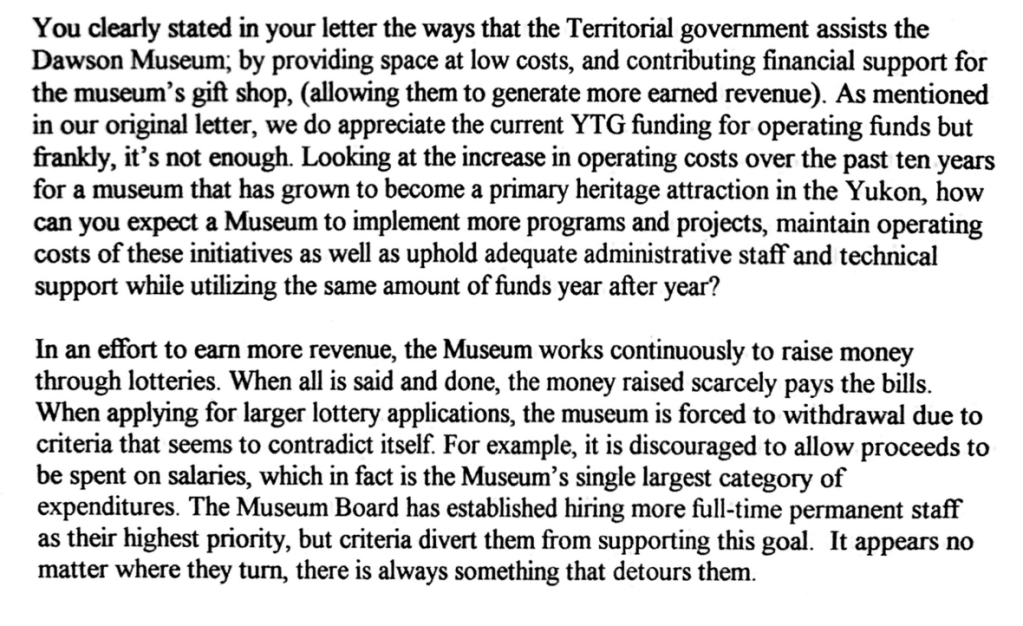
Within this post, I build on my considerations of Director task saturation and the obstacles community museums face. I am looking at letters sent to the territorial government advocating for more support to the Dawson City Museum at a time when the Museum faced severe financial difficulties. Importantly, Museum representatives sent these letters (e.g., board members and the Director), but so did community members and organizations.
For example, Bombay Peggy’s Victorian Inn & Pub wrote a general letter of support stating:
2002, January. Letter to whom it may concern. O & M Correspondence. Box 29b. Dawson City Museum Archives.
Providing another example, the Dawson City Chamber of Commerce wrote to the Premier of Yukon, stating:
2002, March. O & M Correspondence. Box 29b. Dawson City Museum Archives
Why are these letters interesting?
In the early 2000s, the Dawson City Museum (DCM) failed to receive expected grants partway through a project. It also experienced unanticipated difficulties, such as a bug infestation.
As a result, the Museum was in a dire financial position and sought additional support from the territorial government. Representatives and supporters engaged in a letter writing campaign (see examples above) and media interviews to address the immediate problem – that is, a lack of funding to pay for staff.
The territorial government and its representatives were far less supportive than they had been when the Museum faced difficulties in 1979 – 1980. To some extent, Yukon helped address the cash shortfall by letting the DCM reallocate some of its project funding. However, the responses to requests for additional funding and advocacy for change were, at times, hostile.
For example, while vocalizing a willingness to assist, the Deputy Minister stated:
We are sorry to hear that the museum has gotten itself into financial difficulty.
Brenan 2001
Further, responses tended to emphasize capital contributions as impressive when the Museum and its allies were advocating for operational support.
Despite the territorial government’s unwillingness to respond with more support, community organizations continued to advocate for the Museum. For example, the Premier responded to the Dawson City Chamber of Commerce’s letter above and outlined the support already provided to the DCM. The Chamber of Commerce was not deterred and continued to advocate, showing an understanding of the Museum’s plight – that is, a need for operational funding. They wrote:
2002, August. Letter to the Premier. O & M Correspondence. Box 29b. Dawson City Museum Archives.
In short, the Dawson City business community responded to the Museum’s problems with letters showing an understanding of its plight and commitment to standing with the Museum in face of opposition.
Is there broader relevance?
In 2002, the letters did not lead to additional territorial support and the Director was let go. However, about a year later – that is, for the 2003-2004 fiscal year – the Museum’s operating grant increased from $23,500 to $80,000.
While the increase happened as part of a new Museum Strategy, its likely these letters and the Dawson City Museum’s plight during the consultation process had some effect in contributing to the change. I have not found anything indicating causation, but there is clearly a correlation between an advocacy effort by one of the most well established museums in the territory and then an increase to the museum program only a year later.
As such, I believe the examples demonstrate the importance of community mobilization in advocacy.
Questions
What do you think? Are these the same lessons you draw from the letter? Do you think this is an important event in the development of the Dawson City Museum?
In some ways, the 1990s were the Golden Years for the Museum. Due to the availability of project grants and employment funding, the Dawson City Museum (DCM) was a flurry of activity. In particular, the DCM expanded the resources available and established a library, digitized collection records, engaged in cataloguing work, renewed exhibitions, and started a major capital project.
Notably, the DCM did not experience the effects of government austerity measures, which are typically described by museum workers as defining the 1990s, until the end of the decade. The difference is likely due to the funding and attention associated with Centennial celebrations in Yukon during that time.
1990:
Collections
Using Small Capital Grants from the territorial government, the Museum engaged in cataloguing work and train stabilization (Directors Report February 27, 1990). There was concern about the condition of the outdoor artifacts – that is, the trains – and a desire for a protective structure (Director’s Report October 23 1990).
The Museum accessioned 1,295 artifacts (Collection Committee Report May 3 1991). Highlights from the year’s acquisitions included (Collection Committee Report May 3 1991):
KVA document collection
a 1919 unused calendar from Robert Service
Big Alex McDonald’s cash register
a NWMP tunic
a program from the 1st Percy DeWolf memorial mail race, autographed by the participants and volunteers
The Museum received funding to buy a computer and funded staff / board member enrollment in Yukon College computer courses (Directors Report February 27, 1990; Director’s Report March 27 1990).
Exhibitions
Using Small Capital Grants from the territorial Government, the Museum developed a model train display, a nightlife display, and signage for the train display (Directors Report February 27, 1990). The Museum received capital funding to upgrade the permanent exhibitions and photographs on display (Director’s Report June 26 1990).
Temporary exhibitions in the court room included (Director’s Report May 15 1990):
the Dawson City Music Festival art auction
Kennedy Bradshaw Yukon Friends photography show
Annual Art Show
Exhibits and Displays. Box 16. Dawson City Museum Archives.
Grants received
The Museum Received the following grants in 1990/91 (Director’s Report 1990 AGM):
Granter
Purpose
Amount
YTG – Heritage Branch
Director’s Wage support
$14,000
YTG – Heritage Branch
Operations & Maintenance
$4,000
YTG – Heritage Branch
Director’s Professional Development
$1,000
YTG – Heritage Branch
Catalogue Project
$4,000
YTG – Heritage Branch
Display Photograph re vamp
$10,915
YTG – Heritage Branch
Exhibitions Upgrading Project
$11,128
YTG – Heritage Branch
Equipment/Book Purchase
$2,490
YTG – Heritage Branch
Storage Facility Development Project
$20,000
Federal
Canada Job Development
?
Federal
Challenge Grant
$20,712
Federal
Resource Room Worker
20 weeks
Lotteries Yukon
Admin Assistance – wage support
$2,100
Lotteries Yukon
Book Purchase
$700
Canadian Council of Archives
Archival backlog reduction
$19,400
YTG – Community Development Fund
Photo finding aid Part II
$44, 480
Programming (Other)
The Museum hosted CCI workshops on mounting techniques and furniture restoration (Directors Report January 9, 1990).
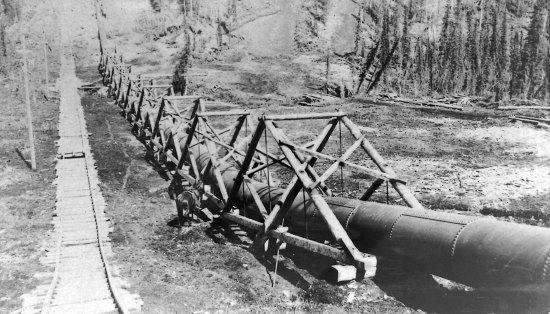
Using Small Capital Grants from the territorial Government, the Museum worked on a slide show of the Twelve Mile Ditch (Directors Report February 27, 1990).
The Museum continued to use employment grants for staffing. For example, in 1990 Museum staff included (Directors Report January 9, 1990, Directors Report February 27, 1990; Director’s Report May 15 1990):
a Job Creation grant provided 17 weeks for a photography project and office assistance;
a Community Development Fund (CDF) grant provided three positions – photography supervisor, photographer, and archivist technician;
a later CDF provided funding for a photo finding aid project, which included work for 2 photographers and 2 cataloguers;
a photographer through a 5 week Canadian Council of Archives grant
a Yukon Employment Incentives Program provided funding for a research librarian;
Lotteries Yukon provided funding for an Administrative Assistant;
Student employees (four tour guide, one research librarian, and one maintenance worker) through the Challenge 90 program; and
a capital contribution grant from YTG provided funding for a cataloguer to work for 8 weeks on the existing backlog.
1991:
Exhibitions
The Museum held the following art shows (DCM Minutes July 9 1991):
Halin DeRepentigny Art Exhibit
Danielle Shula’s art show
Yukon Expressions
Collections
From 1986 to 1991 the Museum had spent over $400,000 on collections management with only $60,000 contributed directly from the Museum (DCM Minutes October 24 1991).
The Museum engaged in the Registration Test Project. The territorial Collections Registration Co-ordinator facilitated the project, which involved three people hired to catalogue more than 800 artifacts (Acting Director’s Report April 29, 1992).
Using a Community Development Fund Grant, the Museum worked on reproducing its original photograph collection and creating an index. Examples included the Chief Isaac Family Collection (YHMA 1991):
The Museum also received funding from Yukon Lotteries and the Heritage Branch to expand their resource library (YHMA 1991).
Programming (Other)
The Museum hired a photographer to develop the sound slide show “Dawson at Forty Degrees Below Zero,” which was designed to answer what the City was like in winter.
The Museum implemented a lecture series to raise community awareness of the Museum (AGM Minutes April 29 1992). Topics included (YHMA 1991, September):
The Museum struggled to have a display committee (DCM Minutes July 27 1991 and August 21 1991).
1992:
Building
The Museum upgraded their security system with funding from the Heritage Branch (YHMA 1992a). They also planned to upgrade their storage facilities (YHMA 1992b).
The Victory Garden was completed, changing the space around the Museum (DCM Newsletter vol. 11 no. 2).
The Museum created a finding aid for the Caley Collection, which included rare books, papers, business ledgers, maps, and newspapers (DCM Newsletter Vol. 10 no. 4).
Using a Community Development Fund Grant, the Museum worked to make Mining Recorders Records more accessible (DCM Newsletter vol. 11 no. 2).
Exhibitions
The Museum opened its visible storage exhibit (DCM Newsletter vol. 10 no. 6).
The Museum opened its visible storage exhibit (DCM Newsletter Vol. 10 no. 6).
Programming (Other)
The Museum offered a workshop on photo conservation with funding from the Canadian Council of Archives and a presenter from the National Archives (DCM Newsletter vol. 11 no. 1).
Research
DCM Newsletter vol. 11 no. 2
1993:
Exhibitions
The Museum received Museums Assistance Program funding to begin researching and designing Klondike Gold – a traveling exhibition celebrating the anniversary of the Gold Rush (DCM Newsletter vol. 11 no. 2).
The Museum hosted an exhibition of paintings in the court room for the summer (DCM Newsletter vol. 11 no. 2).
The Museum developed an exhibition marking the centennial of the Yukon Order of Pioneers, which was installed around Dawson City (See documents available in YTG YOOP exhibit, Box 21a, Dawson City Museum Archives).
Using grants from the Canadian Council of Archives, the Museum worked to upgrade archival storage and produce an inventory (DCM Newsletter vol. 11 no. 2).
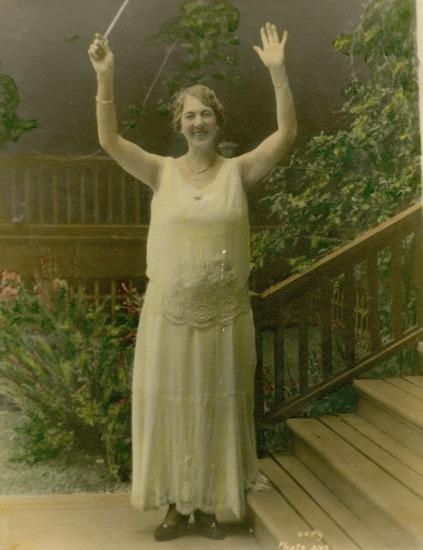
“Klondike” Kate Rockwell’s dress (below) returned from receiving conservation treatment at the Canadian Conservation Institute (DCM Newsletter vol. 11 no. 3).
The Museum hosted an oral history workshop (DCM Newsletter vol. 11 no. 1).
The Museum worked to provide curriculum linked programming (DCM Newsletter vol. 11 no. 2):
DCM Newsletter vol. 11 no. 2
The lecture series continued.
The Museum acquired a gold-melting furnace for the upcoming traveling exhibition. In order to trial the device, the Museum had gold-pouring demonstrations during the summer (DCM Newsletter vol. 11 no. 3).
DCM Newsletter vol. 11 no. 3
The Museum began to have live performances in the space, which were a main attraction. The most popular performance was called Discovery Claims, which involved multiple characters claiming to have found the first nugget (DCM Newsletter vol. 11 no. 3).
1995:
Building
The Museum installed a fire suppression and sprinkler system with funding from the territorial heritage branch and Department of Canadian Heritage (YHMA 1994). For more information see: Fire vs. Heritage.
Exhibitions
Klondike Gold – a DCM traveling exhibition celebrating the 100th anniversary of the discovery of gold in the Yukon – was at the Yukon Arts Centre. The exhibition included a CD ROM game with films, photos, and archival records (YHMA 1994, December).
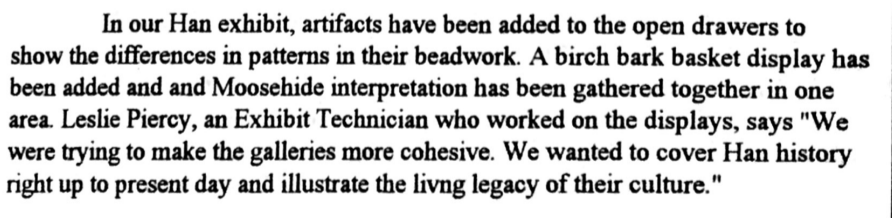
The permanent exhibitions “received a facelift.” For example:
DCM Newsletter vol. 12 no. 1
The Museum hosted two special exhibitions – “Too Thick to Drink, Too Think To Plow” and “Sketchbooks by George Back (1796-1878) Overland to the Arctic with Sir John Franklin” (DCM Newsletter vol. 12 no. 1).
Programming (Other)
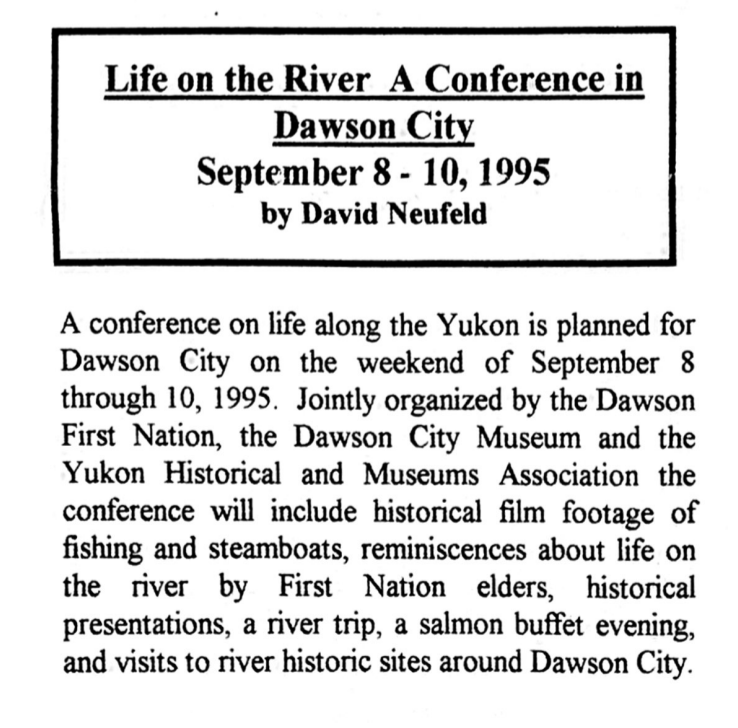
The Museum collaborated with Dawson First Nation and the YHMA on a conference about life on the River.
The Museum began to partner with Parks Canada to supply dramatic performances for their interpretive tours in Dawson (DCM Newsletter vol. 12 no. 1; see documents available in 95 seed challenge, Box 23b, Dawson City Museum Archives).
Staffing
In 1994/95 the Museum employed 50 people with payroll of $344,180 (DCM Newsletter vol. 12 no. 1).
1996:
Collections
With funding from the Heritage Branch, the Museum worked on registering the collections in storage and data entry of the collections records (YHMA 1996).
Exhibitions
With funding from the Heritage Branch, the Museum upgraded their Klondike Railway Train exhibit (YHMA 1996).
Staffing
The Museum continued to use short term grants or staffing. For example:
The Canada/Yukon Summer Career Placement Program provided 103 work weeks for nine University students who worked in interpretation and the gift shop (Swackhammer 1996a).
The first Young Canada Works in Heritage offered through the Canadian Museums Association provided 49 work weeks for five high school students. They worked as a cataloguer’s assistant and as part of the interpretation / gift shop team (Swackhammer 1996b).
1997:
Exhibitions
The Museum hosted a photography exhibition – “Neath the Midnight Sun” with help from the Yukon Arts Branch (DCM Newsletter vol. 13 no. 2).
The Museum opened “A New Look at Old Landscapes – the glacial history of the Dawson Region” (DCM Newsletter Nov. 1997).
1998:
Building
Although the Museum had occupied the Old Territorial Administration Building (OTAB) since 1962, it did not have a lease. At the request of Yukon Property Management, they entered negotiations that started at a rent of $10,000 (DCM Minutes 14 January 1998).
The Museum began a multi-year process to upgrade the train shelter and conserve the locomotives with funding from the Community Development Fund, Heritage Branch, and Museums Assistance Program (DCM Newsletter vol. 14 no. 1).
The Museum also began a new storage facility with funding from the Lind Family Foundation and Community Development Fund, but weather caused delays (DCM Newsletter vol. 14 no. 1).
Exhibitions
The Museum worked with the Robert Service School to create a Family Treasures Exhibit (Annual General Meeting Director’s Report 1999).
The Museum’s traveling exhibit – Klondike Gold – went to the West Vancouver Museum (Heritage Vancouver 1998).
Library
Museum donors, donating books and other resources, asked the Museum to develop an appropriate history library to house the collection alongside the Museum’s archives and other resources (DCM Minutes 14 January 1998). The Library was dedicated in July (DCM Minutes 8 July 1998).
Programming (other)
The Museum hosted or participated in 16 events from May to October, such as the Canadian Museums Association study tour and conference (Annual General Meeting Director’s Report 1999).
Throughout 1998, the Museum held special programming associated with the centennial of the Klondike Gold Rush (DCM Newsletter Nov. 1997).
Staffing
The Museum provided employment for 28 people with a payroll over $250,000 (Annual General Meeting Director’s Report 1999).
1999:
Governance
The Museum adopted a new statement of intent (DCM Newsletter Vol. 15 no. 1).
Grants
Granter
Purpose
Amount
YTG – Heritage Branch
Operations & Maintenance
$23,00
YTG – Heritage Branch
Move & Shelving
$145,000
YTG – Heritage Branch
Lind Galery
$15,000
YTG – Heritage Branch
Registration Support
$15,000
Lotteries Yukon
Lind Gallery
$20,000
City of Dawson
Operating
$10,000
Federal – Museums Assistance Programme
Move & Shelving
$48,600
Federal – HRDC
Supper Career Placement
$13923
Canadian Museums Association
Young Canada Works
$2,334
Canadian Museums Association
Professional Development
$750
Canadian Library Association
Young Canada Works
$2,406
Heritage Canada Foundation
Young Canada Works
$2,406
Canadian Council of Archives
Young Canada Works
$2,406
Canadian Council of Archives
Control of Holdings
$4,077
Yukon Historical and Museums Association
Professional Development
$750
Klondike Regional Training Trust Fund
Professional Development
$750
Foundation
Professional Development
$750
DCM AGM May 2000
Staffing
The Museum continued to access employment programs, including Young Canada Works grants from the Canadian Museums Association, the Canadian Council of Archives, and the Canadian Library Association. A grant from the Heritage Branch enabled the Museum to hire people for collections work (DCM Newsletter vol. 15 no. 2).
The Dawson First Nation collaborated with the Museum on a conference:
Neufeld 1995
The Dawson First Nation also collaborated with the Museum in 1994/95 on a job training project, which gave the Museum staff they trained to care for the Dawson First Nation papers (DCM Newsletter vol. 12 no. 1).
1996:
The Tr’ondek Hwech’in (formerly the Dawson Band) hosted a cultural day to honor the regaining of their identities (YHMA 1996).
In past research, federal cuts to cultural funding emerged as highly significant to museum development in the 1990s. Surprisingly, these have been mentioned very little in interviews and documents related to the Dawson City Museum Project.
1990:
Canadian Conservation Institute (CCI)
The CCI presented:
“Artifact Mounting Workshop” at the Dawson City Museum (CCI 1990, September).
“Field Conservation Techniques” at the Canadian Archaeological Association Conference in Whitehorse (CCI 1991, March).
“Emergency and Disaster Planning in Museums” at the Old Log Church Museum in Whitehorse (CCI 1991, March).
Museums Assistance Program (MAP)
A MAP employee conducted a security review of the Dawson City Museum (Acting Director’s Report April 29, 1992).
Parks Canada
In 1984, Parks Canada had been asked to store objects, such as an oil painting, for the Museum as it conducted renovations for the period of the renovation. In 1990, three years after the Museum’s re-opening, Parks Canada still had the oil painting (see documents available in admin correspondence KNHS. Box 17b. Dawson City Museum Archives).
1995:
Museums Assistance Program (MAP)
There were cuts to MAP and then the Minister of Canadian Heritage did not attend a Canadian Museums Association conference. The museum community had a moment of silence for MAP, putting a black ribbon on the podium (McAcvity 1995).
Parks Canada
Parks Canada began to reduce its public presentations and street theater (Swackhammer 1995).
1996:
Employment Policy
The Canadian Museums Association administered Young Canada Works for the first time (see documents available in YCW CMA 1996, Box 23, Dawson City Museum Archives).
1997
Employment Policy
Human Resources and Development Canada reduced the Dawson City Museum Summer Career Placement grants by 39 % (DCM Newsletter vol. 13 no. 2).
1999:
Cultural Policy
A Sense of Place, A Sense of Being – The Evolving Role of the Federal Goverament in Support of Culture released
Parks Canada
Parks Canada published Draft Management Plans for the Dawson City Historical Complex and Dredge no. 4 (DCM Newsletter vol. 15 no. 3).
Canada – Yukon
1990:
Explicit Museum Policy
Federal support influenced the development of territorial support for artifact inventory:
The second initiative is under the artifact inventory catalogue project. We have received a grant from the federal museums assistance programs that will provide 100 percent of the cost to undertake a planning pilot project for the registration and automation of museum collection record.
At the request of the Territorial Museum Advisor, staff from the federal Museum Assistance Program conducted a security evaluation of the Dawson City Museum (Kelly 1990).
1994:
Explicit Museum Policy
The territorial Heritage Branch sponsored Canadian Conservation Institute Workshops (YHMA 1994).
Territorial
During the 1990s, the territorial government continued the museum policy and programs established in the 1980s with new programs related to federal support (see above). Importantly, the 1990s involved support and attention to anniversaries in the territory.
1990:
Explicit Museum Policy
The YTG Museum budget decreased by 43% (Directors Report January 9, 1990). The Heritage Branch’s Director reported on these cuts at the Dawson City Museum’s annual general meeting in April, advising the Museum to seek funding from alternative sources like the Community Development Fund. He also suggested the Museum develop a traveling exhibition on the Gold Rush due to the importance of the Yukon Anniversaries Commission (AGM Minutes April 27 1990)
The territorial conservator helped the Dawson City Museum with projects (Director’s Report March 27 1990).
1991:
Explicit Museum Policy
The territorial government hired a Collections Registration Coordinator to facilitate the Artifact Inventory and Cataloguing project for the Heritage Branch (see documents in Admin correspondence director misc. Box 17b. Dawson City Museum Archives).
Heritage Policy
Historic Resources Act
1992:
Explicit Museum Policy
Museums Artifact Conservation Policy
Tourism / Museum Policy
The Yukon Gold Explorers Passport Program was introduced (and continues today).
Yukon Lotteries Commission
The Yukon Lotteries Commission (YLC) met with representatives from the City of Whitehorse and Yukon Recreation Advisory Committee (YRAC) to consider a request from the MacBride Museum for increased support to administration wages for winter programming. The YLC issued a statement with the YRAC saying:
Y.R.A.C. and Y.L.C. are not receptive to the idea of being responsible for providing ongoing operating and maintenance grants to Yukon museums. In fact, we believe that operating grants to museums are the joint responsibility of the Heritage Branch of Y.T.G. and the community in which the museum is located.
Beaumont 1994
1994:
Explicit Museum Policy
The Heritage Branch funding focused on the decade of anniversaries, including the museums exhibit assistance program. For example:
Specifically, support will be provided to the MacBride Museum for their Northwest Mounted Police/RCMP travelling exhibit, to the Dawson City Museum for their Klondike gold rush anniversary travelling exhibit and to one of my favourite museums, the Keno Museum, to complete the new exhibit development work
Museums Assistance, which included “for the Dawson Museum, the Yukon Order ofPioneers centennial exhibit was $12,200; the sprinkler design was $10,000; self-guided tours was $7,800; computer upgrade, $2,500” (YLA 28.1.81).
Exhibits Assistance, which included “$35,000 for the Dawson City Museum for a gold discovery exhibit” (YLA 28.1.81).
Artifact Inventory and Cataloguing
Conservation and Security
Yukon Lottery Commission
The Yukon Lottery Commission restated their position that museums are the responsibility of the Heritage Branch and local community (Beaumont 1994).
1997:
Explicit Museum Policy
The Dawson City Museum received (DCM Newsletter vol. 13 no. 2):
operation and maintenance funding
project funding for:
cataloging and registering a backlog of artifacts
an exhibition on glacial and geological history of the Klondike mining district
upgrading the Klondike Mines railway interpretation
research on the history of tourism in Dawson.
Conservation assistance for textiles
The Operational and Maintenance funding formula changed to include a component tied to memberships and fundraising (See documents available in Correspondence director 1997-1998, Box 25, Dawson City Museum Archives).
Yukon Beringia Interpretive Centre opened
Tourism / Museum Policy
The Passport program underwent review (See documents available in Correspondence director 1997-1998, Box 25, Dawson City Museum Archives)
1998:
Explicit Museum Policy
The territorial government designed a collection management database for community museums with a master copy at each museum and a copy on the Registration computer in Yukon government (Ball 2004).
1999:
Explicit Museum Policy
There were decreases in the Museum support program:
From 1996-97 to 1999-2000, we’ve got a21-percent decrease in the capital funding to museums. In the historic sites area, from 1996-97 to 1999-2000,we’ve got a 31-percent decrease – we’re talking $881,000 down to $605,000… The museums assistance in 1996-97 was $467,000. The estimate for this year is $314,000. That’s 33-percent down. The interpretive signage was $245,000 in 1996-97 and is $125,000 now. That’s almost a 49-percent decrease.
The City of Dawson began to provide funding from the Centennial Events Fund to offset costs of summer student wages (DCM Newsletter vol. 12 no. 2)
1997:
The City of Dawson provided $10, 000 through its Centennial Events Fund to continue offsetting the Museum’s interpretive staff wages (DCM Newsletter vol. 13 no. 2)
1998:
The City of Dawson continued to provide a grant to the Dawson City Museum to offset summer student wages (Annual General Meeting Director’s Report 1999).
Community Action
Most importantly, the 1990s were a decade of activity related to anniversary celebrations.
1991:
Museum Community
The Yukon Historical and Museums Association held an introductory computer workshop, involving the Canadian Heritage Information Network and the Ontario Museum Association’s Trillium project (YHMA 1991)
1998: It was the centennial of the Klondike Gold Rush, leading to an increase in visitors to Dawson City.
1999:
Museums Community
The Yukon Museums and Historical Association engaged in consultation to develop a strategic plan (Coop 2000/2001, Winter).
Questions
Do you know of any important milestones that are missing?
Would any of the entries benefit from more information or links to additional resources?
References
Ball, Drew. 2004. Museums Status Report. Blue Binder. Box 33. Dawson City Museum Archives.
Beaumont, Doug. 1994, November 24. Letter to the Dawson City Museum, Sports and lotteries paper. Box 22. Dawson City Museum Archives.
After a very intensive week in the Dawson City Museum (DCM) archives, I am sorting, reading, and analyzing what I found. The documents scanned are interesting and contributing to the narrative(s) about the DCM’s development. In order to help with the analysis, the “Archival Research” series considers the stories archival materials tell, looking at the items I found most exciting.
This post builds on Overwhelming Obstacles, which considers a Board member’s feeling of overwhelm. In that instance, the Dawson City Museum (DCM) did not a full-time, year round Director yet. This post considers three instances where Directors similarly felt overburdened and expressed this feeling in correspondence.
Examples
Instead of contextualizing the examples, I am going to provide the three examples one after the other to show how the problem has existed across time and with different Directors. Here they are:
Document in 7.7.40, Box 5, Dawson City Museum Archive
DCM is recognized as one of the most important heritage attractions in the community yet we have few volunteers, locals rarely attend our special events, and financial support is nil. My fear is that eventually the Museum will not be able to sustain its operations and will close. It will only be then that people will realize our struggle and step up to help.
A Director’s Exit report
Letter from O & M correspondence, Box 29b, Dawson City Museum Archives.
Why are these excerpts interesting?
The excerpts are most interesting because they are part of a trend, showing a pattern of the Museum Director being overwhelmed with the amount of work needed. However, they each highlight specific problems, which are not mutually exclusive and do repeat:
The first letter reflects on the Board’s lack of participation and tendency to expect the Director to do a job the Board should have be doing or hired someone qualified to do. In particular, the Director was working as their secretary. The Director was also working as Financial Clerk, doing the bookkeeping, despite being unqualified for that position. She wrote:
… To spend one year as Financial Clerk and secretary is not my idea of the job position.
See Above
When the Director expressed her concerns, they were not addressed:
I spoke out at our May meeting…I have had to struggle all summer to do a job that I said that I was not really qualified for.
See above
In the second example, the Director talks about the lack of ongoing local support for the institution – that is, outside of a crisis – despite its recognition as a vital attraction:
….we have few volunteers, locals rarely attend our special events, and financial support is nil. My fear is that eventually the Museum will not be able to sustain its operations and will close.
See above
Finally, the last excerpt touches on a lack of financial resources, which led to a lack of support for employment:
My success rate in obtaining grants has been declining recently because of the poor economy and the overwhelming number of deserving applications being submitted to funders of every description. The Museum was extremely close to closing its doors twice during the peak tourist season last summer.
See above
In short, the Museum’s Directors are often left feeling “frustrated, exhausted, enervated, and despondent” (See third letter above) due to a perceived lack of support from the Board, the community and/or potential funders. Running a museum is hard and involves work in administration, collections, exhibitions, facilities management, research, and public programming. This work becomes even harder without support.
Is there broader relevance?
The broader relevance becomes apparent when looking at period(s) where Directors were not reporting feelings of being overwhelmed. In particular, the Museum was relatively well staffed due to the availability of project, employment, and Yukon anniversary funding from the mid 1980s to the late 1990s. During that period, the Museum also had an active and involved board, including people with relevant knowledge working with Parks Canada. As a result, the Museum thrived.
The “Golden Age” of the Museum started with a 2.9 million dollar renovation in the mid 1980s and continued with new exhibitions, active involvement in the community, and an expanded resource center. It ended as funding became scarcer and the board became less active. Without funding for staff and active committees, the workload was left to the director and the few contract employees that depended on grant availability.
The Dawson City Museum has the largest collection of artifacts in Yukon and is a key attraction in a community that relies on tourism. In many ways, the institution punches above its weight. However, as the responsibility for that work falls on fewer shoulders, those people feel overwhelmed. I recommend checking out Paul Thistle’s, a former Director of the Dawson City Museum, blog on task saturation for more information about the scope of work required of museum workers and possible solutions. It is available here.
Questions
What do you think? Are these the same lessons you draw from the excerpts? Do you think it is important to consider Director overload when looking at the Museum’s development?
After a very intensive week in the Dawson City Museum (DCM) archives, I am sorting, reading, and analyzing what I found. The documents scanned are interesting and contributing to the narrative(s) about the DCM’s development. In order to help with the analysis, the “Archival Research” series considers the stories archival materials tell, looking at the items I found most exciting.
Within this post, I am looking at the Dawson City Museum’s response to a 1968 Fire Marshal’s report, which stated a fire would result in a complete loss of the Museum’s building – the Old Territorial Administration Building (OTAB). I talked about a later fire inspection, labeling the building a “death trap,” in the last Archival Research post – Government Relationships. Not much had changed from 1968 to 1979!
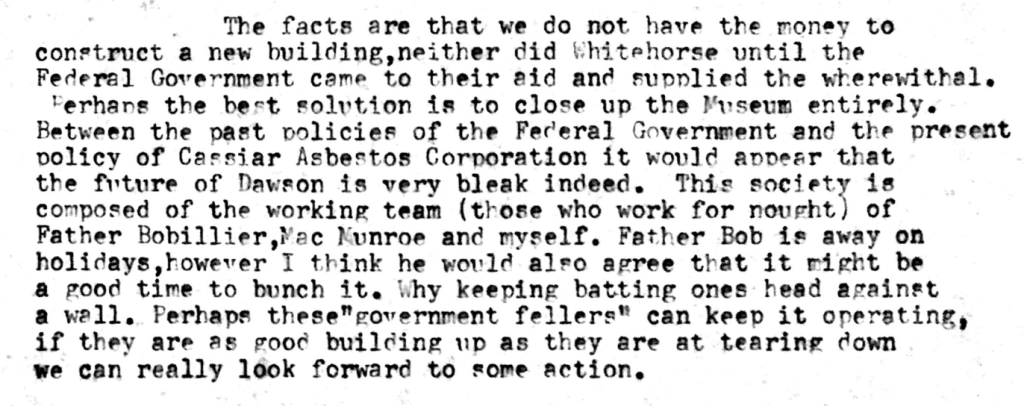
The letter in question is from the Museum Society’s Treasurer to the Commissioner. It is three pages so I won’t post the entire document. Here are some interesting excerpts:
1.1.38 correspondence 1968, Box 1, Dawson City Museum Archives
Why is the letter interesting?
The Museum received the Fire Inspector’s report condemning the Old Territorial Administration Building (OTAB) housing the Museum in August 1968. Importantly, those running the Museum did not believe the OTAB was any more dangerous than it had been when the government used the space. The treasurer argued:
Sure this old building is a fire trap. Has been for as long as I can remember… One thing is certain that it is no more a fire hazard than it was when the government were using it, in fact less.
See letter above
As a result, the inspector’s report was seen as an unreasonable obstacle for an already overburdened group of volunteers running the Museum. After describing the Museum as a team of three people, the treasurer stated:
… it might be a good time to bunch it. Why keep batting ones head against a wall?
See letter above
The letter makes the writer’s frustration clear. The volunteers running the Museum felt overworked and were not getting the support they needed from the community or government. Instead, the government was creating obstacles:
It has now come to the time where the hurdles are too great. Bucking public apathy is hard enough, when government artificials start giving one a bad time this is the last straw. As far as I am concerned, personally the government can shut down the whole operation, I would save myself a lot of work and worry.
see letter above
In response to the letter, the federal government began working with the Museum to find a solution – that is, alternative accommodations. However, it did not work out. By 1970, the Museum offered to sell their assets to National Historic Sites for $1 as they planned to cease operations.
Is there broader relevance?
Clearly, the Museum still exists in the Old Territorial Administration Building (OTAB) so they did not sell the collection or even move.
I also found no evidence that they addressed the fire inspector’s report… it appears to have been forgotten about until the Museum failed another report in 1979 and were prevented from re-opening in 1980 (See Government Relationships for more information).
However, the event is still important because it illustrates a broader point – that is, running a museum is hard and people are often overworked. The few people running the Dawson City Museum in the late 1960s were not getting the support they needed from the community or government to do so effectively. The fire inspector’s report was the final straw, leading to so much frustration that the Museum’s collection was almost consumed by the federal government’s operation in the area.
Importantly, the Dawson City community tends to rally in support of the Museum in times where the institution is threatened. In this instance, a new board was elected and brought an enthusiasm to the Museum’s operations, which enabled it to continue (Snider 1971 1972). As the new Secretary wrote:
We have faced a problem in that some have had a desire to abandon the work rather than improve it. This has started to change now with some changes in our directors.
Snider 1972
Questions
What do you think? Are these the same lessons you draw from the letter? Do you think this is an important event in the development of the Dawson City Museum?
References
Snider, K. C. 1971, January 27. Letter to the NHS Superintendent. 2.2.1: Correspondence. Box 1. Dawson City Museum.
Snider, K.C. 1972, February 21. Letter to the White Valley Historical Society. 2.2.2: Correspondence 1972. Box 1. Dawson City Museum.


















 Museoception