Interview Analysis: The Community’s Voice

As part of the Dawson City Museum Project, I conducted fifteen interviews with people associated with the institution historically and today. Most of the transcripts have been approved. So, my Research Assistant and I are analyzing them now. The Interview Analysis series considers this analysis and the insights people have provided.

Within this post, I am continuing to examine the role of the Dawson City Museum as a community resource (Community Resource, Museum as Employer). In particular, I am considering the Museum as the community’s voice – that is, a place for the community to tell stories. Becoming a place for the community to tell its own stories is also a goal for current staff, but interview data demonstrates it was a reality for the Museum in the 1990s into the early 2000s.

Examples

In the 1990s, the Museum was seen as a community hub, telling the community’s stories. As one Interview Participant described:

I would introduce it as the community’s museum, telling the community story in a grand building that has a story of its own. An immersive experience and it was a hub in many ways to the

community.

Interview 10

Community involvement led to some interesting exhibitions about the community. One Interview Participant described “Dawson at Forty Degrees Below Zero”:

There was a really awesome project that they did one year where they pulled together just interested community members that wanted to tell visitors what their life was like in the winter and they helped them take good quality photographs and they created a slideshow for the summer. And it contained sort of these iconic images of what a day in the life of a Dawsonite was like in the winter. It included things like learning how to soak a roll of toilet paper in kerosine and set it under your vehicle to warm up the oil pan.

Interview 10

“Dogs” provides another example:

There was another exhibit that asked people to bring their favorite photo of their dog in… The idea was that people could bring in their dog portraits. The exhibit took place in the courtroom. So it was a fairly small space but those walls were filled with people’s dog portraits, and it was just an ability for people to come and honor the dog, which… has played such a large role in the community, in Dawson.

Interview 10

Ideas for these temporary exhibitions or programming came from the community. As a participant recalled:

But there were tons of exhibits that came on suggestion from the community. People would walk into the museum and say, “hey, I’ve got a great idea, and I’d like to do this.”

Interview 10

Notably, the Museum also actively sought out community members’ contributions for traveling exhibition on the Gold Rush in the 1990s, circulating their stories to a broader audience.

I was there during the time that the traveling exhibit for the centennial of the Gold Rush was coming together and that involved multiple stakeholders and partners. And it also involved a lot of community input for everything from gold miners donating gold and sharing their story about what they wanted the world to know about their experience to community members in general that had a buy-in about what narrative was going out there in the world about their town. And so there just seemed to be a lot of interplay between the community voicing their opinion and then that directing exhibits and activities within the Museum.

Interview 10

In short, during the 1990s, the Museum was actively listening to and telling community stories through an active temporary and traveling exhibition program.

The Importance of Leadership

The timelines created for the project (1990s, 2000s, 2010s) and interview data suggest there has been a less dynamic temporary exhibition program since about 2006. There is no one change that explains the shift. However, some have pointed to the importance of leadership in creating the relationship needed in the community for the community to approach the museum with ideas and enthusiasm. Most notably, the Museum had a Director in the 1990s widely recognized as charismatic, drawing the community into the Museum:

So there was what feels like to me a real Heyday time, but I don’t think it was one single component that shifted that and made things a little more challenging at the Museum. But certainly would not want to understate how formative [he] was as the Executive Director of the Museum as well as that incredibly involved community member who was very good at engaging people and keeping that interest, keeping the Museum as the community’s hub.

Interview 10

Other changes that help explain the shift include a move from project based funding to more operational funding for museums at the territorial level, changes in employment considered in Museum as Employer, and the reality that the 1990s was a decade of anniversaries for the Yukon, which can contribute to more enthusiasm for heritage.

Questions

What do you think? How to museums become vehicles for the community to tell its own story?

Teaching Resource: Mini Lecture on Museum Development

I am currently re-writing a course on Museum Management at MacEwan University. As part of the course, I have created some mini lectures. When I created Museoception, I originally conceived it as a place to share teaching resources. So… I am sharing!

The history and development of museums in what we now call Canada is often misunderstood or not discussed. In this post, I am sharing a mini talk on the development of museums, which is embedded in my course. I would love to hear your thoughts – Did I miss anything you feel are important to consider?

Interview Analysis: Museum as Employer

As part of the Dawson City Museum Project, I conducted fifteen interviews with people associated with the institution historically and today. Most of the transcripts have been approved. So, my Research Assistant and I are analyzing them now. The Interview Analysis series considers this analysis and the insights people have provided.

Within this post, I am continuing to examine the role of the Dawson City Museum as a community resource (Community Resource). In particular, I am considering its role as an employer, which was mentioned in a few interviews. Interview quotes provided below highlight the Dawson City Museum’s role as an employer and its related expansion in the 1980s and 1990s. However, the Museum stopped being a major employer in the 21st century, which can be explained through an examination of both community and policy changes. The interview data thus serves as a starting point to discuss ways the Dawson City Museum’s development was shaped through government policy and community action.

Interview Excerpts

During the 1970s through the 1990s, there were a dedicated group of about five people who worked for the Museum. As one interview participant recalled:

Those folks [were] very important for … the work of the Museum, the day-to-day job of the Museum. They were the most important crew, ultimately.

Interview

These individuals had an interest in heritage and, as such, enjoyed working at the Museum. Several were interviewed for this project and one remembered:

At the time when I started [at the Museum] I think I was making five dollars an hour. And so it wasn’t a well-paid job. People didn’t come to it because of that. They came because it was an interesting place to work and it drew other interesting people.

Interview

Through their hard work, the Museum was able to professionalize and ran an active museum program with exhibitions, collections work, research, and public programs. Different projects led to more employment for more people. As one interview participant recalled:

I would just say that it expanded. It expanded in its outreach, and expanded in its projects, and it expanded with the staff. It became one of the larger employers in the community at that time.

Interview

Similarly, another participant who worked at the Museum in the 1990s noted:

At the time that I started there, it was one of the main employers in Dawson.

Interview

Despite the significance of their work to the Museum, staff were not hired in full time permanent positions.

We were essentially employees, but we were contractors.

Interview

Since staff were tied to projects, running the Museum involved ongoing work to develop projects and get funding for them to support staffing.

And that’s the way the funding works. You have to have a new project every time. You just get people enthused and trained and actually excited about doing something and you have to come up with something new and find new people. Even then, that was a problem. You were always searching for things that fit inside what a museum is interested in doing but would bring money is into the coffers so you could keep people employed.

Interview

At the time, there were a range of project grants available related to unemployment. As one former Director from the period recalled:

As I mentioned, we would access the EI grants all the time. We also accessed all sorts of other grants about keeping people employed, or project-based, probably through MAP, which was.Museum Assistance Program, at the time, that existed… It was a time of unemployment, and governments wanting to get people working and keep them working.

Interview

Importantly, this era of employment came to an end at the close of the 20th century. Entering the 21st century, it became increasingly challenging to staff the museum. The Museum is no longer considered a major employer in the region and a consideration of community and policy changes helps explain why.

Community

Changes in the community provide a partial explanation for why the Museum is no longer an employer as a primary role.

As noted above, from the 1970s to the 1990s, there was a core group of about five people who would work for the museum regularly on contracts associated with project or employment funding. However, a number of these individuals left Dawson in the late 1990s or early 2000. As one interview participant recalls:

At the time as well, there was this amazing group of people who had been involved with the Museum for quite a long time… So there was this corporate knowledge and energy that was there as well. Just because of happenstance, most of those people ended up getting Yukon government jobs and moving to Whitehorse kind of at the same time that [the Director] as well moved on and also at the same time that I think financial constraints came in on the Museum. 

Interview 10

While not stated in the interviews, their departure from Dawson to government jobs reflects a core issue of contract staffing in museums, which can fail to address the needs of employees as a community. Most notably, there is a lack of job security, meaning the Museum lost valuable resources when other, more secure and well paying opportunities became available. As stated in a discussion paper for the Yukon Museums Strategy in the early 2000s:

The other aspect of staffing which requires immediate attention is the so-called itinerant museum contractors who are largely responsible for the outstanding quality one can observe throughout the Yukon’s museum system. Their training, skills and commitment, coupled with the unique manner in which they work, are an outstanding example of adjusting to local circumstances without sacrificing quality and expertise.

But the message here is also loud and clear. These contract workers, despite their sustained success, are feeling abused and neglected by the government system they serve. It is our understanding that they have no secure employment contracts, receive no benefits, and are not necessarily paid in keeping with their skills and experience. The loss of these talented workers would do serious damage to the overall content and quality of Yukon’s museums, even if it were possible to replace them.

Barkley et al 2001.

The Dawson City Museum was never able to replace the people who had helped the museum thrive, maintaining corporate knowledge for over 20 years. While there are a variety of reasons they have not been replaced, looking at policy changes provides another partial explanation.

Policy

Importantly, several programs existed in the 1980s and/or 1990s, which the Museum used to employe people. These programs either no longer exist or exist in different forms.

Local Employment Opportunities Program (LEOP) + Others = Community Development Fund

The Local Employment Opportunities Program (LEOP) was announced in October 1985 with the goal to provide employment during the winter months (YLA 26.2.4). More specifically, the Minister responsible for Community and Transportation Services explained:

it is our intention that this will assist local governments, Indian Bands, registered societies, recognized non-profit institutions to undertake projects that normally would not have been undertaken due to a lack of funding. The program will fund capital projects that are labour intensive, will improve the quality of life, will be a measurable asset to the community as a whole. The program will also stimulate the economy at the local level, as one of the concrete examples of the government’s commitment to jobs for Yukon people.

YLA 26.2.7

The Dawson City Museum used LEOP in the late 1980s to develop their exhibitions. For example, in 1987 LEOP provided over 20 thousand dollars in wages for carpenters (DCM AGM 1987; See for example, YTG LEOP Program, Box 13, Dawson City Museum Archives).

LEOP was terminated in the late 1990s and the Community Development Fund (CDF) replaced it (Source). Importantly, CDF started as an amalgamation of several employment programs the Museum was once able to use. For example, the Yukon Employment Incentives Programs, through which the Museum employed someone for 16 weeks in 1990 (DCM Directors Reports 1990), was also amalgamated into CDF (YLA 27.1.57).

While the Museum has used CDF, it does not support employment at the Museum in the same way that multiple overlapping programs designed to increase employment once did.

Lotteries

Starting in the late 1980s, the Museum began receiving funding for a part time administrative assistant (Gorrell 1988). However, in the 1990s, the MacBribe Museum asked for increased funding for administration during the winter. Subsequent meetings led to a statement in which the Yukon Lottery Commission asserted:

operating grants to museums are the joint responsibility of the Heritage Branch of Y.T.G. and the community in which the museum is located.

Beaumont 1994

As a result, the Museum was no longer able to get wage support from lottery funding.

Federal Strategies

The Dawson City Museum began to use federal employment programs in the 1970s, starting with the Local Initiatives Program. The Program enabled the Museum to have year round employees for the first time. It also started the trend of the Museum using federal programs to subsidize employment. For example, in 1981 the Museum received a $133,000 “work grant” from the Department of Employment and Immigration’s Canada Community Services Program.

In 1985, the Government of Canada announced the Canada Job Strategy, which included a number of programs that the Museum used. For example, the Museum used the Job Development program, which provided support to make unemployed people more employable (O’Brien et al. 2005). In 1990, the Museum used Job Creation (Sec. 25) to employ someone on a photography project and for office assistance (DCM Directors Reports).

In 1996 the Government of Canada the job strategy was reformed, changing the available programs.The Youth Employment Strategy launched in 1997, including funding for student employment like Young Canada Works. The Young Canada Works program targets museums specifically and contributed a shift whereby the majority of temporary workers at the Museum became summer students.

Implications

As employee support for winter employment became less accessible, funding for student summer employment became more available and the people who had been contracted by the Museum moved away. Since then, the Museum stopped being a major employer outside the summer months.

As one participant noted there is a gap in support for the community itself to once again have a role in the Museum:

One of my big things is I think in the old days, the seniors and elders in the community had more of a role with the Museum. And now it’s so focused on providing employment for young students that we’re really missing the big important connection with the community not having support for all these people who have these wonderful stories to tell and could really contribute to the Museum’s sustainability because you get more loyalty from the community and you’d have more interesting programming.

Interview

Questions

How do government employment programs shape the work of museums? Are there alternative arrangements that could serve everyone better?

References

Barkley, Bill, Janes, Robert, Jensen, Marilyn, Johnston, Ingrid, Ingram, Rob, and Dobrolsky, Helene. 2001. Preliminary Observations on Yukon’s Museum Community: Discussion Paper. Strategy for Yukon Museums. Box 29a, Dawson City Museum Archives.

Beaumont, Doug. 1994, November. Letter to the Dawson City Museum. Sports and Lotteries Paper. Box 22. Dawson City Museum Archives.

Gorrell, Truska. 1988, December 14. Letter to the DCM. Lotteries Yukon. Box 15, Dawson City Museum.

O’Brien, Cathleen, Tommy, Diane, and Thomas, Bob. 2005, June. Wage Subsidies in Canada. Paper for Korean Ministry of Labour and Korea Labour Institute. Government of Canada.

Inexpensive and Impressive but Challenging and Restrictive: A Consideration of Non-profit Museum Management in a Historic, Government-Owned Space

The Dawson City Museum project asks – How has the Dawson City Museum evolved in relation to government policy and community action? 

We are taking two approaches to answering the question. First, we are considering the data chronologically to discuss the evolution of the Museum over time. Second, we have developed key themes related to policy and community. To solicit feedback, I will post a series of working papers that consider the data in these two ways – that is, chronologically and thematically. These papers will inform the final report for the Dawson City Museum and podcast miniseries.   

Providing the first thematic consideration of the data, this working paper focuses on the relationship between the Dawson City Museum and the space it occupies – that is, the Old Territorial Administration Building or the OTAB.  The OTAB is a National Historic Site and a government owned building. So, this thematic consideration relates to policy and demonstrates the role of unarticulated or implicit policies in shaping the Museum’s development. 

After summarizing the answers and outlining our research approach, I give a short overview of the Old Territorial Administration building. Then, I outline the benefits born from the Dawson City Museum’s relationship with the building and the challenges it causes. Finally, I conclude that although the OTAB is a significant form of government support, government inaction hinders the Museum’s development and necessitates ongoing advocacy, which places a significant human resource burden on the Museum. 

Summary

What is the relationship between the Dawson City Museum and the Old Territorial Administration Building?

Most simply, the Dawson City Museum has lived in the Old Territorial Administration Building since 1962. As a result, the grand and imposing space has become an integral component of the Museum’s identity, featuring prominently in marketing materials and shaping the Museum’s development. 

What effect has the relationship had on the Museum’s development?

The Yukon Government owns the OTAB, which causes benefits and challenges for the Museum. The rent for the grand, neoclassical building is relatively inexpensive and represents a significant form of support. However, Yukon Government’s reluctance to properly maintain the space creates a human resource burden for the Museum as Executive Directors manage mishaps, advocate for change, and work with the government to ensure they follow through on commitments. Moreover, Yukon Government’s reticence can hinder the Museum’s ability to seek other funding and properly care for the collection. It also represents a threat to the building itself. 

What are the policy implications?

Yukon Government’s lease agreement with the Museum is a kind of implicit cultural policy with both intended and unintended effects. The agreement supports the Museum’s development. However, the Government’s apparent reluctance to adequately maintain the space and support the Museum’s use of the space (in)actively works against the Museum’s interests. 

Research Methods

The analysis draws on research conducted for the Dawson City Museum (DCM) Project, including archival research, document analysis, and interviews with fifteen people. The former Executive Director, Alex Somerville, provided comments on a draft of this paper, which contributed to significant edits.  

Overview

The Old Territorial Administration Building (OTAB) is a National Historic Site constructed in 1901 and designated in 2001. Architect Thomas Fuller designed the building to house diverse legislative and administrative activities in the new Yukon Territory. It accommodated various offices (e.g., the Mining recording office, commissioner’s office), rooms (e.g., a draughting room), and the Council chamber. By the 1920s, all federal and territorial administrative services for Yukon were consolidated into the building except for the Royal Canadian Mounted Police and the Public School. However, when the school building burnt to the ground, it also moved into the OTAB for a short time. Despite the OTAB’s versatility, the territorial capital had moved from Dawson City to Whitehorse in 1953 and the building was empty by 1961 (Archibauld 1977).   

Like the Public School, the Dawson City Museum needed space after its building burnt down in 1960. As such, the Museum moved into the OTAB in 1962 and has remained ever since. The building benefits the Museum because it is inexpensive and impressive. However, it also restrictive and challenging, influencing the Museum’s development in both beneficial and detrimental ways. 

Benefits 

Inexpensive (Financial)

As noted in “Dawson City’s Community Attic,” the Old Territorial Administration Building (OTAB) represents a significant form of government support to the Dawson City Museum (DCM). 

The DCM originally rented the OTAB from the federal government for $5 a month during the Gold Rush Festival period in Summer 1962. Despite no longer paying rent, the Museum continued to display artifacts on the first floor of the OTAB through the 1960s and 1970s. After ownership transferred to the territorial government in the late 1970s, the Museum even expanded onto the second floor. However, in 1998, Yukon Property Management began asking for rent, which the Museum negotiated from $10,000 to $4,000 a year (DCM Minutes 14 January 1998).  

Importantly, rent has stayed $4,000 a year. It is below the Yukon government’s costs and has not increased with inflation. Moreover, Yukon Government took over responsibility for janitorial costs in 2006, increasing their commitment (DCM Minutes September 21, 2006). 

Operational and maintenance costs for the OTAB, which also now houses 1100 square feet of government offices, are now over $130,000 a year – that is, more than the Museum’s operating grant from Yukon government. See Figure One for the annual totals from 2016-2017 to 2020-2021.

2016/17145,389.68
2017/18155,124.33
2018/19158,312.30
2019/20146,716.22
2020/21137,396.12
Figure one: Operation and Maintenance Costs for the Old Territorial Administration Building

Yukon government has also made capital investments into the OTAB (though, as discussed below, these investments can be stop gap measures that do not address core issues). Most notably, in the 1980s, the OTAB underwent over 2.9 million dollars in renovations. These renovations made the building code compliant after a failed fire inspection and addressed issues with the crumbling foundation. They also made the building more usable year-round with insulation and modern washroom facilities. 

From 2016-2017 to 2020-2021 capital investments have included updates to the fire alarm system, asset management planning, and repairs (e.g., stairs, ice damage, sprinklers). These costs range from 18 thousand dollars to over a million in a year, totaling 2,052,466.11 from 2016 to 2021. However, importantly, that figure include a revitalization project started in 2020-2021, which has not been completed. A less expensive example includes $7,000 to level and repair stairs after a patron complained about the tripping hazard and wrote a letter to government (notably, this is an example of Yukon Government not acting on a known issue until there was some advocacy work).   

In short, the low rent that the Museum pays for OTAB and the investment in the space represents a kind of implicit cultural policy whereby the government provides space that supports museum operations. 

However, when accounting for the building as a form of support, it is also important to recognize that the Museum’s work supports Yukon Government. According to Yukon Government’s 2020-2021 Five-Year Capital Plan, capital investments, such as those made to OTAB, ensure Yukoners are able to live healthier, happier lives. Moreover, Yukon Government owns the OTAB and would ultimately be responsible for the building costs regardless of the Museum’s occupation.  As an occupant, the Museum has the legitimacy to advocate for maintenance and capital work to ensure the historic building’s continued operation as a publicly accessible space. The Museum’s role as advocate for the building extends nationally as well. In particular, the Museum applied for historic site designation in the early 2000s, leading to national recognition of the building’s significance.

Impressive 

The Old Territorial Administration Building is both an artifact and home to artifacts. As an artifact, it is visually impressive. An Interview Participant described the building as follows:

When it was finished in 1901, the Old Territory Administration Building was the largest building in the north. It’s 200 feet long. It’s 2 and 1/2 stories high. It’s a beautiful old wooden building. It was built to house the government of the Yukon of the late nineteenth century. We couldn’t have asked for a grander home in resplendent white neoclassical style, gently set back on dusty 5th avenue in the park-like setting. 

Interview 1

This description is significant because context influences how objects look and signify (Jones and MacLeod 2016). The OTAB – a visually impressive and imposing historic building – provides context, influencing perception in two major ways. 

First, museum architecture can contribute the experience of the transcendent because, through architecture, people can feel connected to something larger than themselves (Buggeln 2012). The observation that the OTAB’s architecture connects visitors to something larger than themselves is not new. The application to designate the OTAB as a national historic site argued the building reflects the sense of optimism that characterized the Klondike Gold Rush. It reads:

As an architectural construct, the imposing size of the (Old Territorial) Administration Building also symbolizes the sense of optimism which characterized the Klondike Gold Rush itself… Evidently, the belief in the continued prosperity of Dawson played a part in architect Thomas W. Fuller’s decision to house the mining offices in such a large facility. 

DCM 2000

The application also argues the building symbolizes the new relationship between Canada and the Yukon. It provided an air of stability and permanence to the new governance structures in the territory (Ibid). As a museum, the Dawson City Museum is thus a colonial construct within a visual representation of and connection to colonialism. The historic building connects visitors to the past and systems of continued relevance as a grand physical representation of bygone eras that are also represented inside through objects. 

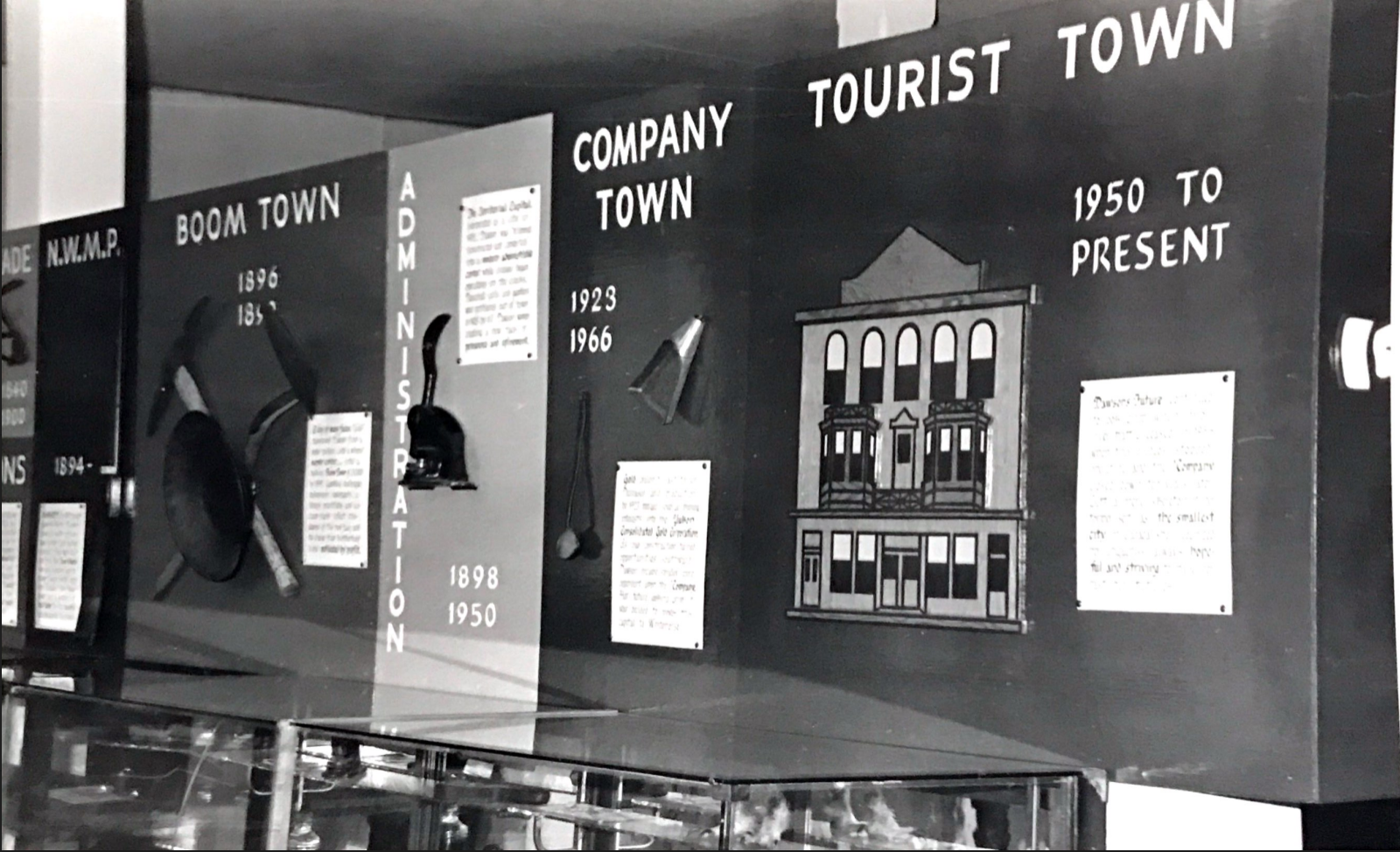
Interestingly, the OTAB and its foundation reflect the Museum’s old exhibitions. The building was created to provide space for government after an influx of minors. It thereby serves as a visual representation of the Klondike Gold Rush era and the old exhibitions centered this migration event. At the same time, the building’s various uses overtime physically represent the new exhibition’s major theme – that is, the people of the Klondike survive and prosper through adaptation and change.  Through the interpretation of the space, the building can help connect visitors to these broader themes. The connection also raises a question thus far unanswered– as staff work in a physical symbol of the past, has the building itself influenced the development of the exhibition themes? 

In addition to signifying the past, the building also provides a visual representation of the Museum’s connection to a broader heritage interpretation in Dawson City. Notably, in 1978, Parks Canada recognized OTAB as a Grade One Historic Resource, which “is essential to the commemorative integrity of the Dawson Historic Complex in order to portray the gold rush and its aftermath in a coherent manner” (Thistle 2001).

Second, experiences are mediated through the architecture, which expresses a position on the function of the museum (Sweet 2007). The OTAB is a historic building that legitimizes the small nonprofit as a professional museum telling stories about that history. As the Interview Participant quoted above observed: 

            It all looks very much like a museum.

Interview

Reflecting the perception that the building looks like a museum, “Saw the building” was the second highest reason people visited the Museum identified in a 1989 visitor survey (the first was a recommendation from the visitor information center). 

Beyond looking like a museum, the space looks grand and impressive, which shapes its use. As a former Executive Director noted, 

The OTAB presents the Museum with a challenge of greatness. It is an intimidating building to fill. 

Somerville, personal communication

Another interview participant observed:

I think it’s quite a grand building, so it’s a lovely space to be in. It elevates the quality of our exhibits from them being in that space, but also, I think it makes people expect great things…

It definitely was a pleasure to work in that space and I think it improves the Museum for it. If we were just in any old building, we’d still be great, but it wouldn’t be as good.

Interview

The OTAB thereby influences how exhibits are perceived, elevating them in the eyes of visitors and challenges staff to elevate their work to meet the greatness called for in the space. For example, starting in 1975, the Museum staff began to professionalize the Museum. An Interview Participant recalled:

At one point, [the Curator] just looked around and it’s a big building with lots going on. So, she and I looked at a few books about how a museum should run, and she got some grants that ran a couple of years and hired nineteen people. We set up, essentially, a modern museum like the staffing structure. That was really the beginning of pulling the Museum out of a curio shop into a museum with policies and procedures and an idea of what the correct way to go about things were.

Interview

The participant went on to say:

            I told you we were trying hard.

interview

Their hard work involved expanding through the building into unused spaces and developing exhibition themes, which began with the observation “it’s a big building with lots going on.” As a result, the Museum evolved from more of a “curio shop” into a modern museum. The building prompts and present the opportunity for “greatness.”

Discussing the OTAB as influencing the Museum due perception raises important questions: without the grand space, would the Dawson City Museum have become the largest collection in the Yukon? How much of what has been accomplished is attributable to the grandness of the OTAB? 

In short, the OTAB is an artifact of aesthetic and historic significance, visually signifying – a museum lives here. The grand and impressive building provides the appearance of a traditional (and relatively well funded) museum. As a result, perceptions of the exhibitions and those working in the space can be elevated. 

Challenges

The ongoing issue of renovations 

When the Dawson City Museum moved into the OTAB in 1962, it needed extensive renovations, which did not happen for more than 20 years. As a result, occupying the space presented significant challenges for the museum society. Advocating for renovations became a major preoccupation of the Museum’s first Director, leading to a 2.9-million-dollar investment in the 1980s. However, the need for renovations persisted given the building’s age and adaptive use. The inability to do these renovations independently and the government’s inaction has presented a number of challenges for the DCM over time.

The OTAB provided its first challenge in 1968 when it failed a fire inspection. Importantly, those running the Museum did not perceive the building as any more dangerous than when the government used the space without addressing core issues. The treasurer argued:

Sure, this old building is a fire trap. Has been for as long as I can remember… One thing is certain that it is no more a fire hazard than it was when the government were using it, in fact less.

Shaw 1968

As a result, the inspector’s report was seen as an unreasonable obstacle for an already overburdened group of volunteers running the Museum. After describing the Museum as a team of only three people, the treasurer stated:

… it might be a good time to bunch it. Why keep batting one’s head against a wall?

Ibid

Due to a lack of support to bring the building up to code, the Museum Society was prepared to sell the collection for one dollar to Klondike National Historic Sites (Shaw 1970). However, the board changed, and the inspection seems to have been forgotten in the early 1970s. The new secretary wrote:

We have faced a problem in that some have had a desire to abandon the work rather than improve it. This has started to change now with some changes in our directors.

Snider 1972

As a result, the Museum continued to live in the OTAB without doing the much-needed renovations that it could not afford. 

In 1979, the Museum once again failed a fire inspection and was labeled a “death trap.” The inspector wrote:

To be completely honest, up until the time of the familiarization tour that you guided for the members of the Fire Department, I considered the Museum as a large “fire trap”. However, since the tour, I believe a more accurate term is a large “death trap”. These are dramatic terms, but I believe they are realistic.

Rehn 1979

As a result, the Museum was forced to remain closed until they addressed the issues and passed another inspection. However, the Museum Society did not have the funds to make the OTAB code compliant. Considering territorial ownership, they asked the Yukon Government to pay for some of the upkeep. The Territory responded with a one-time grant of $14,000, making its first capital investment into the OTAB since the Museum’s occupancy. The investment allowed the Museum to do electric work, plumbing, carpentry and fix broken windows (DCM Director’s Report for August). Importantly, the successful advocacy for funding reflected a positive relationship between the Museum’s director and the Klondike’s MLA who was a Minister within the government at the time (see “Government Relationships”). 

Despite the investment, there continued to be issues with the OTAB. For example, the basement was full of ice, making the building incredibly cold. As one interview participant remembers:

So, the two Elders or the two seniors that I told you about that were so delightful, they used to wear their idea of old-time costume, which was a long dress, frilly. They would wear long johns and whatever else they could get on underneath the dresses because it was just freezing, even in the summer.

Interview

Due to the cold, when the Museum began using employment programs to hire year-round staff in 1975, they could not work in the building. It was simply too cold during the winter. There were also critical structural issues. Most alarming, a report found 26% of the foundation posts had failed and 35% had rotten to an unsalvageable level (Ross 1982).

The Museum Society, in partnership with Parks Canada, advocated for the much-needed renovations. Fortunately, the Canada-Yukon Sub agreement on Tourism was signed in 1980 to undertake programs identified as integral to long term tourism development. The investment directed attention to the Museum’s issues and some funding, such as $125,000 for roof reconstruction (DCM President’s Report AGM 1980; YLA 25.3.38). The Museum expected to receive funding for the foundation as well but were considered ineligible (Ross 1982) so they continued to advocate. When a Minister and government officials received a tour of the building, someone leaned on a foundation post, and it fell (Interviews). The Museum then received funding for the foundation (Dawson City Museum and Historical Society 1983), which started 2.9 million dollars in renovations in the mid 1980s. 

Subsequent renovations have related to exhibit renewal. In the early 2000s, the gallery space underwent construction to install a new permanent exhibition, which required new wall openings. These renovations were delayed by Yukon Government. The Director gave the plans to and spoke with the on-site property manager in late 1999. The Manager did not provide negative feedback and agreed it was a relatively simple plan. In 2000, the Director began working with the Government Services’ technical review staff to approve the tender documents. However, after revisions responded to their feedback, they decided a professional architect was needed to produce more detailed documents. So, the Museum hired an architect, but struggled to obtain the correct drawings of the OTAB from government that were needed to start the process (Thistle 2001, May). Eventually, the documents were obtained, but these delays and the lack of clarity about the need for an architect at the beginning of the process meant the new gallery did not open until 2002. 

More recently, the Museum underwent a renewal project and installed new exhibitions. The territorial government agreed to do related renovations, such as changing the south gallery into the library, archives, and offices. They also identified a new fire panel, new sprinkler pipes and heads, as well as retro fitting the attic, crawl space, and windows as priorities (DCM ED Report Aug 21). However, most of the renovations never occurred despite the Museum installing its new exhibitions. As of March 2022, the only work that has been done was on the floors at the Museum’s insistence when the floors were exposed during the exhibit renewal. As a result, a section of the building is currently closed. 

Perhaps more importantly, the sprinkler system still has not been replaced, which is an urgent problem for the Museum’s collection and the building itself. In 2012 the OTAB’s sprinkler system began to fail (See “Fire vs. Heritage”). As stated in an interview with the former Executive Director:

In 2012 part of our fire system came apart and flooded the museum, damaging our collections. It will be ten years next year since that happened before the fire suppression system will be replaced and updated. 

Interview

As of March 2022, the system has not yet received an upgrade, putting the Museum’s collection at a significant risk. As the Executive Director observed:

In some ways, the museum’s holdings have been at risk of similar floods because we are at the mercy of the building owner. We can’t get the money to replace that system on our own. We don’t own the building. We don’t own the system.

Interview

The quote highlights the Museum’s inability to address the issue without the cooperation of Yukon Government. Unfortunately, that cooperation can be difficult to get.

In short, the Old Territorial Administration Building is a historic site and, as an old building, presents challenges for those animating the space. Despite its occupancy, the Museum is unable to address these challenges alone because of the costs and its position as a tenant. While the owner – that is, the Yukon Government – has provided significant financial investment to address some issues, this investment is only made after significant advocacy from the Museum. Moreover, the government’s involvement can delay projects and, as a result, the Museum’s collection is currently at a significant risk of water damage. The Government’s inaction actively works against the Museum’s interest. 

Restriction (No Lease)

As the renovation issues demonstrates, Yukon Government can be slow to act, and this can cause challenges for the Museum. For example, in March 2015 the Dawson City Museum’s lease expired. At the time Yukon Government was not negotiating new leases because it was conducting a review of its policies (DCM ED Report March 20, 2018). In 2018, the Museum’s Director began preparing an application for the Cultural Spaces Program to support the renewal project, working with a federal program officer. However, they were unable to apply without a 10-year lease agreement (DCM Minutes September 18, 2018).

Getting a 10-year lease agreement was difficult. Yukon Government officials were involved in meetings with the federal program officer and knew the requirements. However, during the process they suggested they could try to provide a five-year lease, which would not have met the needs for federal funding (DCM ED Report May 08). As delays continued, Yukon’s Property Management Director noted “the Executive Council decision on the Museum’s lease has not happened because the matter has been so far left off the Executive Council’s agenda” (DCM ED Report Aug. 21). 

The delays meant that the lease became “the greatest hold up on the progress of the renewal project” (DCM Minutes July 5, 2018). It prevented the museum from applying for funding in 2017-2018 (DCM 2018 Annual Report) and 2018-2019 (DCM 2019 Annual Report). In May 2019, the Museum finally signed a lease with Yukon Government and were able to apply for funding from the federal Cultural Spaces program. The funding application was successful and supported their work on the renewal project.

In short, the Museum’s lease agreement ended in March 2015. Yukon Government did not offer a new agreement until May 2019 (DCM 2019 Annual Report; DCM 2020 Annual Report). The lack of action on the part of the territorial government caused a two-year delay in the Museum’s ability to apply for federal funding. Territorial inaction has, therefore, hindered the Museum’s ability to go outside the territory for financial support. 

Conclusion

The Dawson City Museum benefits from being in the Old Territorial Administration Building because it reduces expenses and provides an imposing historic site, which arguably elevates the exhibitions and work of staff as it influences perception and presents the challenge of greatness. However, Yukon Government can be slow to act, and the building has significant deficiencies. The Museum cannot address those deficiencies alone due to ownership and costs. As a result, the Museum expends significant human resources advocating for upgrades and working to ensure renovations come to fruition. The OTAB is, therefore, both a benefit and a challenge for the Museum. 

From a policy perspective, the Yukon Government’s intention is unclear. The lease agreement benefits the Museum because OTAB is inexpensive and impressive. However, the government also hinders the Museum’s development with an apparent lack of interest, challenging and restricting the Museum in ways that undermine their own support . 

Questions

What do you think? When asking – How has a museum evolved in relation to government policy and community action? – what role do you think a building plays?

References

Archibald, Margaret E. 1977. Manuscript Report Number 217. National Historic Parks and Sites Branch, Parks Canada, Department of Indian and Northern Affairs. Accessed: http://www.parkscanadahistory.com/series/mrs/217.pdf

Buggeln, Gretchen T. 2012. “Museum Space and the Experience of the Sacred.” Material Religion: The Journal of Objects, Art and Belief. 8(2): 30-50. 

Dawson City Museum and Historical Society. 1983. “Dawson Museum News.” Newsletter, 13: 39-41.

Dawson City Museum. 2000. “Application, Part 1 OTAB.” In Heritage Canada – YCW, 2000. Box 27b, DCM Archives.  

Rehn, Rick. 1979, June. Letter to the Museum director. 4a.4.15: Fire inspection 1979, Box 4. Dawson City Museum Archives, Dawson City. 

Ross, Brian. 1982, September. Letter to the Deputy Minister of Tourism, Heritage and Cultural Affairs. 7.7.10; grants 1981 1982. Box 5. Dawson City Museum Archives, Dawson City.

Shaw, Geo. O. 1968, October 7 Letter to the Commissioner 1.1.38 Correspondence 1968, Box 1, Dawson City Museum Archives, Dawson City. 

Shaw, G. 1970, March 11. Letter to National Historic Sites. 1.1.43 correspondence 1970. Box 1. Dawson City Museum Archives, Dawson City.

Snider, K.C. 1972, February 21. Letter to the White Valley Historical Society. 2.2.2: Correspondence 1972. Box 1. Dawson City Museum Archives, Dawson City. 

Sweet, Jonathan. 2007. “Museum Architecture and Visitor Experience,” in Museum Marketing: Competing in the Global Marketplace, edited by Ruth Rentschler and Anne-Marie Hede, 226 – 237. Taylor & Francis Group. 

Thistle, Paul. 2001, May. Letter to Mr. Philip B. Lind. Correspondence Lind. Box28b. Dawson City Museum.

Interview Analysis: Community Resource

As part of the Dawson City Museum Project, I conducted fifteen interviews with people associated with the institution historically and today. Most of the transcripts have been approved. So, my Research Assistant and I are analyzing them now. The Interview Analysis series considers this analysis and the insights people have provided.

Within this post, I am continuing to engage with the curator interview and the question – What is the Dawson City Museum’s role? Notable, the Museum was founded as part of an effort to encourage tourism and its static exhibitions primarily appealed to tourist (As discussed in Tourism Role). The new exhibitions, which opened in 2021, reflect a desire to be more responsive to and reflective of their community, becoming a community resource beyond tourism.

Examples

As discussed elsewhere, the Dawson City Museum is a tourism attraction. For example, in an interview, the curator stated:

The Dawson City Museum at large in the community, I don’t think is really viewed right now, unfortunately, as a hub, whether it’s for events, or for research or for programs, or to come and see the exhibit. It’s very much viewed as, let’s bring visiting family or tourists to see them.

Tourism

Importantly, the Museum is undergoing change. A current objective is for the Museum to be more reflective of the community’s diverse needs.

I really want the Dawson City Museum to become a community resource for research, for recreation, for understanding, or whatever. I feel like that is my chief goal, rather than just become an attractive tourist attraction.

Interview

The new exhibitions, which opened in 2021, reflect this desire to become a community museum for the community, reflecting the community and responding to its needs. To that end, the Klondike Gold Rush is not as centered in story telling as it once was. The curator explained:

With the new exhibits going up, we definitely are making a more concerted effort to be more reflective, and maybe responsive, to our community. I want to say responsive is definitely a way where we have a lot to learn, and a lot to go to be genuinely responsive, but I mean more so to be better storytellers for Dawson City. I think, we see the importance as a small town museum to actually be that small town’s museum, to be a community museum rather than just a tourist attraction, and in doing so, wanting to tell stories beyond that Gold Rush period.

Interview

Rather than focusing on the Gold Rush, the new exhibitions center the people of the Klondike, telling a story of survival and prosperity through adaptation and change:

I think the story of the Klondike, beyond the Gold Rush, is fascinating. It is one of adaption, one of survival, and that should be appreciated as much as the Gold Rush. It’s something that I hope visitors from afar would like to learn about. And I, even more, sincerely hope that community members really want to reflect on.

Interview

Further, in their daily work, museum staff are focused on building relationships within the community in order to:

be responsive to their requests, and their interests, and also trying to be part of new stories developing, whether it’s in the work on Truth and Reconciliation we did or helping certain projects out around town.

In short, the Museum staff is working to be seen as a community resource in addition to being a tourists destination. Importantly, the Museum has played a variety of roles within its community over time. As such, subsequent interview analysis posts will explore other roles the museum has had, which reflect both community need and government policies that have changed over time.

Questions

I always struggle with this question – When museums say their role is as a community resource, what does that mean in practice?

Interview Analysis: Tourism Role

As part of the Dawson City Museum Project, I conducted fifteen interviews with people associated with the institution historically and today. Most of the transcripts have been approved. So, my Research Assistant and I are analyzing them now. The Interview Analysis series considers this analysis and the insights people have provided.

As someone who loves museums but recognizes they are colonial constructs, I often wonder: What, exactly, is the contemporary role of a museum within a community? Do they perpetuate and reinforce colonial narratives or do they serve other functions?

In the working paper Dawson City’s Community Attic, I discussed the critical role of tourism to the Dawson City Museum’s establishment and early development. Within this post, I consider the interview with the Dawson City Museum’s curator to describe the Museum’s contemporary role in tourism.

Examples

In 2021, the Dawson City Museum reopened with new permanent exhibitions. These new exhibitions aim to better engage and reflect the local community.

Importantly, the old exhibitions were installed in the 1980s with small changes over time and an addition in the early 2000s. They primarily appealed to a tourist audience rather than locals. As stated in the interview with the curator:

I could see the visitors that were enjoying it at the time. It was really checking their boxes, for lack of a term. I’ve really perceived it, in that sense, as a tourist attraction for a certain kind of niche of visitor.

There were some community events happening, but there wasn’t as close a connection to reflecting community stories or community focused activities that I would expect from a small museum.

Interview

Here, they wanted to see the authentic item in a certain display. Again, very much for the tourists, because most locals know about that, and there wasn’t necessarily any additional context provided.

Interview

As part of appealing to tourists and reflecting the tourism industry within Dawson City, the Museum exhibitions were oriented around the Klondike Gold Rush. As stated in the interview:

It was very much Gold Rush focused. It kind of toed the party line locally of the Gold Rush experience. I think it really complemented, in a sense, the Parks Canada narrative, because it just kind of gave what people wanted to see; lots of stuff in the story of the Gold Rush context.

Interview

The focus on the Gold Rush was reflected in the interpretation, including rocker box and gold pouring demonstrations. As the Curator explained:

They very much covered that period in history, the Gold Rush – just before, or during, and just after – that tourists tend to craveThat’s very much how I saw it. I think that’s very much the tourist designated program, and again, any tours or guidance within the building would focus on the salient features of that period.

Interview

Tourism and the Dawson City Museum

The Dawson City Museum was founded, in part, for tourists in an effort to grow the tourism industry following deindustrialization and the Yukon Government’s move from Dawson to Whitehorse. The exhibitions that were in place for between 20 and 40 years served this objective well. Considering tourism, therefore, helps to explain consistency in the Museum’s historical development – that is, exhibitions and interpretive programming stayed the same over a long period of time.

Notably, tourism is not the only role the museum served while maintaining the exhibitions and programming. In subsequent posts we will consider other roles that more directly respond to evolving community needs, such as its role as an employer.

Questions

What do you think – Is tourism a key role for museums generally or simply this Museum?

What are the policy implications of a tourism focus?

Timeline: Dawson City Museum, 2010s

As part of the Dawson City Museum Project, I am creating timelines of the Museum’s development in relation to government policy and community action (1950s, 1960s, 1970s, 1980s, 1990s, 2000s, 2010s).

Museum Operations

  • 2010:

    Collection

    The Museum deaccessioned most of its paleontology collection, giving the artifacts to Yukon Government (DCM Report June 28, 2010).

    Acquisitions were minimal because of an ongoing collections project. However, the Museum accessed a series of photographs, which were significant because they showed the interior of buildings (DCM Annual Report 2011).

    Exhibitions

    The Museum created French translations of exhibition content (Source).

    The Museum held an exhibition titled “The Beauty that Surrounds us” featuring the work of Palma Berger as part of the Riverside Art Festival’s Gallery Hop (DCM Annual Report 2011).

    Programming (other)

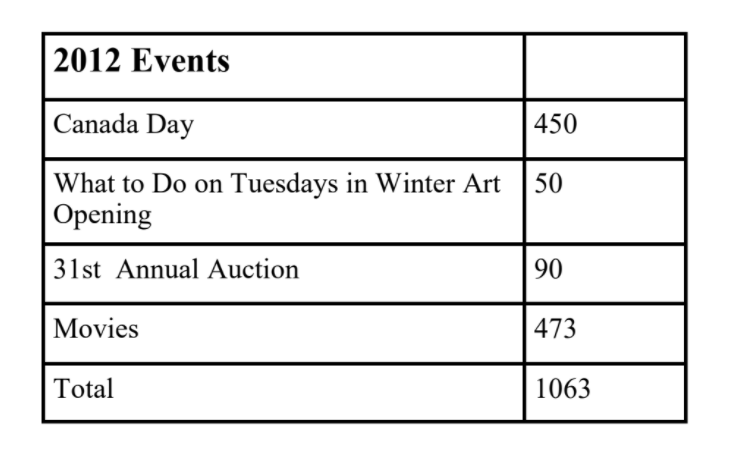
    Canada Day continued to be a significant success for the Museum (DCM Report August 4, 2010).

    Screenshot from the DCM 2011 annual report
  • 2011:

    Collections

    After finishing the three year collections project in 2010, the Museum began a three year project to assess and address inefficiencies in the archival collection (DCM ED Report May 30, 2011).

    The Museum acquired Yukon Order of Pioneer photographs.

    Exhibitions

    The Museum launched three new exhibits:

    •  “Discovered in the Collections”: A case on the landing featuring sports related material. 
    • “Children of the Klondike”
    • an exhibition about Minto Park and its historic importance

    The Museum held a retrospective of Jackie Olsen’s painting for the Arts Festival’s Artswalk (DCM Annual Report 2011-12).

    Governance

    The Museum passed a new Corporate Records Management Policy, a Facilities Use Policy, and a Gift Shop and Admissions Policy (DCM Annual Report 2011-12).

    Partnerships

    The Museum partnered with the Dawson City Music Festival and the Klondike Institute of Art and Culture to access support from the Cultural Investment fund for website upgrades (DCM Report Jan 24 2011).

    Programming (Other)

    Screenshot from DCM Annual Report 2011-12

    With funding from Yukon Energy, the Museum began offering the education kit “Simple Machines” to the local school with plans for more boxes (DCM Report Jan 24, 2011). However, school programs were suspended due to the departure of the program manager (DCM Annual Report 2011-12). .

    The Museum began to offer tours of the storage facilities (DCM Review of Dawson City Museum 2007-2012).

    A summer student – future museum director – prepared a guide for the train shelter to be used by future interpreters (DCM End of Summer Report).

    Staffing

    The Museum eliminated a short lived programmer position due to financial challenges (DCM ED Report January 17, 2011; DCM Annual Report 2011-12). However, the Museum continued to have a seasonal gift show and admissions Manager, Archival Technician, Collections Technician, and summer student workforce of six (DCM Annual Report 2011-12).

  • 2012:

    Building

    A sprinkler burst, causing damage to the collection.

    Collections

    The Museum received a donation of 446 editions of the Klondike Sun in physical and digital format (DCM Annual Report 2013).

    Exhibitions

    The Museum had a temporary exhibition titled – What to do on Tuesdays in Winter? – which featured quilts as part of the local Arts Festival (DCM Annual Report 2013).

    Governing

    The Museum transitioned from being an administrative governing board, which did hands-on work, to a policy governing board (DCM Annual Report 2013).

    Library

    Due to the donation of proceeds from the sale of In the Footsteps of my Father, the Museum began to professionalize the appearance of the Klondike History Library (DCM Annual Report 2011-2012).

    Programming (Other)

    Screenshot from the DCM Annual Report 2013

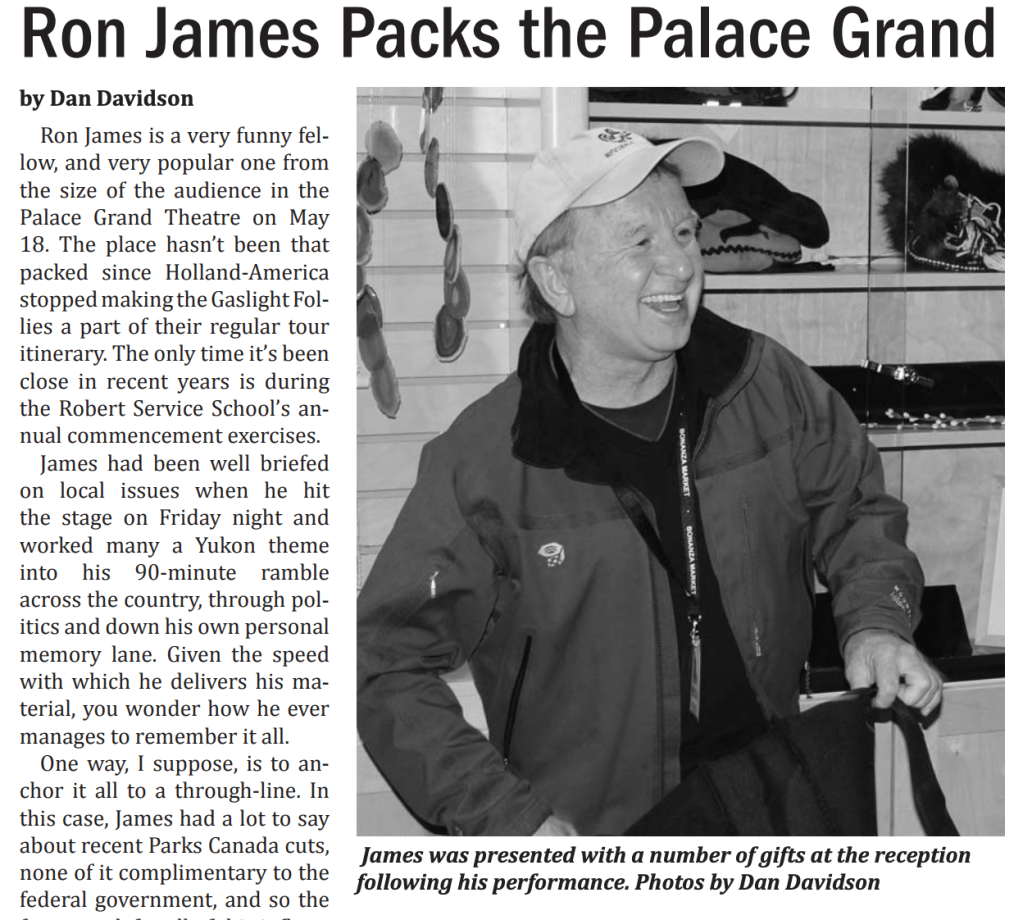
    The Museum organized a comedy show with Ron James at the Palace Grand.

    Screenshot from Davidson, Dan. 2012, May 30. “Ron James Packs the Palace Grand.” Klondike Sun. P22.

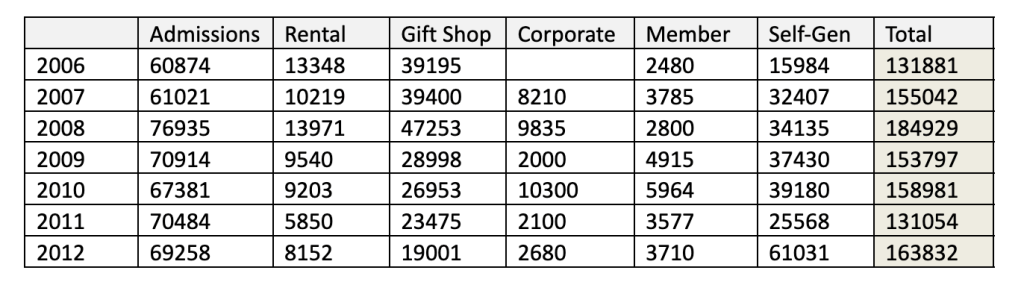
    Self generated / Earned revenue

    Screenshot from DCM Notes for meeting with Minister
  • 2013:

    Collection

    The Museum used donations to make more photographs available on their website (DCM Annual Report 2013). Check out their awesome photo collection here!

    Significant donations accepted into the collection came from families of deceased Dawsonites, such as images from “Dinty” Dines:

    Colour view of gold being prepared for shipment. The location of the Mining Recorders Office at the time was located in the Old Post Office on Third Avenue and King Street.
The man is tentatively identified as John Dines [source: S. Burkhard].

Caption: Mining Recorder Shipping Gold 1957.
    Preparing Gold for Shipment, December 1957 (Harold Dines; 2013.1.9.15)

    The Museum hired a conservator to restore the piano damaged in the 2012 pipe burst.

    Exhibition

    The Museum hosted Riley Brenan for the Riverside Arts Festival (DCM Annual Report 2014).

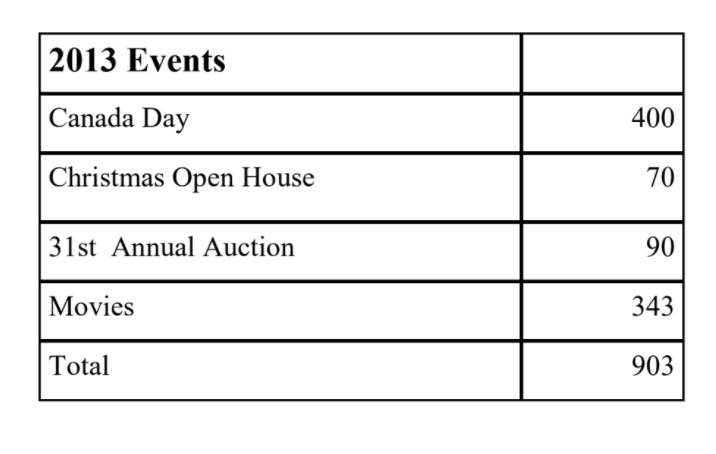
    Programming (other)

    Screenshot from DCM Annual Report 2014
  • 2014:

    Staff

    The Museum hired a full time curator and an archivist/librarian in addition to the executive director.

  • 2015:

    Building

    There was a small flood in the Museum, but fortunately nothing was damaged (DCM ED Report June 16, 2015).

    Governance

    After a hiatus of almost two years, the collections committee began to meet and accept donations (DCM 2016 Annual Report).

    Staff

    The Museum began hiring fewer student summer staff (DCM 2016 Annual Report).

  • 2016:

    Building

    The Museum continued to experience problems with its sprinkler system, resulting in damage to a Gwichin language bible and the board room (DCM ED Report February 16, 2016).

    Collection

    The Museum had a dermestid beetle infestation, but were able to clean the infested artifacts with help from the territorial conservator before their summer opening (DCM 2016 Annual Report).

    The Museum continued to receive artifacts through donation, including Diamond Jubilee Dolls (DCM 2017 Annual Report).

    Exhibitions

    The Museum began working with Origin Studios on the Exhibit Renewal Project with support from the Community Development Fund (DCM 2016 Annual Report).

    The Museum hosted three temporary exhibits during the summer. They were on (DCM 2017 Annual Report):

    • Jewish history of the Klondike Gold Rush
    • Yukon’s role in the First World War
    • artwork by Priska Wettstein

    Programming

    The Museum held a St. Valentine’s Day dance fundraiser, which cost the institution money (DCM March 1 Minutes).

    The Museum stopped its movie program due to low attendance (DCM 2016 Annual Report).

    The Museum participated in Chris Clarke and Bo Yeung’s walk for Truth and Reconciliation, providing research resources (DCM 2017 Annual Report).

    The Museum participated in the Jack London Festival with movie nights and as judges for the gala dinner’s costume contest (DCM 2017 Annual Report).

    Staff

    The Museum laid off the Archivist/ Librarian, leaving the museum with only two core staff members (DCM 2017 Annual Report).

  • 2017:

    Building

    There were minor sprinkler renovations, but the system was not replaced (DCM 2017 Annual Report).

    Collection

    The Museum continued to receive donations, accepting ten acquisitions and receiving 15 new donation lots (DCM 2018 Annual Report).

    The Museum loaned Tr’ondëk Hwëch’in artifacts for a display in the Tr’ondëk Hwëch’in government building (DCM 2018 Annual Report).

    Exhibitions

    The Museum used a Special Projects and Capital Assistance grant to create a traveling exhibition on the sinking of the S. S. Princess Sophia (DCM 2018 Annual Report).

    Governance

    The Museum commissioned a feasibility study for their renewal project (DCM 2018 Annual Report).

    Programming (Other)

    The Museum participated in the Walk for Truth and Reconciliation with research and speaking at two spots (DCM 2018 Annual Report).

    The Executive Director provided a talk on the Museum’s hot soda machine for the Tr’ondëk Hwëch’in conference Myth and Medium (DCM 2018 Annual Report).

    The Museum launched a social media initiative – the History of the Tr’ondëk-Klondike in 100 objects (DCM 2018 Annual Report).

    Staff

    The Museum experienced significant difficulties hiring summer staff due to fewer applicants and applicants turning down interviews (DCM ED Report May 16, 2017). However, they hired four 35 hour/week student positions at the museum using Young Canada Works and Canada Summer Jobs (DCM 2018 Annual Report).

  • 2018:

    Collections

    The Curator conducted an inventory of the Museum’s artifacts (DCM 2019 Annual Report).

    Staff

    With recommendations from teachers, the Museum was able to fill summer positions primarily with local students (DCM 2019 Annual Report).

    The Museum used funding from the Yukon Heritage Training Fund for both full time employees to attend courses outside of the territory (Source)

  • 2019:

    Building

    Leaks continued to be a problem for the Museum (DCM 2020 Annual Report)

    Collections

    The Museum reconciled donor records with catalogued information (DCM 2020 Annual Report).

    The Collections Committee reviewed 35 donation lots, including material from the Gold Rush Festival (DCM 2020 Annual Report).

    Exhibitions

    The Museum began working with Kubik-Maltbie on the new exhibitions.

    Staff

    The Museum hired two 35 hour / week student positions using the federal Youth Employment Strategy Programs (DCM 2020 Annual Report).

Government Policy

First Nation

Federal

  • 2012:

    Parks Canada

    Cuts to Parks Canada resulted in the loss of six full time jobs at Klondike Historic Sites and reduced hours for an additional five positions (Davidson 2012).

  • 2015:

    Parks Canada

    Parks Canada provided the Museum with space for staff housing (DCM ED report September 15, 2015).

  • 2017:

    Parks Canada

    Parks Canada submitted the Tr’ondëk-Klondike World Heritage Site Advisory Committee’s nomination to the World Heritage Center (source).

  • 2019:

    Cultural Spaces Fund

    The Government of Canada contributed $557,000 to the Dawson City Museum’s new exhibits.

Canada – Yukon

  • 2012:

    Parks Canada Cuts

    Territorial Ministers were concerned about the effects cuts to Parks Canada would have on the territory. The Minister of Tourism and Culture stated:

    The Yukon government is actively taking steps, as I mentioned, to identify potential solutions to address the impacts of these changes within Parks Canada and on Yukon. I’ve written to the Hon. Peter Kent about this issue and department officials have been meeting with local Parks Canada representatives to also identify possible mitigations to these cuts.

    YLA 33.1.64
  • 2013:

    Canadian Conservation Institution (CCI) and Yukon Government

    At Yukon Government’s request, a CCI representative visited the Dawson City Museum and conducted a site assessment (DCM ED Report October 15, 2013).

  • 2017:

    The Issue of a lease

    In order to apply for federal funding for the Dawson City Museum’s renewal project, the Museum needed a 10 year lease from the territory for the Old Territorial Administration building. The lease was not provided (DCM 2018 Annual Report).

  • 2019:

    The Issue of a lease

    The lack of a lease with Yukon government continued to delay the Museum’s application for funding. They finally received a lease in May 2019, allowing them to apply for federal funding (DCM 2019 Annual Report; DCM 2020 Annual Report).

Territorial

  • 2011:

    Explicit Museum Policy

    The territorial Museums Unit held the first roundtable (Cambio 2013).

    The Museums Advisory Committee (MAC) asked the territorial Museums Unit to review standards in other jurisdictions (Cambio 2013).

  • 2013:

    Explicit Museum Policy

    The roundtable participants formed a working group on standards (Cambio 2013).

    The Museums Unit met with clients to review special projects funding, clarifying the criteria and evaluation process (Cottongrass Consulting Group, Inc 2014).

  • 2014:

    Explicit Museum Policy

    Funding Allocation for Yukon Museums and First Nation Cultural/Heritage Centres Options Paper

  • 2015:

    Explicit Museum Policy

    Yukon government considered and implemented changes to the museum funding program. The government (Cambio 2015):

    • considered a new hybrid funding model that would tie some funding to standards.
    • committed to a two staged increase to operational funding of 10% a year for two years.
    • proposed a 10% increase in the third year dependent on standards adherence and taken from the Special Projects Capital Assistance Program funding. .

    Due to a lack of demand for special project money, the Museums Unit had a surplus and provided each of the 19 museums and cultural centers with over three thousand dollars to spend (DCM ED Report June 16, 2015).

    Historically, the MacBride Museum and Dawson City Museum were in a highest tier for operational funding. In 2015, the Territory made a separate higher tier for the MacBride Museum (DCM 2016 Annual Report).

  • 2016:

    Explicit Museum Policy

    Due to concerns from First Nations Cultural Centre, the hybrid model for funding was reassessed during the 2016 Roundtable. As a result, the third year funding increase was no longer tied to meeting standards (Cambio 2016).

    The Museums Unit hired a contractor to review the collections management database in consultation with museums and cultural centers (Cambio 2016).

    Operational funding increased.

    The territorial conservator visited the Dawson City Museum to help manage a beetle infestation (DCM 2017 Annual Report).

  • 2017:

    Explicit Museum Policy

    The territorial conservator visited to clean artifacts that had been moved for the Dawson City Museum’s sprinkler renovations (DCM 2017 Annual Report).

    At the 2017 Roundtable, Museums were asked whether they supported the Museums Unit exploring the CollectiveAccess System for collections management. According to the roundtable report, clients were supportive (Glynn-Morris 2017).

    Participants at the Roundtable also voted unanimously that they would like to develop a new museum strategy (Glynn-Morris 2017).

  • 2019:

    Explicit Museum Policy

    The Yukon Government provided $500,000 to help the Dawson City Museum Pay for new exhibits. Describing the support, the Minister of Tourism and Culture stated:

    On the Dawson City Museum exhibit renewal, we have $250,000 for each of the next two years — so a total of $500,000 has been allocated to this. This is multi-year — again, it will take some time, but it is about the exhibit redevelopment at the Dawson City Museum. They are going to be redoing all of their exhibits, and this will align with their anniversary. Highways and Public Works is doing extensive work as well with the Dawson City Museum to address some challenges. Again, they will be doing the permanent exhibits in the museum which require updating or replacing. Archival storage has exceeded its capacity and its offices are very inconveniently located on the second floor. To address the challenges, the museum is planning a renewal of the offices, archival storage, the exhibits, and the gallery spaces

    YLA 34.2.142

    Within Yukon Government, the Museums and Heritage Unit merged, resulting in challenges as staff had limited time to do everything (Hemmera 2019).

    Old Territorial Administration Building

    Yukon Government conducted a building assessment, funding serious defects with the building (DCM 2020 Annual Report).

Local

  • 2013:

    During regional economic planning, the World Heritage Project (a proposal to designate the Klondike Region as a UNESCO world heritage site) was identified as a key priority (source).

Community Action

  • 2013:

    Local Community

    The Tr’ondëk-Klondike World Heritage Site Advisory Committee formed with participation from the Dawson City Museum (DCM ED Report April 16, 2013).

  • 2018:

    Local Community

    The Tr’ondëk-Klondike World Heritage Site Advisory Committee decided to withdraw and resubmit its nomination (source).

Questions

Is there anything missing? Let me know!

References

Cambio. 2013, October. Yukon Museums & Cultural Centers: Annual Roundtable Workshop.

Cambio. 2015, October. Yukon Museums & Cultural Centres Roundtable.

Cambio. 2016, November. Yukon Museums & Cultural Centres Roundtable.

Catherine C. Cole & Associates. 2014. Funding Allocation for Yukon Museums and First Nation Cultural/Heritage Centres Options Paper. Cultural Services, Department of Tourism and Culture, Yukon Government.

Davidson, Dan. 2012, May 30. “Council Reacts to the Cuts at Parks. The Klondike Sun. P3. http://klondikesun.com/wp-content/uploads/2012/07/Sun12-5-30online.pdf

DCM – internal documents from the Dawson City Museum

Glynn-Morris, John. 2017, October. Museums and Cultural Centres: Dawson Roundtable.

Hemmera. 2019, November. Museums and Cultural Centres 2019 Roundtable Report.

Case Study: Dawson City Museum Timeline, 2010s

As part of the Dawson City Museum Project, I am creating timelines of the Museum’s development in relation to government policy and community action (1950s, 1960s, 1970s, 1980s, 1990s, 2000s, 2010s).

Museum Operations

  • 2010:

    Collection

    The Museum deaccessioned most of its paleontology collection, giving the artifacts to Yukon Government (DCM Report June 28, 2010).

    Acquisitions were minimal because of an ongoing collections project. However, the Museum accessed a series of photographs, which were significant because they showed the interior of buildings (DCM Annual Report 2011).

    Exhibitions

    The Museum created French translations of exhibition content (Source).

    The Museum held an exhibition titled “The Beauty that Surrounds us” featuring the work of Palma Berger as part of the Riverside Art Festival’s Gallery Hop (DCM Annual Report 2011).

    Programming (other)

    Canada Day continued to be a significant success for the Museum (DCM Report August 4, 2010).

    Screenshot from the DCM 2011 annual report
  • 2011:

    Collections

    After finishing the three year collections project in 2010, the Museum began a three year project to assess and address inefficiencies in the archival collection (DCM ED Report May 30, 2011).

    The Museum acquired Yukon Order of Pioneer photographs.

    Exhibitions

    The Museum launched three new exhibits:

    •  “Discovered in the Collections”: A case on the landing featuring sports related material. 
    • “Children of the Klondike”
    • an exhibition about Minto Park and its historic importance

    The Museum held a retrospective of Jackie Olsen’s painting for the Arts Festival’s Artswalk (DCM Annual Report 2011-12).

    Governance

    The Museum passed a new Corporate Records Management Policy, a Facilities Use Policy, and a Gift Shop and Admissions Policy (DCM Annual Report 2011-12).

    Partnerships

    The Museum partnered with the Dawson City Music Festival and the Klondike Institute of Art and Culture to access support from the Cultural Investment fund for website upgrades (DCM Report Jan 24 2011).

    Programming (Other)

    Screenshot from DCM Annual Report 2011-12

    With funding from Yukon Energy, the Museum began offering the education kit “Simple Machines” to the local school with plans for more boxes (DCM Report Jan 24, 2011). However, school programs were suspended due to the departure of the program manager (DCM Annual Report 2011-12). .

    The Museum began to offer tours of the storage facilities (DCM Review of Dawson City Museum 2007-2012).

    A summer student – future museum director – prepared a guide for the train shelter to be used by future interpreters (DCM End of Summer Report).

    Staffing

    The Museum eliminated a short lived programmer position due to financial challenges (DCM ED Report January 17, 2011; DCM Annual Report 2011-12). However, the Museum continued to have a seasonal gift show and admissions Manager, Archival Technician, Collections Technician, and summer student workforce of six (DCM Annual Report 2011-12).

  • 2012:

    Building

    A sprinkler burst, causing damage to the collection.

    Collections

    The Museum received a donation of 446 editions of the Klondike Sun in physical and digital format (DCM Annual Report 2013).

    Exhibitions

    The Museum had a temporary exhibition titled – What to do on Tuesdays in Winter? – which featured quilts as part of the local Arts Festival (DCM Annual Report 2013).

    Governing

    The Museum transitioned from being an administrative governing board, which did hands-on work, to a policy governing board (DCM Annual Report 2013).

    Library

    Due to the donation of proceeds from the sale of In the Footsteps of my Father, the Museum began to professionalize the appearance of the Klondike History Library (DCM Annual Report 2011-2012).

    Programming (Other)

    Screenshot from the DCM Annual Report 2013

    The Museum organized a comedy show with Ron James at the Palace Grand.

    Screenshot from Davidson, Dan. 2012, May 30. “Ron James Packs the Palace Grand.” Klondike Sun. P22.

    Self generated / Earned revenue

    Screenshot from DCM Notes for meeting with Minister
  • 2013:

    Collection

    The Museum used donations to make more photographs available on their website (DCM Annual Report 2013). Check out their awesome photo collection here!

    Significant donations accepted into the collection came from families of deceased Dawsonites, such as images from “Dinty” Dines:

    Colour view of gold being prepared for shipment. The location of the Mining Recorders Office at the time was located in the Old Post Office on Third Avenue and King Street.
The man is tentatively identified as John Dines [source: S. Burkhard].

Caption: Mining Recorder Shipping Gold 1957.
    Preparing Gold for Shipment, December 1957 (Harold Dines; 2013.1.9.15)

    The Museum hired a conservator to restore the piano damaged in the 2012 pipe burst.

    Exhibition

    The Museum hosted Riley Brenan for the Riverside Arts Festival (DCM Annual Report 2014).

    Programming (other)

    Screenshot from DCM Annual Report 2014
  • 2014:

    Staff

    The Museum hired a full time curator and an archivist/librarian in addition to the executive director.

  • 2015:

    Building

    There was a small flood in the Museum, but fortunately nothing was damaged (DCM ED Report June 16, 2015).

    Governance

    After a hiatus of almost two years, the collections committee began to meet and accept donations (DCM 2016 Annual Report).

    Staff

    The Museum began hiring fewer student summer staff (DCM 2016 Annual Report).

  • 2016:

    Building

    The Museum continued to experience problems with its sprinkler system, resulting in damage to a Gwichin language bible and the board room (DCM ED Report February 16, 2016).

    Collection

    The Museum had a dermestid beetle infestation, but were able to clean the infested artifacts with help from the territorial conservator before their summer opening (DCM 2016 Annual Report).

    The Museum continued to receive artifacts through donation, including Diamond Jubilee Dolls (DCM 2017 Annual Report).

    Exhibitions

    The Museum began working with Origin Studios on the Exhibit Renewal Project with support from the Community Development Fund (DCM 2016 Annual Report).

    The Museum hosted three temporary exhibits during the summer. They were on (DCM 2017 Annual Report):

    • Jewish history of the Klondike Gold Rush
    • Yukon’s role in the First World War
    • artwork by Priska Wettstein

    Programming

    The Museum held a St. Valentine’s Day dance fundraiser, which cost the institution money (DCM March 1 Minutes).

    The Museum stopped its movie program due to low attendance (DCM 2016 Annual Report).

    The Museum participated in Chris Clarke and Bo Yeung’s walk for Truth and Reconciliation, providing research resources (DCM 2017 Annual Report).

    The Museum participated in the Jack London Festival with movie nights and as judges for the gala dinner’s costume contest (DCM 2017 Annual Report).

    Staff

    The Museum laid off the Archivist/ Librarian, leaving the museum with only two core staff members (DCM 2017 Annual Report).

  • 2017:

    Building

    There were minor sprinkler renovations, but the system was not replaced (DCM 2017 Annual Report).

    Collection

    The Museum continued to receive donations, accepting ten acquisitions and receiving 15 new donation lots (DCM 2018 Annual Report).

    The Museum loaned Tr’ondëk Hwëch’in artifacts for a display in the Tr’ondëk Hwëch’in government building (DCM 2018 Annual Report).

    Exhibitions

    The Museum used a Special Projects and Capital Assistance grant to create a traveling exhibition on the sinking of the S. S. Princess Sophia (DCM 2018 Annual Report).

    Governance

    The Museum commissioned a feasibility study for their renewal project (DCM 2018 Annual Report).

    Programming (Other)

    The Museum participated in the Walk for Truth and Reconciliation with research and speaking at two spots (DCM 2018 Annual Report).

    The Executive Director provided a talk on the Museum’s hot soda machine for the Tr’ondëk Hwëch’in conference Myth and Medium (DCM 2018 Annual Report).

    The Museum launched a social media initiative – the History of the Tr’ondëk-Klondike in 100 objects (DCM 2018 Annual Report).

    Staff

    The Museum experienced significant difficulties hiring summer staff due to fewer applicants and applicants turning down interviews (DCM ED Report May 16, 2017). However, they hired four 35 hour/week student positions at the museum using Young Canada Works and Canada Summer Jobs (DCM 2018 Annual Report).

  • 2018:

    Collections

    The Curator conducted an inventory of the Museum’s artifacts (DCM 2019 Annual Report).

    Staff

    With recommendations from students, the Museum was able to fill summer positions primarily with local students (DCM 2019 Annual Report).

    The Museum used funding from the Yukon Heritage Training Fund for both full time employees to attend courses outside of the territory (Source)

  • 2019:

    Building

    Leaks continued to be a problem for the Museum (DCM 2020 Annual Report)

    Collections

    The Museum reconciled donor records with catalogued information (DCM 2020 Annual Report).

    The Collections Committee reviewed 35 donation lots, including material from the Gold Rush Festival (DCM 2020 Annual Report).

    Exhibitions

    The Museum began working with Kubik-Maltbie on the new exhibitions.

    Staff

    The Museum hired two 35 hour / week student positions using the federal Youth Employment Strategy Programs (DCM 2020 Annual Report).

Government Policy

First Nation

Federal

  • 2012:

    Parks Canada

    Cuts to Parks Canada resulted in the loss of six full time jobs at Klondike Historic Sites and reduced hours for an additional five positions (Davidson 2012).

  • 2015:

    Parks Canada

    Parks Canada provided the Museum with space for staff housing (DCM ED report September 15, 2015).

  • 2017:

    Parks Canada

    Parks Canada submitted the Tr’ondëk-Klondike World Heritage Site Advisory Committee’s nomination to the World Heritage Center (source).

  • 2019:

    Cultural Spaces Fund

    The Government of Canada contributed $557,000 to the Dawson City Museum’s new exhibits.

Canada – Yukon

  • 2012:

    Parks Canada Cuts

    Territorial Ministers were concerned about the effects cuts to Parks Canada would have on the territory. The Minister of Tourism and Culture stated:

    The Yukon government is actively taking steps, as I mentioned, to identify potential solutions to address the impacts of these changes within Parks Canada and on Yukon. I’ve written to the Hon. Peter Kent about this issue and department officials have been meeting with local Parks Canada representatives to also identify possible mitigations to these cuts.

    YLA 33.1.64
  • 2013:

    Canadian Conservation Institution (CCI) and Yukon Government

    At Yukon Government’s request, a CCI representative visited the Dawson City Museum and conducted a site assessment (DCM ED Report October 15, 2013).

  • 2017:

    The Issue of a lease

    In order to apply for federal funding for the Dawson City Museum’s renewal project, the Museum needed a 10 year lease from the territory for the Old Territorial Administration building. The lease was not provided (DCM 2018 Annual Report).

  • 2019:

    The Issue of a lease

    The lack of a lease with Yukon government continued to delay the Museum’s application for funding. They finally received a lease in May 2019, allowing them to apply for federal funding (DCM 2019 Annual Report; DCM 2020 Annual Report).

Territorial

  • 2011:

    Explicit Museum Policy

    The territorial Museums Unit held the first roundtable (Cambio 2013).

    The Museums Advisory Committee (MAC) asked the territorial Museums Unit to review standards in other jurisdictions (Cambio 2013).

  • 2013:

    Explicit Museum Policy

    The roundtable participants formed a working group on standards (Cambio 2013).

    The Museums Unit met with clients to review special projects funding, clarifying the criteria and evaluation process (Cottongrass Consulting Group, Inc 2014).

  • 2014:

    Explicit Museum Policy

    Funding Allocation for Yukon Museums and First Nation Cultural/Heritage Centres Options Paper

  • 2015:

    Explicit Museum Policy

    Yukon government considered and implemented changes to the museum funding program. The government (Cambio 2015):

    • considered a new hybrid funding model that would tie some funding to standards.
    • committed to a two staged increase to operational funding of 10% a year for two years.
    • proposed a 10% increase in the third year dependent on standards adherence and taken from the Special Projects Capital Assistance Program funding. .

    Due to a lack of demand for special project money, the Museums Unit had a surplus and provided each of the 19 museums and cultural centers with over three thousand dollars to spend (DCM ED Report June 16, 2015).

    Historically, the MacBride Museum and Dawson City Museum were in a highest tier for operational funding. In 2015, the Territory made a separate higher tier for the MacBride Museum (DCM 2016 Annual Report).

  • 2016:

    Explicit Museum Policy

    Due to concerns from First Nations Cultural Centre, the hybrid model for funding was reassessed during the 2016 Roundtable. As a result, the third year funding increase was no longer tied to meeting standards (Cambio 2016).

    The Museums Unit hired a contractor to review the collections management database in consultation with museums and cultural centers (Cambio 2016).

    Operational funding increased.

    The territorial conservator visited the Dawson City Museum to help manage a beetle infestation (DCM 2017 Annual Report).

  • 2017:

    Explicit Museum Policy

    The territorial conservator visited to clean artifacts that had been moved for the Dawson City Museum’s sprinkler renovations (DCM 2017 Annual Report).

    At the 2017 Roundtable, Museums were asked whether they supported the Museums Unit exploring the CollectiveAccess System for collections management. According to the roundtable report, clients were supportive (Glynn-Morris 2017).

    Participants at the Roundtable also voted unanimously that they would like to develop a new museum strategy (Glynn-Morris 2017).

  • 2019:

    Explicit Museum Policy

    The Yukon Government provided $500,000 to help the Dawson City Museum Pay for new exhibits. Describing the support, the Minister of Tourism and Culture stated:

    On the Dawson City Museum exhibit renewal, we have $250,000 for each of the next two years — so a total of $500,000 has been allocated to this. This is multi-year — again, it will take some time, but it is about the exhibit redevelopment at the Dawson City Museum. They are going to be redoing all of their exhibits, and this will align with their anniversary. Highways and Public Works is doing extensive work as well with the Dawson City Museum to address some challenges. Again, they will be doing the permanent exhibits in the museum which require updating or replacing. Archival storage has exceeded its capacity and its offices are very inconveniently located on the second floor. To address the challenges, the museum is planning a renewal of the offices, archival storage, the exhibits, and the gallery spaces

    YLA 34.2.142

    Within Yukon Government, the Museums and Heritage Unit merged, resulting in challenges as staff had limited time to do everything (Hemmera 2019).

    Old Territorial Administration Building

    Yukon Government conducted a building assessment, funding serious defects with the building (DCM 2020 Annual Report).

Local

  • 2013:

    During regional economic planning, the World Heritage Project (a proposal to designate the Klondike Region as a UNESCO world heritage site) was identified as a key priority (source).

Community Action

  • 2013:

    Local Community

    The Tr’ondëk-Klondike World Heritage Site Advisory Committee formed with participation from the Dawson City Museum (DCM ED Report April 16, 2013).

  • 2018:

    Local Community

    The Tr’ondëk-Klondike World Heritage Site Advisory Committee decided to withdraw and resubmit its nomination (source).

Questions

Is there anything missing? Let me know!

References

Cambio. 2013, October. Yukon Museums & Cultural Centers: Annual Roundtable Workshop.

Cambio. 2015, October. Yukon Museums & Cultural Centres Roundtable.

Cambio. 2016, November. Yukon Museums & Cultural Centres Roundtable.

Catherine C. Cole & Associates. 2014. Funding Allocation for Yukon Museums and First Nation Cultural/Heritage Centres Options Paper. Cultural Services, Department of Tourism and Culture, Yukon Government.

Davidson, Dan. 2012, May 30. “Council Reacts to the Cuts at Parks. The Klondike Sun. P3. http://klondikesun.com/wp-content/uploads/2012/07/Sun12-5-30online.pdf

DCM – internal documents from the Dawson City Museum

Glynn-Morris, John. 2017, October. Museums and Cultural Centres: Dawson Roundtable.

Hemmera. 2019, November. Museums and Cultural Centres 2019 Roundtable Report.

Interview Analysis: How do I Consider Space?

As part of the Dawson City Museum Project, I conducted fifteen interviews with people associated with the institution historically and today. Most of the transcripts have been approved. So, my Research Assistant and I are analyzing them now. The Interview Analysis series considers this analysis and the insights people have provided.

Within this post, I consider descriptions of the Old Territorial Administration Building (OTAB). The building and its relationship to the Dawson City Museum (DCM) is a major theme within both the interview and archival data. As such, I am writing a paper on the building, examining the challenges and benefits it has provided the Museum. However, I am a little stuck. I do not know how to consider the descriptions below.

Examples

The Old Territorial Administration Building

Those interviewed described the Old Territorial Administration Building, which has housed the Dawson City Museum since 1962, as an actor of incredible significance. Here are some examples:

Ultimately, the Museum Society managed to take up residence in the Old Territorial Administration Building.

A 1901 vintage building on Fifth Avenue prominently cited. When it was finished in 1901, the Old Territory Administration Building was the largest building in the north. It’s 200 feet long. It’s 2 and 1/2 stories high. It’s a beautiful old wooden building. It was built to house the government of the Yukon of the late nineteenth century.

We couldn’t have asked for a grander home in resplendent white neoclassical style, gently set back on dusty 5th avenue in the park-like setting. It all looks very much like a museum.

Interview

I think it’s quite a grand building, so it’s a lovely space to be in. It elevates the quality of our exhibits from them being in that space, but also, I think it makes people expect great things…

It definitely was a pleasure to work in that space and I think it improves the Museum for it. If we were just in any old building, we’d still be great, but it wouldn’t be as good.

Interview

The Old Territorial Administration Building and the Museum’s Development

The Old Territorial Administration Building (OTAB( has played a significant role in the Dawson City Museum’s development. For example, the OTAB is a government owned building and the Museum’s occupancy reflects a significant form of support without which the Museum may have closed after a fire in 1960.

The space also tangibly influences the exhibitions, which are designed with location in mind. In particular, the new exhibition cases work with the architecture. The architecture also shapes how visitors move through the building and therefore how the exhibition themes are laid out.

While there are a number concrete examples of the building’s influence, the quotes above suggest a more intangible influence – that is, the building looks like a grand museum, which effects perception.

People use words like “resplendent” to describe the space. They derive pleasure from working there and visiting. I experienced this while doing archival work in the Museum. Approaching the building in darkness was awe inducing. Sitting in the old council chambers reading letters from the 1950s felt inspiring.

According to at least one person interviewed, the space also elevates the exhibitions. People begin to both expect and see greatness. As a researcher with a love for more concrete data, I do not know how to talk about this reality.

Questions

What role does a museum space have on the ways people experience the exhibitions?

Do historic sites confer additional legitimacy to museums?

Have you ever been to the Dawson City Museum and, if so, what did you think about the space? What effect, if any, do you think it had on your experience?

Dawson City’s Community Attic: The Development of the Dawson City Museum from the 1950s to 1972

The Dawson City Museum project asks – How has the Dawson City Museum evolved in relation to government policy and community action? 

We are taking two approaches to answering the question. First, we are considering the data chronologically to discuss the evolution of the Museum over time. Second, we have developed key themes related to policy and community. To solicit feedback, I will post a series of working papers that consider the data in these two ways – that is, chronologically and thematically. These papers will inform the final report for the Dawson City Museum and podcast miniseries.   

Providing the first chronological consideration of the data, this working paper asks – How was the Dawson City Museum established? What are some key moments, influential policies, and community activities that define its early development from 1954 to 1972? 

After summarizing the answers and outlining our research approach, I give a short overview of the Museum’s development from the early 1950s to 1972. I consider significant policies, focusing on federal action – that is, the provision of an operating grant and free or low-cost space. Then, a section on community activity describes collecting practices and work to develop the tourism industry in Dawson City. Finally, the paper concludes with a summary and research implications.  

  1. Summary
    1. How was the Dawson City Museum established?
    2. What are some key moments (1), influential policies (2), and community activities (3) that define its early development from 1954 to 1972?
  2. Research Methods
  3. Overview
  4. Policy 
    1. Space
    2. Operational Support
  5. Community
    1. Tourism
    2. Collection
  6. Conclusion
  7. References

Summary

How was the Dawson City Museum established?

The Museum opened as part of the Klondike Tourist Bureau (now the Klondike Visitors Association) in 1954 to preserve artifacts in Yukon and provide an activity for tourists. The founders formed the Dawson City Museum and Historical Society in 1957, incorporated in 1959, to cash a cheque from government, and thereby became an independent museum. 

What are some key moments (1), influential policies (2), and community activities (3) that define its early development from 1954 to 1972?

  1. A key moment is the Gold Rush Festival in 1962, which motivated the Museum to reopen after it burnt down in 1960. 
  2. Influential policies include the federal grant for museums, the territorial support for tourism organizations, and the provision of low cost or free space to the Dawson City Museum. 
  3. Individuals from the Museum’s communities helped rebuild the collection after the fire. Further, organizations in the local community focused on tourism, most notably the Klondike Visitors Association, were key to the Museum’s establishment. 

Research Methods

The Dawson City Museum (DCM) Project has involved extensive archival research, document analysis, and interviews with fifteen people. However, no one interviewed worked for or with the DCM before 1972. As such, this analysis relies on an interview conducted with founders in 1973 (available here), two publications (Stuart 1990, Warner 1963), and the DCM’s corporate archives. 

Overview

In the early 1950s, members of the Klondike Tourist Bureau (now the Klondike Visitors Association or KVA) began collecting and preserving artifacts in Dawson City. The collection began due, in part, to concern that artifacts were being taken out of the Yukon and Canada. However, the group’s main objective was to promote the tourism industry. So, they began asking for space from government to exhibit their collection for tourists. In 1954, the Museum opened for the first time in the old fire hall, functioning as a community attic that was open to tourists. However, without financial support, there was limited local interest  and no regular hours (Interview).

Eventually, an individual from British Columbia (possibly the museums advisor) told those running the Museum:

You need assistance, you’ve got to have government help. You need the help to work, but you need money as well

Interview

At the time, the federal government had a grant for museums distributed through the territorial government. The federal government wrote a cheque to the “Dawson City Museum and Historical Society,” which forced a member of the KVA to form the Museum society to deposit the cheque. The DCM was thereby founded as an independent entity in 1957 and officially incorporated in 1959. 

Unfortunately, the Museum burnt down in June 1960 and, as a result, most of the collection was lost. However, at the same time in 1960 members of the Dawson community began planning the 1962 Gold Rush Festival. Opening a museum in time for the festival was a key goal. To achieve this goal, the Museum Society did two things. First, they began asking for artifacts from both the local community and a broader community of people with a connection to the Klondike, rebuilding a collection with a focus on the Klondike Gold Rush. Second, they searched for a new space to house the collection. 

After significant effort, the Museum Society successfully rebuilt a collection and found housing just in time for the festival, reopening in the federally owned Old Territorial Administration Building (OTAB). Over the next decade, the DCM continued operating as a volunteer-run community museum, receiving a relatively small grant ($500) and most of its income from admissions. Importantly, they also continued occupying the OTAB for free.

Due to age and a lack of proper upkeep, problems emerged with the new museum space. By 1968, the OTAB failed a fire inspection and was labeled a death trap (for the first but not the last time). Fearing closure, the Society offered to sell the collection to Klondike National Historical Sites in Dawson. However, the board changed, and the failed report was forgotten, leading to renewed interest in maintaining an independent museum (Shaw 1970; Snider 1971 1972). 

The first period, therefore, ends with a museum in a rent-free but poorly maintained space, functioning as an attic for community treasures open for tourists and those interested in the Klondike. 

Policy 

In the Museum’s first 20 years, the federal government played a key role in its development through the provision of space after the 1960 fire and the original operating grant. 

Space

The Dawson City Museum (DCM) open in the Old Territorial Administration Building (OTAB) just in time for the 1962 Gold Rush Festival and has been there ever since. The building itself has played an important role in the DCM’s development and will be the subject of its own paper. When considering the space and DCM’s early evolution, there are two important points to consider.

First, the federal government leased the OTAB to the Museum during the Gold Rush Festival period for $5.00 a month. After the festival, the Museum continued to occupy the space, but stopped paying rent until the 1990s. The free (and later relatively inexpensive) space was and continues to be a significant form of support for the institution. 

Second, while the free or relatively inexpensive space was crucial to reopening the Museum, it also led to significant challenges. In particular, the space failed a fire inspection and was labeled a death trap. As a result, the overwhelmed volunteers almost sold the collection and shut down the institution. Although a new Board decided to keep the Museum open, building maintenance continued to present challenges and, despite extensive renovations, continues to be an issue today. These issues will be discussed throughout the papers which take the chronological approach to answering the research question and in a paper focusing on the building as a key theme. 

To summarize, the federal government rented the Old Territorial Administration Building to the DCM for five dollars a month and then for free. The provision of space was a significant form of support because it allowed the Museum to reopen. However, at the same time, the lack of support to renovate the space threatened the Museum’s existence. 

Operational Support

The federal government provided funding, which led to the Museum’s incorporation and separation from the KVA when they wrote a cheque to the Dawson City Museum and Historical Society. As museum founder Margretta Gaundroue recalled: 

The Klondike Visitor’s Association were instigators of our Museum. They were the sponsors. I just ran [it], so what could we do? I went to the bank and I said, “how can we cash this cheque?” He says, “you can’t, you have to deposit it.” We had no account to deposit it, so I phoned our minister, Allan Haldenby and I said, “I just formed a new society, you’re the president and the secretary-treasurer.” Knowing how I did things, he said “that’s fine with me,” so that was it.

Interview

The federal government continued to provide a $500 grant until 1961-1962, asking the Museum to detail what they planned with the funds every year. While the territorial government did not begin a specific museum grant program until the 1980s, they did continue the support through a grant for tourism organizations, such as museums. 

In other words, the federal operating grant led to the DCM’s incorporation and contributed to the development of territorial support for museums. 

Community

The Dawson City Museum is a product of its local community’s desire to both serve as a tourist destination and protect its local artifacts in Yukon.

Tourism

In 1953, Yukon’s capital moved from Dawson City to Whitehorse. At the same time, large scale mining was declining. Aiming to capitalize on an increased interest in the north, private and public organizations began to organize to develop a tourism industry in Dawson. To that end, what is now called the Klondike Visitors Association or KVA formed in 1952 and began greeting tourists in costumes. Then, the Dawson City Festival Foundation formed to host the 1962 Gold Rush Festival, which also aimed to increase tourism (Stuart 1990). Both organizations had key roles in the Dawson City Museum’s early development.    

First, as established above, the Dawson City Museum, which opened in 1954, was a product of the KVA. Then, after the Museum incorporated, individuals continued to be members of both groups. Lotz reported:

Two organizations in the city cater to tourists – The Klondike Visitors Association, which ran a campground in 1963, has put signs on the old buildings, and runs the Palace Grand shows, and the Dawson City Museum and Historical Society, which focuses its attention on building up and running the museum in the old Administration Building. Some individuals in Dawson are members of both organizations, and the shortage of able individuals in the town due to the small population and the summer rush, means that some of the tourist attractions and activities are run on a part-time basis or by old people and teenagers.

Lotz 1964, 128

In addition to observing people had dual membership in the KVA and DCM, the quote highlights the Museum’s perceived role as a tourism operation despite its separation from the KVA. Moreover, it draws attention to the local community’s commitment to developing tourism in the area through organizations like the Museum despite limited human resources. 

Second, the Dawson City Museum that reopened in the Old Territorial Administration building in 1962 was a product of the Gold Rush Festival. After the Museum burnt down in 1960, the Museum Society was unable to solicit enough support to construct a new building (Warner 1963, 13). Society members worked to find space for almost two years when the pending Festival provided some urgency to their requests. Members of the Festival Foundation had organized traveling exhibitions to be hosted at the Museum. In a plea for space, a Museum Society representative wrote:

It is imperative to assist the Festival that we have accommodations. 

Shaw 1962

Interestingly, as seen with the KVA, the connections between the Festival and Museum are even more evident when considering the people who formed them. For example, the Gold Rush Festival’s general manager became the Society’s president. 

In short, public and private interests were attentive to the tourism industry in Dawson during the 1950s and 1960s, leading to the Klondike Visitors Association and Dawson City Festival Foundation. Both of these groups involved the local community working to provide activities for tourists. The Dawson City Museum was part of both plans.

Collection

After the fire, the Museum rebuilt its collection due to the generosity of its communities, including Dawsonites, visitors and a network of people with an interest in the Klondike Gold Rush. For example, in 1963 a Society member wrote:

The museum was built up piece by piece through the kindness and generosity of visitors to Dawson, who assisted the museum executives in many ways.

Warner 1963, 13

A tiny harmonium was sent in from the creeks. It was broken. Happily, a man just wandered in the door and asked if he could fix it! 

Warner 1963, 14

These objects came to the Museum following a public appeal. For example, an entry in the Vancouver Board of Trade newsletter stated:

Since the people of the Yukon will be entertaining Bureau members next Monday, it’s nice to discover that we have an opportunity to repay their kindness.

All you are asked to do is look around that attic or basement storeroom of yours for relics of the Klondike days. 

Seems that the Dawson’s Museum burned down last summer, and many priceless mementos of the past were lost. With a festival planned for next year, they are appealing to the people of Canada and the U.S.A, for the donations of relics of the Gold Rush era…

Found in: 1.1.4: Correspondence w secretary treasurer March 1958 to October 1960. Box 1. DCM.

In addition to exemplifying the public appeals, the excerpt demonstrates the focus on the Gold Rush era.

In sum, the Dawson City Museum collection was and is built by their communities.  

Conclusion

In 1954 the Dawson City Museum opened as part of the Klondike Visitors Association to preserve artifacts in the Yukon and provide tourists with something to do. It became its own independent organization to access federal funding then moved into a federal building after burning down. The Museum’s communities rebuilt the collection as the Society worked to reopen for the Gold Rush Festival. By 1972, the Museum was firmly established as an independent organization. However, the Society began experiencing the challenges of occupying a historic site they did not own and did not have funding to fix despite the clear fire code violations. 

The early history demonstrates the significance of both federal policy and community action. The Dawson City Museum was established and despite significant challenges, such as a fire that destroyed its collection, remained open due to federal support, community initiatives to promote tourism in Dawson, and a community’s desire for a space to preserve artifacts in the Yukon. 

References

Haldenby, Allan. 1960, December 7. Letter to the Superintendent public works. 1.1.4: Correspondence w secretary treasurer March 1958 to October 1960. Box 1. DCM Archives

Lotz, Jim. 1964. The Dawson Area: A Regional Monograph No. 2. In Yukon Research Project Series, Northern Co-ordination and Research Centre, Department of Northern Affairs and National Resources, Ottawa, Ontario.

MacKenzie, K. 1961, December. Letter to the Dawson Museum & Historical Society. Correspondence Roy minister 1961-2. Box 39. Dawson City Museum Archives.

Shaw, G. 1962. Letter to the Superintendent of Buildings. Correspondence Minister 1961-62, Box 39c. Dawson City Museum Archives.

Shaw, G. 1970, March 11. Letter to National Historic Sites. 1.1.43 correspondence 1970. Box 1. DCM.

Snider, K. C. 1971, January 27. Letter to the NHS Superintendent. 2.2.1: Correspondence. Box 1. Dawson City Museum.

Snider, K.C. 1972, February 21. Letter to the White Valley Historical Society. 2.2.2: Correspondence 1972. Box 1. Dawson City Museum.

Stuart, Richard. 1990. “Recycling Used Boom Towns: Dawson and Tourism. The Northern Review. 1:108-131. 

Warner, Iris. 1963. “A Museum for Dawson City.” North, 10(4): 13-16.