Interview Analysis: I Love Dawson

As part of the Dawson City Museum Project, I conducted fifteen interviews with people associated with the institution historically and today. Most of the transcripts have been approved. So, my Research Assistant and I are analyzing them now. The Interview Analysis series considers this analysis and the insights people have provided.

Within this post, I consider the love people feel for Dawson City and ask – what role has individual affection for the local community played in the Dawson City Museum’s development?

Examples

Interview participants often expressed affection for Dawson City and/or the people who live(d) there. For example, one person noted:

I did fall in love with Dawson.

Interview

Most notably, the current Executive Director, Alex Somerville, expressed love in response to multiple questions. Here are two examples:

I started working at the Dawson City Museum in 2011 as a summer student. I had a really great time. I loved living in Dawson. I loved working for the museum.

Interview

I’ve worked for the Museum now for ten years, I know the museum well, I obviously love it dearly, and I love Dawson.

Interview

Alex also explained that love for Dawson is a theme in historic documents, stating:

In my position working at the Museum, I know that it is a feeling that people have reported at all kinds of different times through the history of the town.

People reported an uncanny attraction to the place in 1898. Laura Burton came to Dawson when it was a very different place in 1907, I think. It was a very different place in 1907 and she reports the same inexplicable attraction.

I wish I knew what it was. I don’t know if anyone does.

Interview

A Love for Dawson and the Museum’s Development

Why found a community museum?

Community museums, by definition, reflect affection for their community. They form to tell community stories, which suggests an underlining belief that these stories are worth telling.

In the Dawson City Museum case, the Museum formed with two explicit objectives – that is, to preserve heritage in Yukon and support the budding tourism industry (Source). The tourism industry was seen as a way to sustain the region’s economy, which was suffering due, in part, to deindustrialization (Stuart 1990). A strong desire to serve the community, therefore, underlined the Museum’s founding.

Who comes to the community?

Community museums can struggle to both hire and retain qualified staff. They have relatively small budgets and demand a lot from their executive directors or curators (see Too Much for One Person).

With a budget of less than $400,000 and in a town of fewer than 2,500 people, the Dawson City Museum has retained the same two full time employees since 2014. They both have a Masters in Museum Studies from the University of Toronto and were complimented for their work ethic across interviews. Despite relatively low pay and high workload, they have stayed in Dawson. The excerpts from Alex’s interview above help explain why – the place itself attracts people who fall in love and stay. As Alex explained:

There’re just all these really excellent examples of people not planning on moving to Dawson for forever, coming for a summer. It’s a cliche, you know, I came to Dawson for a summer [and] here I am thirty-five years later. It’s just something about this place.

interview

Questions

What do you think? Should I consider a love for Dawson City when answering – How has the Dawson City Museum evolved in relation to government policy and community action?

If so, how else does or has affection for the place shaped the Museum?

More broadly, how can and should community be considered when discussing a museum’s evolution?

Timeline: Dawson City Museum, 2000s

Last updated : February 15, 2022

As part of the Dawson City Museum Project, I am creating timelines of the Museum’s development in relation to government policy and community action (1950s, 1960s, 1970s, 1980s, 1990s, 2000s, 2010s).

Museum Operations

After a decade of increased funding and activity related to territorially significant centennials (e.g., the Klondike Gold Rush), the 2000s saw significant changes for the Dawson City Museum (DCM). Signaling the shift, in 2000-2001, the Director / Curator was laid off for 20 weeks and the Administrative Assistant was placed on part time hours. The Museum was also forced to borrow money on two occasions (DCM AGM June 6, 2002).

  • 2000:

    Building

    The Museum nominated the Old Territorial Administration Building to the National Historic Sites and Monuments Board of Canada as a National Historic Site.

    The Museum completed the Lind Storage Facility (See documents available in City of Dawson funding 2000, Box 27a, Dawson City Museum Archives).

    Exhibitions

    The Museum worked to develop a new gallery, but began experiencing delays in obtaining approval from the Yukon Territorial government to conduct renovations on the Old Territorial Administration Building (Thistle 2001, October).

    Governance

    The Museum began a strategic planning exercise (DCM Newsletter vol. 15 no. 4).

    Programming (Other)

    The Lecture Series was re-established (DCM Newsletter vol. 16 no. 1; See documents available in City of Dawson funding 2000, Box 27a, Dawson City Museum Archives).

    Staffing

    The Museum continued to use short term grants for staffing, including (DCM Newsletter vol. 16 no. 1):

    • Funding from Human Resources Development Canada’s Summer Career Placement Programme for five summer interpreters. Importantly, this program was becoming less effective due to reductions to individual applications (see government policy – federal – 2000 – employment policy below).
    • Young Canada Works students through the Canadian Heritage Foundation, the Canadian Library Association, the Canadian Museums Association, and the Canadian Council of Archives.

    In total, the Museum hired 12 contract workers in addition to the staff complement of 2.5 (See documents available in City of Dawson funding 2000, Box 27a, Dawson City Museum Archives).

  • 2001:

    The Museum began to experience significant financial difficulties, requiring the use of a personal line of credit to operate the museum (See documents available in O&M correspondence, 29b, Dawson City Museum Archives)

    Building

    The Old Territorial Administration Building was designated as a historic site.

    Collections

    The Museum experienced an insect infestation, requiring 245 hours of work to dismantle exhibitions then examine, bag, freeze, thaw, clean and reinstall infected artifacts (Thistle 2001, September).

    Exhibitions

    Heritage Canada’s declared that 2001 was a year to celebrate transportation history. So, the Museum mounted a photography exhibit on the history of the Klondike Mines Railway (YHMA 2001, Fall)

    Fundraising / Earned Revenue

    The Museum established an endowment (DCM Newsletter June 2001).

    Governance

    The Museum adopted a five year plan (DCM Newsletter vol. 16 no. 4).

    Programming (Other)

    The Museum continued the lecture series.

    The Museum published A Walking Tour of Dawson City Cemeteries with funding from Yukon Tourism’s “On Yukon Time” program (YHMA 2001, Fall).

    Staffing

    The Museum hired 16 contract workers (See documents in City of Dawson Funding, box 28c, Dawson City Museum Archive).

    Due to financial difficulties, the Director was temporarily laid off (see Too Much for one Person).

  • 2002:

    Advocacy

    The Museum engaged in an advocacy campaign for increased operational funding (See documents available in O&M Correspondence, Box 29b, Dawson City Museum Archives).

    Exhibitions

    The Museum opened the Lind Gallery, which focused on pre-Gold Rush history (DCM Newsletter vol. 18 no. 2).

    The Museum held a temporary exhibition of posters designed by the local grade three students. The photo below is of the student poster chosen for promotional materials (DCM Newsletter vol. 18 no. 2):

    Artist: Katrina Kocsis

    Grants

    The Museum received the following grants (DCM AGM Director’s Report 2003):

    GranterPurposeAmount
    YTG – Heritage BranchOperations & Maintenance$23,500
    YTG – Heritage BranchGift Shop Development$11,000
    YTG – Heritage BranchExhibit planning$30,00
    YTG – Heritage Branchright sizing$12,000
    YTG – Heritage BranchNegative scanning$12,000
    YTG – Heritage BranchKRMy$14,000
    YTG – Heritage BranchWalking tour booklet$6,000
    Federal HRDC$21,520
    Canadian Museum AssociationYoung Canada Works$5,518.80
    Canadian Library AssociationYoung Canada Works$2,488.50
    FederalYCW in Both Official Languages$3,197.70
    Koerner Foundationproduction of Dawson at 40 Below$1,500
    KVA Community Events Casino$8,095.92
    Tr’ondek Hwech’in $5,000
    City of DawsonOperating $10,000

    Library

    Using funding from lotteries, the Museum updated the Klondike History Library Equipment (DCM AGM Director’s Report 203).

    Staffing

    The Museum once again hired 16 contract workers (See documents available in City of Dawson funding, Box 29a, Dawson City Museum Archive), employing 19 people in total (DCM AGM Director’s Report 2003)

  • 2003:

    Building

    The Museum began to experience difficulties with the sprinkler system in the storage facilities (DCM Report to Sept 17 to October 20).

    Collections

    Significant acquisitions included (DCM Newsletter vol. 19 no. 2):

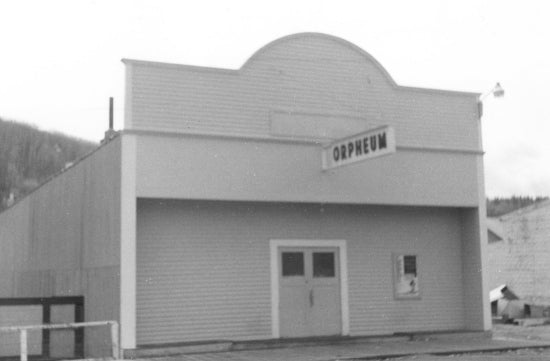
    • an original slide projector from the Orpheum Theatre
    • an album of photographs
    • Royal Canadian Legion Dawson Branch minute book and associated papers
    • a number of Rebekah Lodge ledgers and membership rolls

    The Museum began to experience significant backlogs in registration of the departure of the collection’s manager (DCM Report to Board for June 19 to July 22). The Museum then hired a full time registrar and re-established the collection committee (DCM AGM Director Report 2004).

    Exhibits

    The Museum developed a Banking Exhibition and worked to redesigned visible storage (DCM AGM Director’s Report 2003).

    The Museum redid a temporary exhibition called “Too Thick to Drink, Too thin to Plow exhibit” in the Court Room (DCM Report to Board for May 15 to June 18)

    Grants

    The Museum received the following grants (DCM AGM Director Report 2004):

    GranterPurposeAmount
    YTG – Heritage BranchOperations & Maintenance$80,000
    YTG – Heritage BranchEmergency security$12,000
    YTG – Heritage BranchSecurity upgrades$50,000
    YTG – Heritage BranchExhibit planning$25,000
    YTG – Heritage BranchCemetery brochure$3,000
    YTG – Heritage BranchMedallions$6,622
    FederalHRDC$12,628
    Canadian Museum AssociationYoung Canada Works$11,073.75
    Canadian Library AssociationYoung Canada Works$2,612.93
    FederalYCW in Both Official Languages$3,952.32
    CCA (?)$3,952.32
    Lotteries$6,445
    City of DawsonOperating$10,000

    Staffing

    There were significant cuts to the funded summer student employees (DCM Newsletter vol. 19 no. 1). However, the Museum still employed a total of 16 people in 2003 (DCM AGM Director Report 2004).

    The Museum experimented with a co-directorship, hiring a Director / Administration and a Director / Curator (DCM Newsletter vol. 19 no. 1).

  • 2004:

    Collections

    The Museum worked with the Tr’ondek Hwech’in to create a First Nations photo finding aid of all the collections held at the Museum (DCM DA Report October 14).

    The Museum received 36 new deposits, meeting with 15 donors to conduct oral research on the donations. They catalogued or significantly modified the records for 2,790 artifacts. They still had a backlog of about 600 items, representing 2% of the collection (DCM AGM Director Report 2005).

    Grants

    The Museum received the following grants (DCM AGM Director Report 2005):

    GranterPurposeAmount
    YTG – Heritage BranchOperations & Maintenance$80,000
    YTG – Heritage BranchExhibit plan$15,000
    YTG – Heritage BranchLind Extension$10,000
    YTG – Heritage BranchTrain Conservation$10,500
    YTG – Heritage BranchLibrary Biography files$2,000
    YTG Community Development Fund$17,70
    FederalHRDC$12,964
    Canadian Museum AssociationYoung Canada Works$2,445.14
    FederalYCW in Both Official Languages$3,102.80
    CCA (?)$3,192
    LotteriesOral historic recorder$481.48

    Programming (other)

    The Museum partnered with Tr’ondek Hwech’in and Parks Canada on a school program titled “Secret Life of Artifacts,” which aimed to help students develop a better understanding of the role of heritage organizations (DCM Newsletter vol. 20 no. 1)

    The summer interpreters performed a musical skit – “Songs in the Key of Gold” (DCM AGM Director Report 2005)

    Staffing

    The Museum employed 14 people (DCM Presentation AGM 2005).

  • 2005:

    Collections

    The Museum hired a collections manager for Fall and Winter, holding regular collections committee meetings where donations were reviewed and participants reminisced about people they recognized in images (DCM Executive Director Report AGM).

    The Museum catalogued/accessioned 674 artifacts and significantly modified over 3000 artifact records during the visible storage project (DCM Executive Director Report AGM).

    Exhibitions

    The Museum opened two new photographic exhibitions – Oldest Profession and Dogs. The Dogs exhibition featured a section for people to pin pictures with their dogs.

    The Museum displayed Chris Caldwell’s “Quoth of the Raven” from the Yukon Government’s permanent art collection in their Gift Shop for the Summer (DCM Report for April 22 to May 19 2005).

    Grants

    The Museum received the following grants (Executive Director Report AGM 2006):

    GranterPurposeAmount
    YTG – Heritage BranchOperations & Maintenance$80,000
    YTG – Heritage BranchExhibit planning$15,000
    YTG – Heritage BranchFrench$7,500
    YTG – Heritage BranchTrain Conservation$13,000
    YTG Community Development Fund$56,187
    FederalHRSDC$7,640
    Federal – Canadian HeritageVirtual Museums of Canada$102,720
    Canadian Museum AssociationYoung Canada Works$4,536
    Canadian Library AssociationYoung Canada Works$3,033
    FederalYCW in Both Official Languages$4,629
    Canadian Council of Archives$8,096
    LotteriesOral historic recorder$750
    STEP3,240

    Partnerships

    The Museum continued to emphasize partnership in their work. Joint projects included (DCM Executive Director Report AGM):

    • the Parks Canada / Tr’ondëk Hwech’in joint partner pass
    • Science Institute lecture series
    • work with McBride and the Yukon Arts Centre
    • assistance to the Old Log Church for their travelling exhibit
    • work with the Yukon Queen on a prop display

    Staffing

    The Museum continued to use student employment programs, but had a number of performance issues and had to let a student go (DCM Report for July 2005). They provided employment for 15 people and 5 contractors (Executive Director Report AGM 2006).

  • 2006:

    Exhibitions

    The Museum launched its first virtual exhibition and opened the redesigned visible storage, which involved treating the silver collection (DCM Newsletter vol. 22 no. 1 and 2).

    Partnerships and collaborations

    The Museum engaged in several partnerships / collaborations with other nonprofits, including (DCM Newsletter vol. 22 no. 2):

    • The Klondike Institute of Arts and Culture (KIAC) to present the movie series Miracle Planet during the summer.
    • KIAC and Musicfest on an application from the federal Cultural Investment Fund to redesign their websites.
  • 2007:

    Earned Revenues

    The Museum decided to close the cafe and focus on things like consignments in the gift shop (DCM Final Report Summer 2007).

    Collections

    The majority of acquisitions were archival, such as a postcard featuring the Yukon Machine Gun Detachment (DCM Annual Report 2008).

    Governance

    The Museum held a series of meetings to develop a strategic plan (DCM Dawson City Museum Strategic Planning Final Report).

    The Board began to review policies (DCM Annual Report 2008).

    Programming

    Screenshot from DCM Annual Report 2008

    The Canada Day attendance figure in the chart above reflects work to offer new and more exciting programming in front of the Museum (DCM Executive Director June 19 2008).

    Since the Museum received late notice for student employees, students did not give guided tours and a self guided booklet was developed. The students conceived and wrote the Miner’s Meeting where an audience member was accused of something and the audience voted on their guilt (DCM Final Report Summer 2007).

    The Museum created a Program Co-ordinator position, leading to Classic Movie Night and Oscar Night (DCM Annual Report 2008).

  • 2008:

    Collections

    The Museum began a project to address the backlog of artifacts for cataloguing. As such, over 3,000 new records were entered into the database (DCM Annual Report 2009).

    Significant acquisitions included:

    • The Yukon Hotel Directory
    • Klondike Sun Photographs
    • Gold samples and pokes

    Governance

    The Museum adopted a new constitution and mission statement:

    To be a gathering place where people are inspired to explore the connection between the Klondike and their world.

    DCM Mission Statement Resolution February 21, 2008

    Programming

    The Museum began to offer “A Night at the Museum” for school children with funding from Yukon Energy (DCM Annual Report 2008).

    The Museum piloted a new program – Camp Cheechako – which taught people about what they needed to survive in Yukon at the turn of the century (DCM Annual Report 2009).

  • 2009:

    Building

    The sprinkler system in the Locomotive Shelter failed. In response, volunteers formed an Emergency Response Team and began training for future problems (DCM Annual Report 2010).

    Collections

    The Museum worked to update its collection records (DCM Annual Report 2009-2010).

    Exhibitions

    The DCM had mannequins of local residents made in order to use in the exhibition (Source).

    Source

    Governance

    The Human Resources Policy was updated (DCM Annual Report 2009-2010).

    Programming (other)

    The Museum held A Night in the Museum for students in grades 5 and 6 (source).

    A new brochure was produced with funding from the Klondike Visitors Association (DCM Annual Report 2009-2010).

    The Museum held Invention Camp, which provided children from the Dawson Day Care and Tr’inke Zho Daycare to make devices based on the artifacts in the Museum’s collection (DCM Annual Report 2010).

    The Museum restarted gold pouring demonstration, which had stopped prior to 2007 because the machine broke (DCM Review of Dawson City Museum 2007-2012).

Government Policy

First Nation

  • 2002:

    The Tr’ondek Hwech’in contributed $5,000 to support the work done for the Lind Gallery (DCM Newsletter vol. 18 no. 2).

  • 2003:

    The Dawson City Museum (+ the ROM) lent the Dänojà Zho Cultural Centre artifacts for “Myth and Medium: Explore Athapaskan Artifacts in Their Homeland” (Source).

  • 2004:

    A Tr’ondek Hwech’in Heritage Office invited the Dawson City Museum to participate in the event Myth and Medium 2004 (See documents in Julia Correspondence, Box 39a, Dawson City Museum Archives).

Federal

  • 2000:

    Employment Policy

    There were some reductions in program amounts. Previously, the Dawson City Museum received funding for five students for eleven weeks. However, in 2000, the Museum received funding for five students for only ten weeks (Thistle 2000).

    Explicit Cultural Policy

    Tomorrow Starts Today was announced and led to investment in the arts and cultural sector, such as the cultural spaces fund (source) as well as the Canadian Arts and Heritage Sustainability Program (source).

    Virtual Museum of Canada (VMC)

    The VMC was established.

  • 2002:

    Canadian Conservation Institute (CCI)

    The CCI conducted a report on the Dawson City Museum’s performance, finding “lt is imperative that key staff be hired on full time status … without key, full time staff, the museum’s operational profile will fall to levels which will question its ability to continue to operate as a museum” (p. 22 qtd in DCM Director Curator Report June 19 2002)

  • 2004:

    Parks Canada

    Parks Canada submitted the Tr’ondëk-Klondike for consideration as a UNESCO world heritage site (source).

  • 2006:

    Canadian Heritage Information Network (CHIN) and Virtual Museums Canada

    CHIN launched an online museum learning space (DCM Newsletter vol. 22 no. 1).

    Explicit Museum Policy

    There was an unprecedented 3 hour debate in the house about museum funding and Members of parliament voted to both rescinding cuts to the Museums Assistance Program and establish a museums policy. A CMA communique on the topic sent to Yukon museums is available here and the relevant debate minutes are available here.

  • 2007:

    Explicit Cultural Policy

    The Building Communities Through Arts and Heritage program was created to support local festivals and capital projects with an emphasis on local engagement (Source).

  • 2009:

    Explicit Cultural Policy

    The Canadian Arts and Heritage Sustainability Programs was renewed, becoming the Cultural Investment Fund (Source).

Canada – Yukon

  • 2000:

    Explicit Museum Policy

    The Yukon government began developing two virtual museums with 100% funding from the federal government (Source)

  • 2006:

    Explicit Museum Policy

    The territorial government sponsored a Canadian Conservation Institute workshop on mannequin making (DCM Newsletter vol. 22 no. 2).

  • 2008:

    Explicit Museum Policy

    The territorial Museums Unit help a Canadian Conservation Institute workshop on the care of industrial artifacts in Dawson City (Meeting 2008).

Territorial

There were significant changes to the territorial funding practices in the 2000s. Most notably, some of the project funding shifted to operational funding in 2003-2004, leading to a notable increase in that grant amount.

A screenshot of Page 10 in the Cole Report
  • 2000:

    Explicit Museum Policy

    The Minister for Tourism articulated an intent to develop a Museum Strategy based on consultation (Source).

    Implicit Cultural Policy

    The Community Development Find, which had previously funded the Dawson City Museum’s new storage facility, was threatened as it underwent review (See for example documents in 2000 CDF application, Box 27b, Dawson City Museum Archives).

  • 2001:

    Explicit Cultural Policy

    The Art and Heritage branches merged (Slobodin 2001).

    Explicit Museum Policy

    The territory began consultations on a new museum policy, but did not consult the museum community on the terms of reference for the study (DCM Newsletter June 2001). The Territory hired consultants who released a discussion paper (DCM Newsletter vol. 17 no. 3).

    The Museum Advisor began actively advising museums to be more entrepreneurial:

    I understand now that one of the museum advisors has been to the community of Teslin, talking to the George Johnston Museum Board, insisting that the museum have a gift shop of sorts or something where they could souvenirs, mementoes, that type of thing on a bigger scale.

    YLA 30.2.69

    Implicit Cultural Policy

    The Finance Administration Act led to a new accountability regime for the Community Museum Operations and Maintenance program, causing delays in receiving funding (See documents available in O&M correspondence, 29b, Dawson City Museum Archives)

  • 2002:

    Explicit Museum Policy

    Consultants released a draft Museum Strategy Report – Strategy for Maintaining Yukon’s Museums (see documents available in Strategy for Yukon museums, Box 29a, Dawson City Museum Archives).

    Yukon formed an advisory committee to draft a strategy from the Report (YHMA 2002, Summer).

  • 2003:

    Explicit Museum Policy

    Yukon began 3 year funding arrangements with “those institutions which have shown an ability to develop long term strategies” (Taylor 2003). They also added four new organizations to the funding program and shifted project funding into the operating grant program (AGM Director Report 2004).

    The Museum Advisor became increasingly unavailable to museums. In a report to the board, the Director of the Dawson City Museum wrote:

    We are still waiting to hear about the success of the exhibit grant and the security grant. Just before the long weekend, I called [Museum Advisor] about this and he said we would know by early the following week.  As is becoming common, I didn’t hear anything. So, I followed up with another call and he gave me the same promises, but nothing has been received yet.  I will continue to pester him until we know.

    DCM Report to Board forJuly 23 to August 26

    There was a Museum Roundtable with the Minister of Tourism and representatives from Dawson City Museum, MacBride, Old Log Church, the Transportation Museum, Miles Canyon Railway, YTG, Yukon Council of Archives, Heritage Resources Board, Beringia, Na Cho N’yak Dun First Nation, YHMA and George Johnston (Report to Oct 21 to November 27).

  • 2004:

    Explicit Museum Policy

    The territorial government implemented a merit based funding arrangement, conducting a technical review of applications (Krahn 2004).

    The Heritage Training Trust Fund was established (YLA 31.1.81). The new program responded to Museum worker concerns. As stated in the Dawson City Museum newsletter:

    I was recently successful in receiving training money from the Yukon Heritage Training Fund. In my case, it was an example of good government at work. I had commented during a recent Yukon Museum Strategy revue that I wished for more accessible funding for training and upgrading and mny wish came true. The administrators of the fund were very helpful and co-operative and the application process was painless

    DCM Newsletter vol.20 no. 1

    There was continued funding for (YLA 31.1.81):

    • Operations
    • Exhibits Assistance
    • Conservation and Security
    • Artifact Inventory and Cataloguing
  • 2005:

    Explicit Museum Policy

    Yukon Museum Strategy

    The Territorial Conservative came to Dawson City for a week for Spring cleaning. While there, she discussed the Museum’s projects, agreed to partially fund a locomotive restoration as well as other projects (DCM Report for April 22 to May 19 2005).

  • 2006:

    Explicit Museum Policy

    The Museum funding was divided into two categories – capital and operations (YLA 31.1.191).

    The Minister of Tourism and Culture announced $200,000 in new funding to museums (DCM Newsletter vol. 22 no. 2).

  • 2007:

    Explicit Museum Policy

    A Museums Advisory Committee was established with representation from the community museums.

    The new Museums Advisory Committee endorsed new funding to the Museums Contribution Program and the creation of new funding levels as follows:

    Chart in Board correspondence, Box 34, Dawson City Museum

    Yukon began distributing funding through Special Projects Assistance (YLA 32.1.47)

  • 2008:

    Explicit Museum Policy

    Yukon provided funding to museums for operations and through the Special Projects Capital Assistance Program (YLA 32.1.73).

  • 2009:

    Explicit Museum Policy

    A new Museum was added to the support program:

    The museums program, administered through the Department of Tourism and Culture, is pleased to provide support to 18 museums in the Yukon for a total of just over $1.3 million in direct funding support. This year we are very pleased to provide funding support of $38,000 to the newest member in the museum family, the John Tizya Centre in Old Crow.

    YLA 32.1.164

    The Yukon Museums Strategy was reviewed (Cambio 2013).

Local

  • 2001:

    The City only provided 2,500 in funding (See documents in City of Dawson Funding, box 28c, Dawson City Museum Archive)

  • 2002:

    The City restored funding to the Dawson City Museum to 10,000 (See documents available in City of Dawson funding, Box 29a, Dawson City Museum Archive).

  • 2006:

    The City was unable to commit funding to the Dawson City Museum, noting:

    As you know the municipality is striving to recover from dire financial hardship and still remains deep in debt. Unfortunately, until our financial picture has improved we must focus on ensuring that essential municipal services and infrastructure are maintained and therefore we are unable to commit any dollars outside of these core responsibilities. That said, we would certainly entertain any non-financial requests to support your work.

    city of Dawson funding 2006, Box 33, Dawson City Museum Archives.

Community Action

  • 2000:

    Local Community

    The Klondike Institute of Arts & Culture (KIAC) began the Yukon Riverside Arts Festival.

    Museum Community

    The Dawson City Museum participated in the Museums Alberta pilot project – the Museum Achievement Programme – to assess their programming (DCM Newsletter vol. 16 no. 1).

  • 2002:

    Local Community

    The Dawson City business community wrote letters in support for the Museum’s campaign for increased operational support (See Community Mobilized).

  • 2003:

    Local Community

    There was a Mammoth Conference in Dawson. The Museum participated by hosting the opening reception (DA Report for June 18, 2003).

    The Klondike Visitor’s Association eliminated the Community Casino grants due to funding constraints (AGM Director Report 2004).

    Museums Community

    The Yukon Historical and Museums Association commissioned Economic Impacts of Yukon Museums and Heritage Institutions

  • 2005:

    Museums Community

    The Director of the Dawson City Museum became the President of the Yukon Historical and Museums Association, working with the YHMA’s director on lobbying issues and sitting on the adjudication committee for the Heritage Training Fund. In that role, the Director attended the Canadian Museums Association’s FORUM meeting, which is a meeting of provincial associations. At the meeting, they realized they were all experiencing similar issues with student funding. The Director wrote (DCM Report for June 2005):

     I was thrilled to be at the table and will sit at the table as often as I am able.  We discussed a number of issues at the meeting.  All the PMA’s had experienced similar problems as Yukon with regard to student funding this year.  We decided as a body to send a letter to the Minister outlining our issues.  The letter that I presented to this board at our last meeting which I sent on behalf of Yukon was used as the basis of the Forum letter. 

  • 2007:

    Museum Community

    The Yukon Historical and Museums Association’s Artefacts Canada Treasures of the Yukon project led to collections work for Yukon Museums, including the Dawson City Museum:

    Work is currently underway at the Dawson City Museum where Erin is working to enhance the records in the collections database for the museums North Gallery where 892 artifacts are on display. To date 342 records have been enhanced, 94 records have been digitized and an inventory of the north gallery has been completed. Once work is completed at the Dawson City Museum the enhanced records from Keno City Mining Museum and the Dawson City Museum will be uploaded to Artefacts Canada

    Source
  • 2009:

    Local Community

    The City declared John Gould Day and the Dawson City Museum served as a gathering place, hosting his birthday (DCM 2009 and 2010 Chair message).

Questions

What do you think? Is anything important missing? What other events should be considered as I ask – How has the Dawson City Museum evolved in relation to government policy and community action?

References

Cambio. 2013, October. Yukon Museums & Cultural Centers: Annual Roundtable Workshop.

Catherine C. Cole & Associates. 2014, June.  Funding Allocation for Yukon Museums and First Nation Cultural / Heritage Centres Options Paper. Cultural Service Branch, Department of Tourism and Culture, Yukon Government. 

DCM – A file name: This documents are internal Dawson City Museum Minutes or reports.

Krahn, Ed. 2004, May. Letter to the Dawson City Museum. YTG O&M 2005, Box 32, Dawson City Museum Archives.

Meuthing, Garnet. 2008, Fall. “CCI Training: Industrial Conservation.” Newsletter: 5. https://www.heritageyukon.ca/sites/default/files/newsletters/Newsletter%20Fall%202008.pdf

Slobodin, Brent. 2001, Fall. “President’s Message.” Yukon Historical & Museums Association Newsletter. 3. 

Taylor, Elaine. 2003, March. Letter to the Dawson City Museum. Directors Correspondence 2003. Box 39. Dawson City Museum Archives.

Thistle, Paul. 2000, July. Letter to the Minister of Human Resources and Development Canada. Correspondence Director. Box 27b. Dawson City Museum Archives.

Thistle, Paul. 2001, September. Letter to the territorial conservator. O&M Correspondence. Box 29b. Dawson City Museum Archives.

Thistle, Paul. 2001, October. Letter to the Deputy Minister of Tourism. Lind Gallery Phase III. Box 28a. Dawson City Museum Archives.

YHMA. 2001, Fall. “Yukon Museum News and Notes“ Yukon Historical & Museums Association Newsletter. 7.

YHMA. 2002, Summer. “Museum Strategy Working Group.” Yukon Historical & Museums Association Newsletter. 5

Case Study: Dawson City Museum Timeline, 2000s

Last updated : February 15, 2022

As part of the Dawson City Museum Project, I am creating timelines of the Museum’s development in relation to government policy and community action (1950s, 1960s, 1970s, 1980s, 1990s, 2000s, 2010s).

Museum Operations

After a decade of increased funding and activity related to territorially significant centennials (e.g., the Klondike Gold Rush), the 2000s saw significant changes for the Dawson City Museum (DCM). Signaling the shift, in 2000-2001, the Director / Curator was laid off for 20 weeks and the Administrative Assistant was placed on part time hours. The Museum was also forced to borrow money on two occasions (DCM AGM June 6, 2002).

  • 2000:

    Building

    The Museum nominated the Old Territorial Administration Building to the National Historic Sites and Monuments Board of Canada as a National Historic Site.

    The Museum completed the Lind Storage Facility (See documents available in City of Dawson funding 2000, Box 27a, Dawson City Museum Archives).

    Exhibitions

    The Museum worked to develop a new gallery, but began experiencing delays in obtaining approval from the Yukon Territorial government to conduct renovations on the Old Territorial Administration Building (Thistle 2001, October).

    Governance

    The Museum began a strategic planning exercise (DCM Newsletter vol. 15 no. 4).

    Programming (Other)

    The Lecture Series was re-established (DCM Newsletter vol. 16 no. 1; See documents available in City of Dawson funding 2000, Box 27a, Dawson City Museum Archives).

    Staffing

    The Museum continued to use short term grants for staffing, including (DCM Newsletter vol. 16 no. 1):

    • Funding from Human Resources Development Canada’s Summer Career Placement Programme for five summer interpreters. Importantly, this program was becoming less effective due to reductions to individual applications (see government policy – federal – 2000 – employment policy below).
    • Young Canada Works students through the Canadian Heritage Foundation, the Canadian Library Association, the Canadian Museums Association, and the Canadian Council of Archives.

    In total, the Museum hired 12 contract workers in addition to the staff complement of 2.5 (See documents available in City of Dawson funding 2000, Box 27a, Dawson City Museum Archives).

  • 2001:

    The Museum began to experience significant financial difficulties, requiring the use of a personal line of credit to operate the museum (See documents available in O&M correspondence, 29b, Dawson City Museum Archives)

    Building

    The Old Territorial Administration Building was designated as a historic site.

    Collections

    The Museum experienced an insect infestation, requiring 245 hours of work to dismantle exhibitions then examine, bag, freeze, thaw, clean and reinstall infected artifacts (Thistle 2001, September).

    Exhibitions

    Heritage Canada’s declared that 2001 was a year to celebrate transportation history. So, the Museum mounted a photography exhibit on the history of the Klondike Mines Railway (YHMA 2001, Fall)

    Fundraising / Earned Revenue

    The Museum established an endowment (DCM Newsletter June 2001).

    Governance

    The Museum adopted a five year plan (DCM Newsletter vol. 16 no. 4).

    Programming (Other)

    The Museum continued the lecture series.

    The Museum published A Walking Tour of Dawson City Cemeteries with funding from Yukon Tourism’s “On Yukon Time” program (YHMA 2001, Fall).

    Staffing

    The Museum hired 16 contract workers (See documents in City of Dawson Funding, box 28c, Dawson City Museum Archive).

    Due to financial difficulties, the Director was temporarily laid off (see Too Much for one Person).

  • 2002:

    Advocacy

    The Museum engaged in an advocacy campaign for increased operational funding (See documents available in O&M Correspondence, Box 29b, Dawson City Museum Archives).

    Exhibitions

    The Museum opened the Lind Gallery, which focused on pre-Gold Rush history (DCM Newsletter vol. 18 no. 2).

    The Museum held a temporary exhibition of posters designed by the local grade three students. The photo below is of the student poster chosen for promotional materials (DCM Newsletter vol. 18 no. 2):

    Artist: Katrina Kocsis

    Grants

    The Museum received the following grants (DCM AGM Director’s Report 2003):

    GranterPurposeAmount
    YTG – Heritage BranchOperations & Maintenance$23,500
    YTG – Heritage BranchGift Shop Development$11,000
    YTG – Heritage BranchExhibit planning$30,00
    YTG – Heritage Branchright sizing$12,000
    YTG – Heritage BranchNegative scanning$12,000
    YTG – Heritage BranchKRMy$14,000
    YTG – Heritage BranchWalking tour booklet$6,000
    Federal HRDC$21,520
    Canadian Museum AssociationYoung Canada Works$5,518.80
    Canadian Library AssociationYoung Canada Works$2,488.50
    FederalYCW in Both Official Languages$3,197.70
    Koerner Foundationproduction of Dawson at 40 Below$1,500
    KVA Community Events Casino$8,095.92
    Tr’ondek Hwech’in $5,000
    City of DawsonOperating $10,000

    Library

    Using funding from lotteries, the Museum updated the Klondike History Library Equipment (DCM AGM Director’s Report 203).

    Staffing

    The Museum once again hired 16 contract workers (See documents available in City of Dawson funding, Box 29a, Dawson City Museum Archive), employing 19 people in total (DCM AGM Director’s Report 2003)

  • 2003:

    Building

    The Museum began to experience difficulties with the sprinkler system in the storage facilities (DCM Report to Sept 17 to October 20).

    Collections

    Significant acquisitions included (DCM Newsletter vol. 19 no. 2):

    • an original slide projector from the Orpheum Theatre
    • an album of photographs
    • Royal Canadian Legion Dawson Branch minute book and associated papers
    • a number of Rebekah Lodge ledgers and membership rolls

    The Museum began to experience significant backlogs in registration of the departure of the collection’s manager (Report to Board for June 19 to July 22). The Museum then hired a full time registrar and re-established the collection committee (DCM AGM Director Report 2004).

    Exhibits

    The Museum developed a Banking Exhibition and worked to redesigned visible storage (DCM AGM Director’s Report 2003).

    The Museum redid a temporary exhibition called “Too Thick to Drink, Too thin to Plow exhibit” in the Court Room (DCM Report to Board for May 15 to June 18)

    Grants

    The Museum received the following grants (DCM AGM Director Report 2004):

    GranterPurposeAmount
    YTG – Heritage BranchOperations & Maintenance$80,000
    YTG – Heritage BranchEmergency security$12,000
    YTG – Heritage BranchSecurity upgrades$50,000
    YTG – Heritage BranchExhibit planning$25,000
    YTG – Heritage BranchCemetery brochure$3,000
    YTG – Heritage BranchMedallions$6,622
    FederalHRDC$12,628
    Canadian Museum AssociationYoung Canada Works$11,073.75
    Canadian Library AssociationYoung Canada Works$2,612.93
    FederalYCW in Both Official Languages$3,952.32
    CCA (?)$3,952.32
    Lotteries$6,445
    City of DawsonOperating$10,000

    Staffing

    There were significant cuts to the funded summer student employees (DCM Newsletter vol. 19 no. 1). However, the Museum still employed a total of 16 people in 2003 (DCM AGM Director Report 2004).

    The Museum experimented with a co-directorship, hiring a Director / Administration and a Director / Curator (DCM Newsletter vol. 19 no. 1).

  • 2004:

    Collections

    The Museum worked with the Tr’ondek Hwech’in to create a First Nations photo finding aid of all the collections held at the Museum (DCM DA Report October 14).

    The Museum received 36 new deposits, meeting with 15 donors to conduct oral research on the donations. They catalogued or significantly modified the records for 2,790 artifacts. They still had a backlog of about 600 items, representing 2% of the collection (DCM AGM Director Report 2005).

    Grants

    The Museum received the following grants (DCM AGM Director Report 2005):

    GranterPurposeAmount
    YTG – Heritage BranchOperations & Maintenance$80,000
    YTG – Heritage BranchExhibit plan$15,000
    YTG – Heritage BranchLind Extension$10,000
    YTG – Heritage BranchTrain Conservation$10,500
    YTG – Heritage BranchLibrary Biography files$2,000
    YTG Community Development Fund$17,70
    FederalHRDC$12,964
    Canadian Museum AssociationYoung Canada Works$2,445.14
    FederalYCW in Both Official Languages$3,102.80
    CCA (?)$3,192
    LotteriesOral historic recorder$481.48

    Programming (other)

    The Museum partnered with Tr’ondek Hwech’in and Parks Canada on a school program titled “Secret Life of Artifacts,” which aimed to help students develop a better understanding of the role of heritage organizations (DCM Newsletter vol. 20 no. 1)

    The summer interpreters performed a musical skit – “Songs in the Key of Gold” (DCM AGM Director Report 2005)

    Staffing

    The Museum employed 14 people (DCM Presentation AGM 2005).

  • 2005:

    Collections

    The Museum hired a collections manager for Fall and Winter, holding regular collections committee meetings where donations were reviewed and participants reminisced about people they recognized in images (DCM Executive Director Report AGM).

    The Museum catalogued/accessioned 674 artifacts and significantly modified over 3000 artifact records during the visible storage project (DCM Executive Director Report AGM).

    Exhibitions

    The Museum opened two new photographic exhibitions – Oldest Profession and Dogs. The Dogs exhibition featured a section for people to pin pictures with their dogs.

    The Museum displayed Chris Caldwell’s “Quoth of the Raven” from the Yukon Government’s permanent art collection in their Gift Shop for the Summer (DCM Report for April 22 to May 19 2005).

    Grants

    The Museum received the following grants (Executive Director Report AGM 2006):

    GranterPurposeAmount
    YTG – Heritage BranchOperations & Maintenance$80,000
    YTG – Heritage BranchExhibit planning$15,000
    YTG – Heritage BranchFrench$7,500
    YTG – Heritage BranchTrain Conservation$13,000
    YTG Community Development Fund$56,187
    FederalHRSDC$7,640
    Federal – Canadian HeritageVirtual Museums of Canada$102,720
    Canadian Museum AssociationYoung Canada Works$4,536
    Canadian Library AssociationYoung Canada Works$3,033
    FederalYCW in Both Official Languages$4,629
    Canadian Council of Archives$8,096
    LotteriesOral historic recorder$750
    STEP3,240

    Partnerships

    The Museum continued to emphasize partnership in their work. Joint projects included (DCM Executive Director Report AGM):

    • the Parks Canada / Tr’ondëk Hwech’in joint partner pass
    • Science Institute lecture series
    • work with McBride and the Yukon Arts Centre
    • assistance to the Old Log Church for their travelling exhibit
    • work with the Yukon Queen on a prop display

    Staffing

    The Museum continued to use student employment programs, but had a number of performance issues and had to let a student go (DCM Report for July 2005). They provided employment for 15 people and 5 contractors (Executive Director Report AGM 2006).

  • 2006:

    Exhibitions

    The Museum launched its first virtual exhibition and opened the redesigned visible storage, which involved treating the silver collection (DCM Newsletter vol. 22 no. 1 and 2).

    Partnerships and collaborations

    The Museum engaged in several partnerships / collaborations with other nonprofits, including (DCM Newsletter vol. 22 no. 2):

    • The Klondike Institute of Arts and Culture (KIAC) to present the movie series Miracle Planet during the summer.
    • KIAC and Musicfest on an application from the federal Cultural Investment Fund to redesign their websites.
  • 2007:

    Earned Revenues

    The Museum decided to close the cafe and focus on things like consignments in the gift shop (DCM Final Report Summer 2007).

    Collections

    The majority of acquisitions were archival, such as a postcard featuring the Yukon Machine Gun Detachment (DCM Annual Report 2008).

    Governance

    The Museum held a series of meetings to develop a strategic plan (DCM Dawson City Museum Strategic Planning Final Report).

    The Board began to review policies (DCM Annual Report 2008).

    Programming

    Screenshot from DCM Annual Report 2008

    The Canada Day attendance figure in the chart above reflects work to offer new and more exciting programming in front of the Museum (DCM Executive Director June 19 2008).

    Since the Museum received late notice for student employees, students did not give guided tours and a self guided booklet was developed. The students conceived and wrote the Miner’s Meeting where an audience member was accused of something and the audience voted on their guilt (DCM Final Report Summer 2007).

    The Museum created a Program Co-ordinator position, leading to Classic Movie Night and Oscar Night (DCM Annual Report 2008).

  • 2008:

    Collections

    The Museum began a project to address the backlog of artifacts for cataloguing. As such, over 3,000 new records were entered into the database (DCM Annual Report 2009).

    Significant acquisitions included:

    • The Yukon Hotel Directory
    • Klondike Sun Photographs
    • Gold samples and pokes

    Governance

    The Museum adopted a new constitution and mission statement:

    To be a gathering place where people are inspired to explore the connection between the Klondike and their world.

    DCM Mission Statement Resolution February 21, 2008

    Programming

    The Museum began to offer “A Night at the Museum” for school children with funding from Yukon Energy (DCM Annual Report 2008).

    The Museum piloted a new program – Camp Cheechako – which taught people about what they needed to survive in Yukon at the turn of the century (DCM Annual Report 2009).

  • 2009:

    Building

    The sprinkler system in the Locomotive Shelter failed. In response, volunteers formed an Emergency Response Team and began training for future problems (DCM Annual Report 2010).

    Collections

    The Museum worked to update its collection records (DCM Annual Report 2009-2010).

    Exhibitions

    The DCM had mannequins of local residents made in order to use in the exhibition (Source).

    Source

    Governance

    The Human Resources Policy was updated (DCM Annual Report 2009-2010).

    Programming (other)

    The Museum held A Night in the Museum for students in grades 5 and 6 (source).

    A new brochure was produced with funding from the Klondike Visitors Association (DCM Annual Report 2009-2010).

    The Museum held Invention Camp, which provided children from the Dawson Day Care and Tr’inke Zho Daycare to make devices based on the artifacts in the Museum’s collection (DCM Annual Report 2010).

    The Museum restarted gold pouring demonstration, which had stopped prior to 2007 because the machine broke (DCM Review of Dawson City Museum 2007-2012).

Government Policy

First Nation

  • 2002:

    The Tr’ondek Hwech’in contributed $5,000 to support the work done for the Lind Gallery (DCM Newsletter vol. 18 no. 2).

  • 2003:

    The Dawson City Museum (+ the ROM) lent the Dänojà Zho Cultural Centre artifacts for “Myth and Medium: Explore Athapaskan Artifacts in Their Homeland” (Source).

  • 2004:

    A Tr’ondek Hwech’in Heritage Office invited the Dawson City Museum to participate in the event Myth and Medium 2004 (See documents in Julia Correspondence, Box 39a, Dawson City Museum Archives).

Federal

  • 2000:

    Employment Policy

    There were some reductions in program amounts. Previously, the Dawson City Museum received funding for five students for eleven weeks. However, in 2000, the Museum received funding for five students for only ten weeks (Thistle 2000).

    Explicit Cultural Policy

    Tomorrow Starts Today was announced and led to investment in the arts and cultural sector, such as the cultural spaces fund (source) as well as the Canadian Arts and Heritage Sustainability Program (source).

    Virtual Museum of Canada (VMC)

    The VMC was established.

  • 2002:

    Canadian Conservation Institute (CCI)

    The CCI conducted a report on the Dawson City Museum’s performance, finding “lt is imperative that key staff be hired on full time status … without key, full time staff, the museum’s operational profile will fall to levels which will question its ability to continue to operate as a museum” (p. 22 qtd in DCM Director Curator Report June 19 2002)

  • 2004:

    Parks Canada

    Parks Canada submitted the Tr’ondëk-Klondike for consideration as a UNESCO world heritage site (source).

  • 2006:

    Canadian Heritage Information Network (CHIN) and Virtual Museums Canada

    CHIN launched an online museum learning space (DCM Newsletter vol. 22 no. 1).

    Explicit Museum Policy

    There was an unprecedented 3 hour debate in the house about museum funding and Members of parliament voted to both rescinding cuts to the Museums Assistance Program and establish a museums policy. A CMA communique on the topic sent to Yukon museums is available here and the relevant debate minutes are available here.

  • 2007:

    Explicit Cultural Policy

    The Building Communities Through Arts and Heritage program was created to support local festivals and capital projects with an emphasis on local engagement (Source).

  • 2009:

    Explicit Cultural Policy

    The Canadian Arts and Heritage Sustainability Programs was renewed, becoming the Cultural Investment Fund (Source).

Canada – Yukon

  • 2000:

    Explicit Museum Policy

    The Yukon government began developing two virtual museums with 100% funding from the federal government (Source)

  • 2006:

    Explicit Museum Policy

    The territorial government sponsored a Canadian Conservation Institute workshop on mannequin making (DCM Newsletter vol. 22 no. 2).

  • 2008:

    Explicit Museum Policy

    The territorial Museums Unit help a Canadian Conservation Institute workshop on the care of industrial artifacts in Dawson City (Meeting 2008).

Territorial

There were significant changes to the territorial funding practices in the 2000s. Most notably, some of the project funding shifted to operational funding in 2003-2004, leading to a notable increase in that grant amount.

A screenshot of Page 10 in the Cole Report
  • 2000:

    Explicit Museum Policy

    The Minister for Tourism articulated an intent to develop a Museum Strategy based on consultation (Source).

    Implicit Cultural Policy

    The Community Development Find, which had previously funded the Dawson City Museum’s new storage facility, was threatened as it underwent review (See for example documents in 2000 CDF application, Box 27b, Dawson City Museum Archives).

  • 2001:

    Explicit Cultural Policy

    The Art and Heritage branches merged (Slobodin 2001).

    Explicit Museum Policy

    The territory began consultations on a new museum policy, but did not consult the museum community on the terms of reference for the study (DCM Newsletter June 2001). The Territory hired consultants who released a discussion paper (DCM Newsletter vol. 17 no. 3).

    The Museum Advisor began actively advising museums to be more entrepreneurial:

    I understand now that one of the museum advisors has been to the community of Teslin, talking to the George Johnston Museum Board, insisting that the museum have a gift shop of sorts or something where they could souvenirs, mementoes, that type of thing on a bigger scale.

    YLA 30.2.69

    Implicit Cultural Policy

    The Finance Administration Act led to a new accountability regime for the Community Museum Operations and Maintenance program, causing delays in receiving funding (See documents available in O&M correspondence, 29b, Dawson City Museum Archives)

  • 2002:

    Explicit Museum Policy

    Consultants released a draft Museum Strategy Report – Strategy for Maintaining Yukon’s Museums (see documents available in Strategy for Yukon museums, Box 29a, Dawson City Museum Archives).

    Yukon formed an advisory committee to draft a strategy from the Report (YHMA 2002, Summer).

  • 2003:

    Explicit Museum Policy

    Yukon began 3 year funding arrangements with “those institutions which have shown an ability to develop long term strategies” (Taylor 2003). They also added four new organizations to the funding program and shifted project funding into the operating grant program (AGM Director Report 2004).

    The Museum Advisor became increasingly unavailable to museums. In a report to the board, the Director of the Dawson City Museum wrote:

    We are still waiting to hear about the success of the exhibit grant and the security grant. Just before the long weekend, I called [Museum Advisor] about this and he said we would know by early the following week.  As is becoming common, I didn’t hear anything. So, I followed up with another call and he gave me the same promises, but nothing has been received yet.  I will continue to pester him until we know.

    Report to Board forJuly 23 to August 26

    There was a Museum Roundtable with the Minister of Tourism and representatives from Dawson City Museum, MacBride, Old Log Church, the Transportation Museum, Miles Canyon Railway, YTG, Yukon Council of Archives, Heritage Resources Board, Beringia, Na Cho N’yak Dun First Nation, YHMA and George Johnston (Report to Oct 21 to November 27).

  • 2004:

    Explicit Museum Policy

    The territorial government implemented a merit based funding arrangement, conducting a technical review of applications (Krahn 2004).

    The Heritage Training Trust Fund was established (YLA 31.1.81). The new program responded to Museum worker concerns. As stated in the Dawson City Museum newsletter:

    I was recently successful in receiving training money from the Yukon Heritage Training Fund. In my case, it was an example of good government at work. I had commented during a recent Yukon Museum Strategy revue that I wished for more accessible funding for training and upgrading and mny wish came true. The administrators of the fund were very helpful and co-operative and the application process was painless

    DCM Newsletter vol.20 no. 1

    There was continued funding for (YLA 31.1.81):

    • Operations
    • Exhibits Assistance
    • Conservation and Security
    • Artifact Inventory and Cataloguing
  • 2005:

    Explicit Museum Policy

    Yukon Museum Strategy

    The Territorial Conservative came to Dawson City for a week for Spring cleaning. While there, she discussed the Museum’s projects, agreed to partially fund a locomotive restoration as well as other projects (DCM Report for April 22 to May 19 2005).

  • 2006:

    Explicit Museum Policy

    The Museum funding was divided into two categories – capital and operations (YLA 31.1.191).

    The Minister of Tourism and Culture announced $200,000 in new funding to museums (DCM Newsletter vol. 22 no. 2).

  • 2007:

    Explicit Museum Policy

    A Museums Advisory Committee was established with representation from the community museums.

    The new Museums Advisory Committee endorsed new funding to the Museums Contribution Program and the creation of new funding levels as follows:

    Chart in Board correspondence, Box 34, Dawson City Museum

    Yukon began distributing funding through Special Projects Assistance (YLA 32.1.47)

  • 2008:

    Explicit Museum Policy

    Yukon provided funding to museums for operations and through the Special Projects Capital Assistance Program (YLA 32.1.73).

  • 2009:

    Explicit Museum Policy

    A new Museum was added to the support program:

    The museums program, administered through the Department of Tourism and Culture, is pleased to provide support to 18 museums in the Yukon for a total of just over $1.3 million in direct funding support. This year we are very pleased to provide funding support of $38,000 to the newest member in the museum family, the John Tizya Centre in Old Crow.

    YLA 32.1.164

    The Yukon Museums Strategy was reviewed (Cambio 2013).

Local

  • 2001:

    The City only provided 2,500 in funding (See documents in City of Dawson Funding, box 28c, Dawson City Museum Archive)

  • 2002:

    The City restored funding to the Dawson City Museum to 10,000 (See documents available in City of Dawson funding, Box 29a, Dawson City Museum Archive).

  • 2006:

    The City was unable to commit funding to the Dawson City Museum, noting:

    As you know the municipality is striving to recover from dire financial hardship and still remains deep in debt. Unfortunately, until our financial picture has improved we must focus on ensuring that essential municipal services and infrastructure are maintained and therefore we are unable to commit any dollars outside of these core responsibilities. That said, we would certainly entertain any non-financial requests to support your work.

    city of Dawson funding 2006, Box 33, Dawson City Museum Archives.

Community Action

  • 2000:

    Local Community

    The Klondike Institute of Arts & Culture (KIAC) began the Yukon Riverside Arts Festival.

    Museum Community

    The Dawson City Museum participated in the Museums Alberta pilot project – the Museum Achievement Programme – to assess their programming (DCM Newsletter vol. 16 no. 1).

  • 2002:

    Local Community

    The Dawson City business community wrote letters in support for the Museum’s campaign for increased operational support (See Community Mobilized).

  • 2003:

    Local Community

    There was a Mammoth Conference in Dawson. The Museum participated by hosting the opening reception (DA Report for June 18, 2003).

    The Klondike Visitor’s Association eliminated the Community Casino grants due to funding constraints (AGM Director Report 2004).

    Museums Community

    The Yukon Historical and Museums Association commissioned Economic Impacts of Yukon Museums and Heritage Institutions

  • 2005:

    Museums Community

    The Director of the Dawson City Museum became the President of the Yukon Historical and Museums Association, working with the YHMA’s director on lobbying issues and sitting on the adjudication committee for the Heritage Training Fund. In that role, the Director attended the Canadian Museums Association’s FORUM meeting, which is a meeting of provincial associations. At the meeting, they realized they were all experiencing similar issues with student funding. The Director wrote (DCM Report for June 2005):

     I was thrilled to be at the table and will sit at the table as often as I am able.  We discussed a number of issues at the meeting.  All the PMA’s had experienced similar problems as Yukon with regard to student funding this year.  We decided as a body to send a letter to the Minister outlining our issues.  The letter that I presented to this board at our last meeting which I sent on behalf of Yukon was used as the basis of the Forum letter. 

  • 2007:

    Museum Community

    The Yukon Historical and Museums Association’s Artefacts Canada Treasures of the Yukon project led to collections work for Yukon Museums, including the Dawson City Museum:

    Work is currently underway at the Dawson City Museum where Erin is working to enhance the records in the collections database for the museums North Gallery where 892 artifacts are on display. To date 342 records have been enhanced, 94 records have been digitized and an inventory of the north gallery has been completed. Once work is completed at the Dawson City Museum the enhanced records from Keno City Mining Museum and the Dawson City Museum will be uploaded to Artefacts Canada

    Source
  • 2009:

    Local Community

    The City declared John Gould Day and the Dawson City Museum served as a gathering place, hosting his birthday (DCM 2009 and 2010 Chair message).

Questions

What do you think? Is anything important missing? What other events should be considered as I ask – How has the Dawson City Museum evolved in relation to government policy and community action?

References

Cambio. 2013, October. Yukon Museums & Cultural Centers: Annual Roundtable Workshop.

Catherine C. Cole & Associates. 2014, June.  Funding Allocation for Yukon Museums and First Nation Cultural / Heritage Centres Options Paper. Cultural Service Branch, Department of Tourism and Culture, Yukon Government. 

DCM – A file name: This documents are internal Dawson City Museum Minutes or reports.

Krahn, Ed. 2004, May. Letter to the Dawson City Museum. YTG O&M 2005, Box 32, Dawson City Museum Archives.

Meuthing, Garnet. 2008, Fall. “CCI Training: Industrial Conservation.” Newsletter: 5. https://www.heritageyukon.ca/sites/default/files/newsletters/Newsletter%20Fall%202008.pdf

Slobodin, Brent. 2001, Fall. “President’s Message.” Yukon Historical & Museums Association Newsletter. 3. 

Taylor, Elaine. 2003, March. Letter to the Dawson City Museum. Directors Correspondence 2003. Box 39. Dawson City Museum Archives.

Thistle, Paul. 2000, July. Letter to the Minister of Human Resources and Development Canada. Correspondence Director. Box 27b. Dawson City Museum Archives.

Thistle, Paul. 2001, September. Letter to the territorial conservator. O&M Correspondence. Box 29b. Dawson City Museum Archives.

Thistle, Paul. 2001, October. Letter to the Deputy Minister of Tourism. Lind Gallery Phase III. Box 28a. Dawson City Museum Archives.

YHMA. 2001, Fall. “Yukon Museum News and Notes“ Yukon Historical & Museums Association Newsletter. 7.

YHMA. 2002, Summer. “Museum Strategy Working Group.” Yukon Historical & Museums Association Newsletter. 5

Archival Photo Finds: Reading Room

After a very intensive week in the Dawson City Museum archives, I am sorting, reading, and analyzing what I found. In order to help with analysis, I discussed archival documents as part of the Archival Research series. The Archival Photo Finds series similarly considers the stories archival photos can tell.  

Within this post, I look at photos from the Klondike Heritage Library’s opening.

Photos

In the Dawson City Museum corporate archive, there is a collection of photograph credited to John Ritchammer from the opening of the Klondike Heritage Library in 1998. The library “opened” after a significant donation from Ed and Star Jones, providing space to access the Museum’s research materials. Photos from the dedication show the Jones’ involvement and community interest in the event. However, there is no attached information about the use and possible restrictions on the photos.

So, instead of provided you with images, I will encourage you to go to dawsonmuseum.ca and search through their wonderful collection as the photo examples for this posts. A search “Jones, Ed and Star” yields 585 results, demonstrating Ed and Star Jones’ significant contributions to the Dawson City Museum photo collections.

Screenshot of the Dawson City Museum website after searching “Jones, Ed and Star” on January 10, 2022

Here two examples of the pictures that come up, which I used in past posts:

Why do I find the pictures so exciting?

There are a few reasons these are interesting.

First, they highlight the Museum’s important role as an archive and site for research on the Klondike. Looking at the Museum’s archival records, they began receiving research requests as early as 1964 – that is, before the Museum even had any employees (Box 1: Genealogy/Research Requests 1964). The research role became increasingly important to the Museum and a deliberate area of activity. For example, the Museum did not follow recommendations and kept their records in the 1980s when they were advised to donate their archival collection to the Yukon Archives. Instead, the Museum used employment programs to support work on the archival collection and photography projects.

Second, the pictures demonstrate the ways in which community has shaped the Museum – that is, through donations. Importantly, the Museum has an extensive photo collection because people, including the Stars, donated photos to the collection. John Gould is another fun name to search in the collection. In particular, I recommend checking out his photos of the Bonanza Mining Museum.

Finally, these pictures demonstrate the importance of timing. They were taken in a distinct moment of time where the Museum was expanding its operations and receiving a lot of support. The dedication came with a promise of a full time staff member to work with the Museum’s library and archives. A few years later the Museum began experiencing financial difficulties and was unable to maintain the finances needed for the director position. If the donation had been made at that time, it seems less likely that the Museum could have secured the donation with a promise to maintain a library.

What can we learn from the pictures?

For me, they bring to mind ideas of institutionalism and path dependency. The Museum established a research role early and became a repository for documents or photos on the Klondike. As a result, the Museum still operates an archive despite the lack of funding for an archivist. 

Questions

Why do you think museums continue to operate archives when they often have difficulty funding them?

Archival Photo Finds: Quilted Emotions

After a very intensive week in the Dawson City Museum archives, I am sorting, reading, and analyzing what I found. In order to help with analysis, I discussed archival documents as part of the Archival Research series. The Archival Photo Finds series similarly considers the stories archival photos can tell.  

Within this post, I look at photos taken as part of the Quilted Emotions temporary exhibition in the 1980s.

Photos

Why do I find these pictures so exciting?

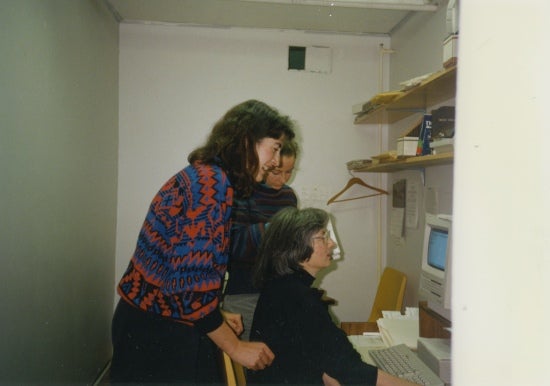
These pictures show Dawsonites creating quilts in the 1983.

In the mid 1980s, the Dawson City Museum underwent a 2.9-million-dollar renovation. They asked for a room that could be used as an exhibition space and got “the Big Black Box” – that is, a room without windows and painted black.  The first exhibition in the space was an exhibition of quilts created by the locals in the photos. 

Community

Before finding the pictures, the story was interesting because it is an example of the community’s influence on the Museum. The Museum’s temporary exhibitions were, historically, created in collaboration with the local community and/or for this community. The local community has thus shaped the stories that are told in the Museum. 

The pictures make the exhibition story more interesting to me because they show that the museum workers were also members of the local community. Several people who were involved with the Museum also participated in quilt creation. They were able to partner with the community to create an exhibition in part because they were that community.

Government Policy

Considering Yukon community museums more broadly, the Quilt exhibition is particularly notable because it enabled the Dawson City Museum to create Yukon’s first exhibition catalogue. The publication relied on funding from the Yukon Government, Yukon Lotteries Commission, and Canada Council. In other words, project funding enabled the catalogue’s creation.

The Quilt exhibition also provided the Museum with the time to develop permanent exhibitions for the newly renovated gallery, using project grants and employment programs.

What can we learn from the pictures?

The pictures challenge me to stop thinking of the Museum and the local community as two distinct groups. At times, the Museum, represented through staff and volunteers, has been an integral component of the community. 

The pictures also help illustrate that temporary exhibitions can provide chances to engage with communities. While permanent exhibitions rarely change and involve multi-year long processes to change, the Dawson City Museum’s temporary exhibitions can change regularly.

Questions

Do you have any great examples of temporary exhibitions providing the impetus for community engagement? How can we ensure that this engagement is not momentary / isolated to that exhibition?

Archival Photo Find: Jubilee Doll Photos

After a very intensive week in the Dawson City Museum archives, I am sorting, reading, and analyzing what I found. In order to help with analysis, I discussed archival documents as part of the Archival Research series. The Archival Photo Finds series similarly considers the stories archival photos can tell.  

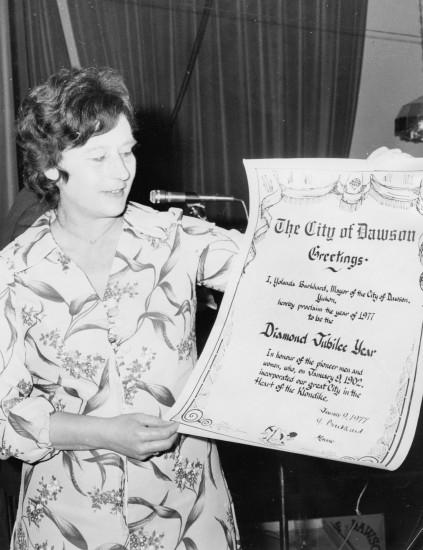
In 1977, Dawson City celebrated its Diamond Jubilee year:

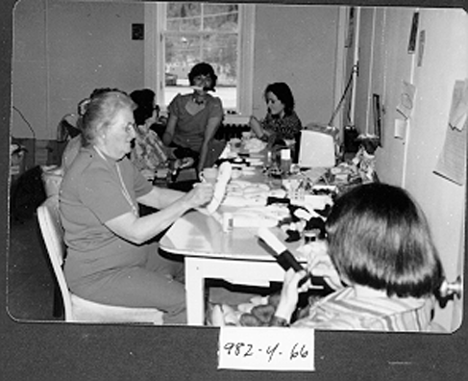
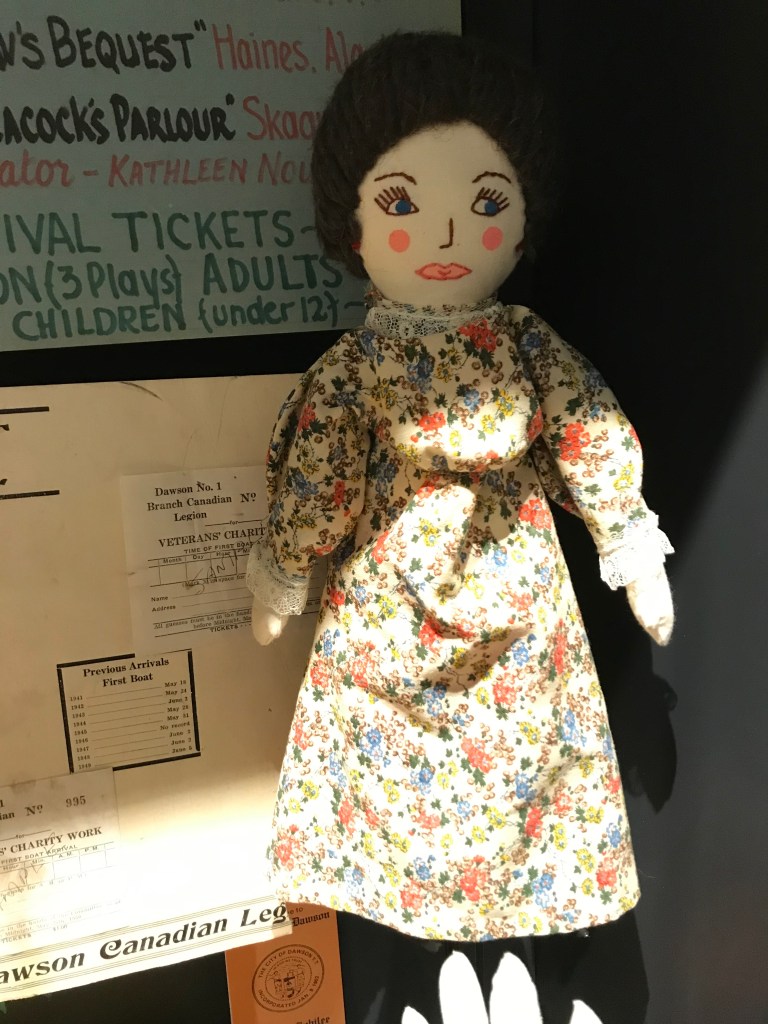
In preparation for the celebrations, the Dawson City Museum employed people to create Jubilee Dolls under the banner “Big Cabin Crafts.” Within this post, I look at photos of these Jubilee Dolls and their creation.

Photos

What can we learn from these pictures?

The Dawson City Museum facilitated Big Cabin Crafts, using a Local Initiatives Program (LIP) grant in winter 1976. LIP was a federal employment program, which enabled the Museum’s first director/curator to work year-round. 

Big Cabin Crafts and the picture above of people creating the dolls illustrates the Museum’s relationship to the community as an employer. Importantly, LIP provided employment in areas, such as Dawson City, suffering due to de-industrialization in the 1970s. The funding allowed the Museum to serve the community’s needs by providing winter employment to a number of people. 

In short, government policy influenced the Museum through the provision of an employment grant, which helped the Museum better serve community needs.

What are some of the lasting impacts of LIP and Big Cabin Crafts on the Museum?

There are several lasting impacts of the Jubilee Doll project:

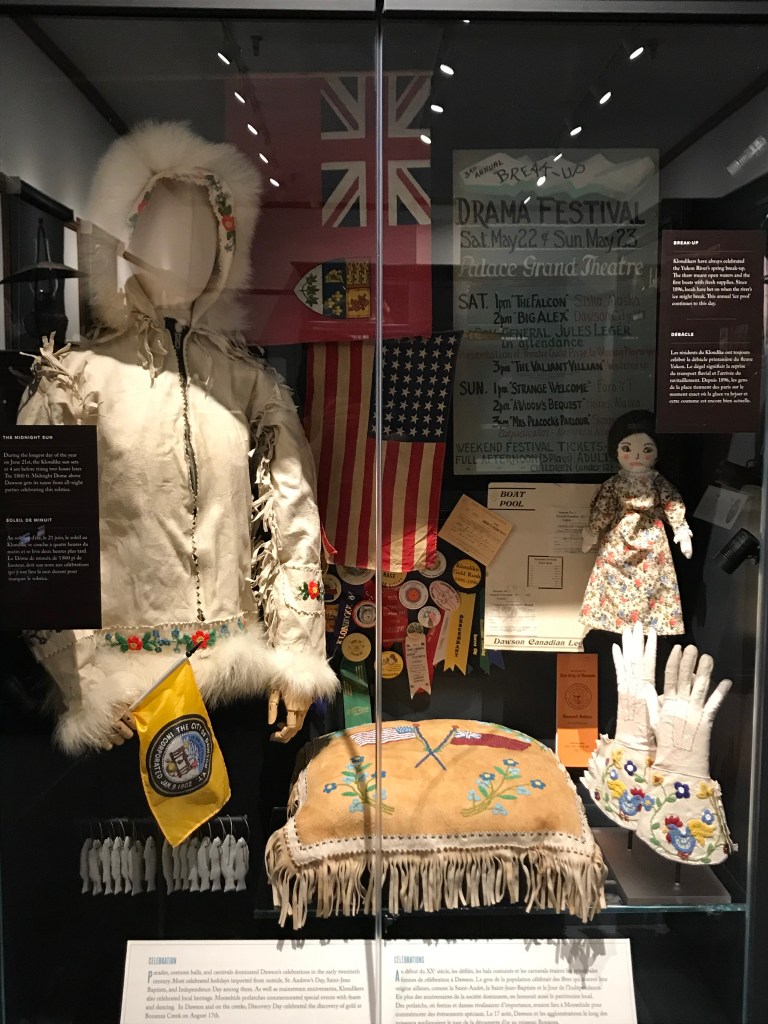
  • One of the dolls is still on display at the Museum as part of a display on celebrations.
  • Employment and more general project grants became the primary means through which the Museum supported paid staff. 
  • When the territory established a grant program explicitly for museums in the 1980s with a curator salary component, advocates pointed to the work accomplished at the Dawson City Museum when they employed someone year-round. 

In short, the use of an LIP grant for Big Cabin Crafts led to a doll in the collection, provided a template for museum employment that continues today, and demonstrated the value of year round employment, which informed the development of a territorial grant program.

Questions

Short term employment and other project grants continue to be a source of funding for staff within museums in what is now called Canada. What effect do you think this has on community museum development and capacity?

Archival Photo Finds: Evolving exhibitions

After a very intensive week in the Dawson City Museum archives, I am sorting, reading, and analyzing what I found. In order to help with analysis, I discussed archival documents as part of the Archival Research series. The Archival Photo Finds series similarly considers the stories archival photos can tell.  

Within this post, I look at photos of the Museum’s permanent exhibitions from 1959 to today. 

Photos

1959

1962

1976 – 1978

1989

2010s – 2020

2021

Why do I find the pictures so exciting?

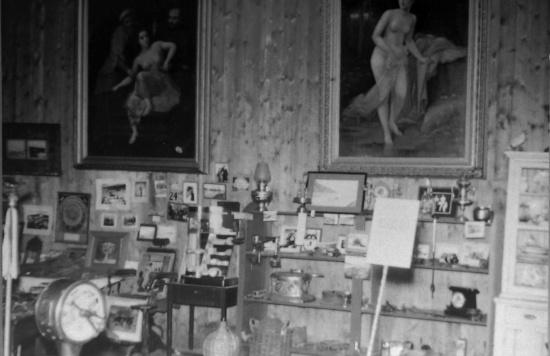
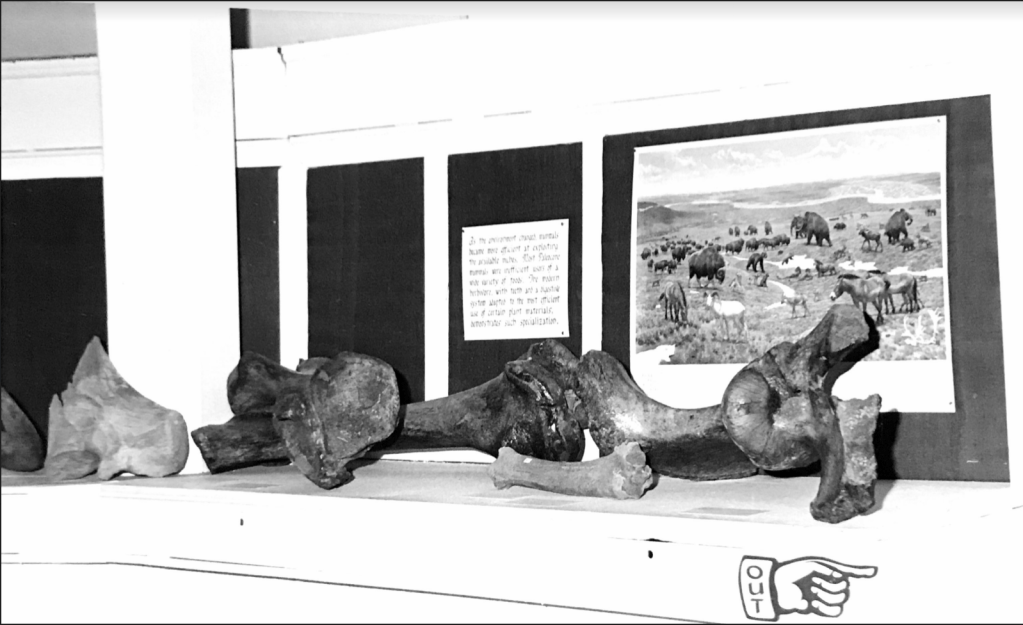
The photos demonstrate an evolution in how artifacts were displayed in a community museum with a relatively small budget. 

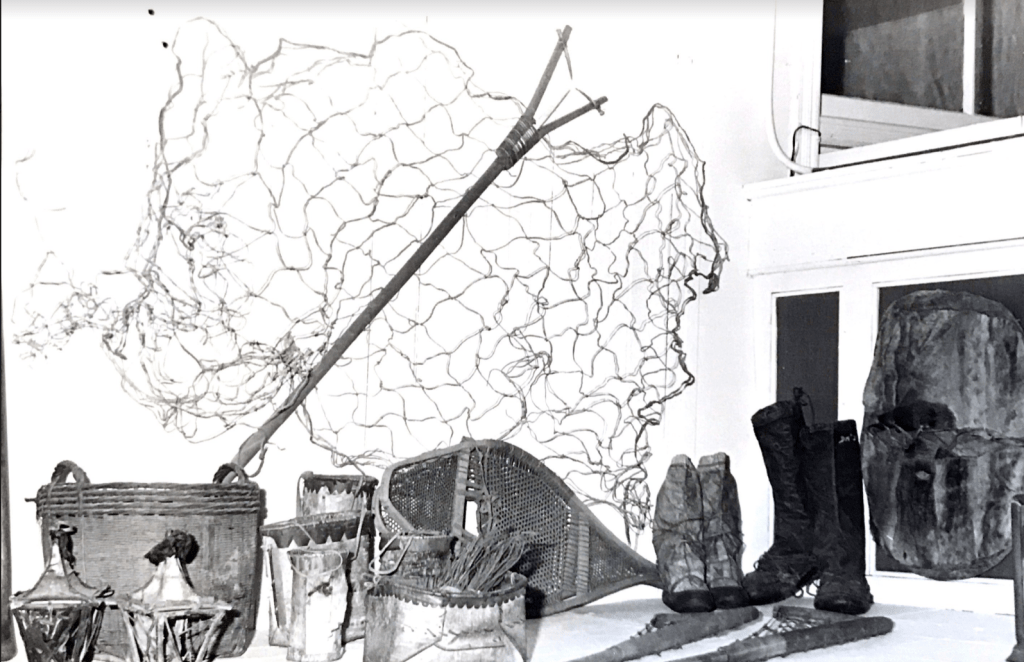
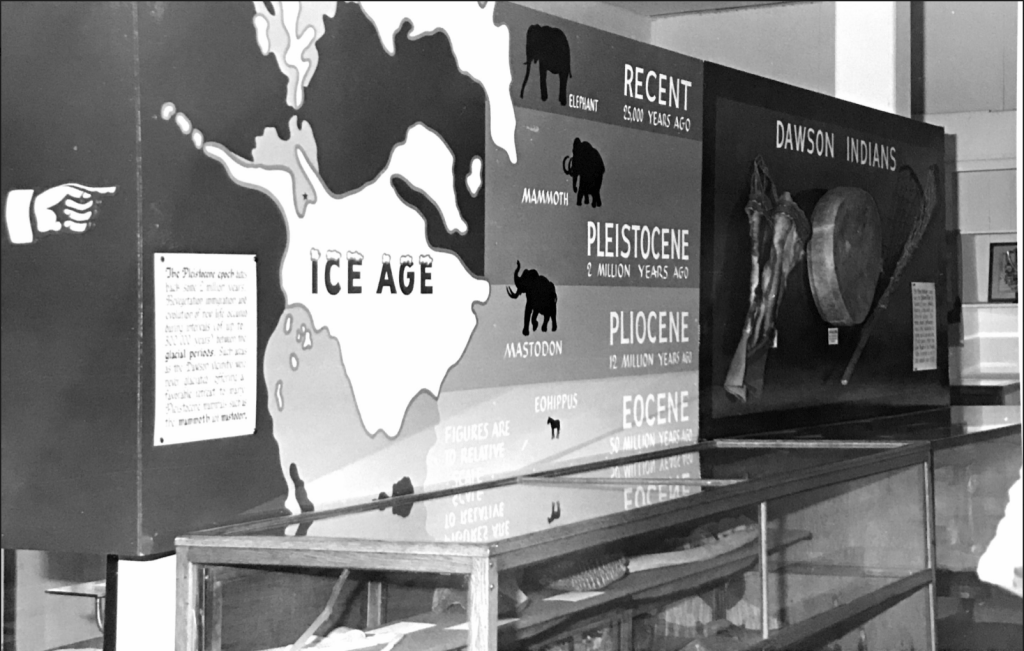
Prior to the 1970s, the Museum objects were grouped together with some organization. However, the space had a “community attic” feel without a narrative. Here is an example:

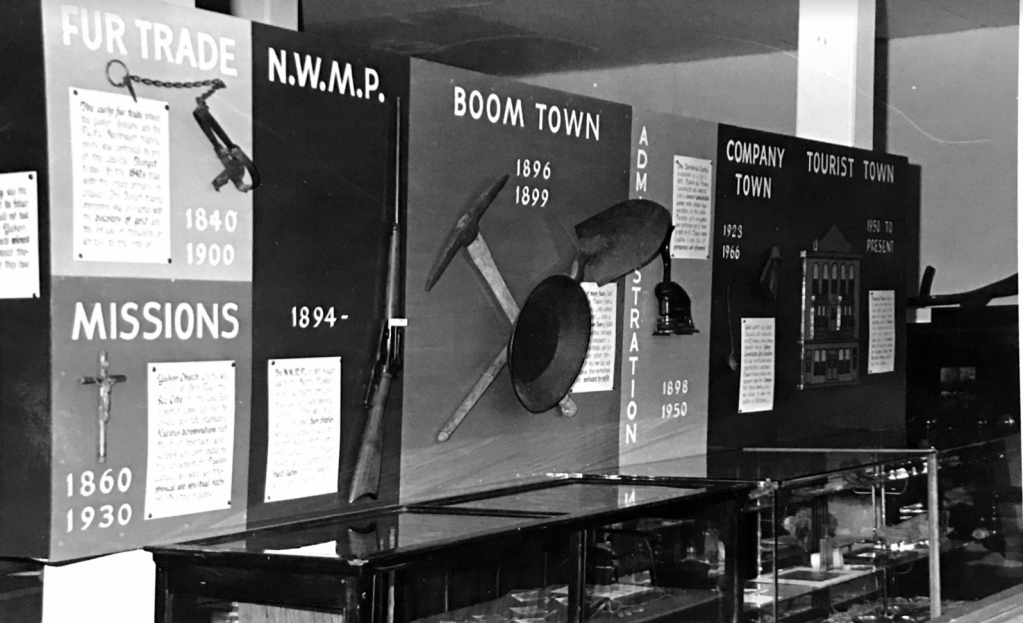
In the 1970s, the Museum began to employ a year-round director who used employment programs to hire staff. The paid staff worked to professionalize the Museum, organizing the exhibitions to tell stories. Here is an example, which shows the development of Dawson City chronologically with different eras:

The photo was found in the Dawson City Museum Corporate Archives with 1976-77 on the back (Box 41; 2000.16.152).

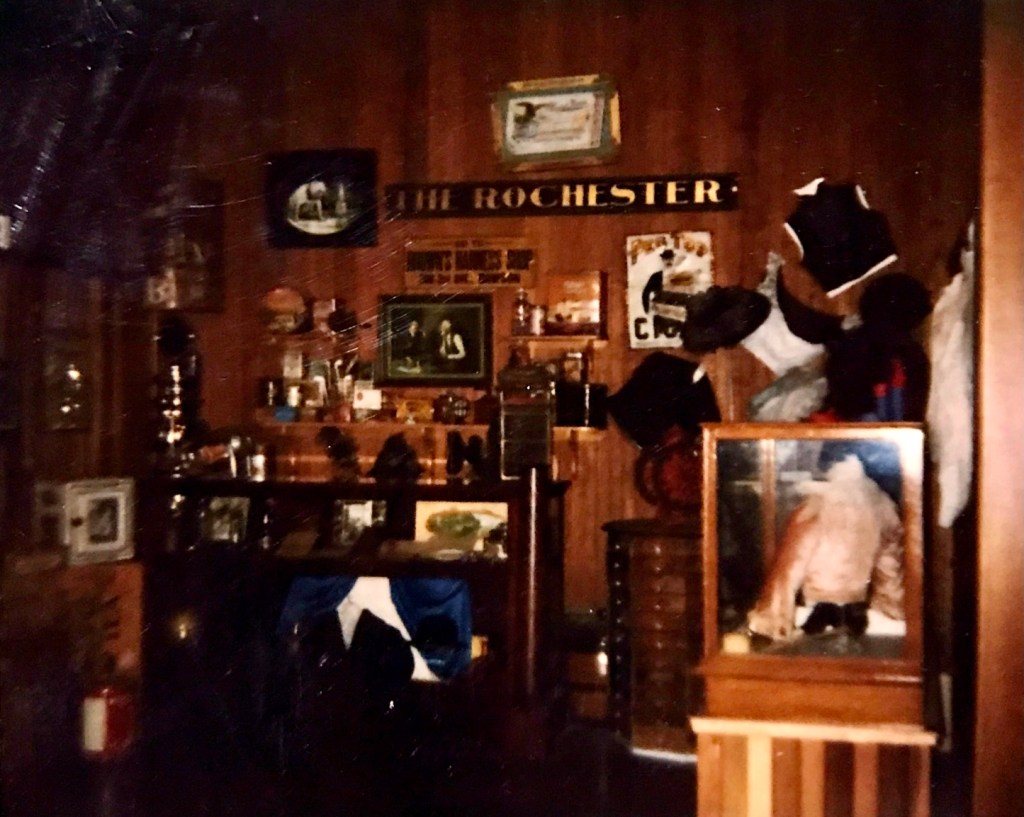
They also began creating dioramas, which organized artifacts according to themes (e.g., items seen in a store):

The photo was found in the Dawson City Museum Corporate Archives with 1977-78 on the back (Box 40; 2000.16.159)

In the 1980s, Parks Canada members were on the Museum’s board, participating on the display committee when dioramas were a popular way to exhibit materials in museums. As such, the Museum staff created more dioramic displays like the one below :

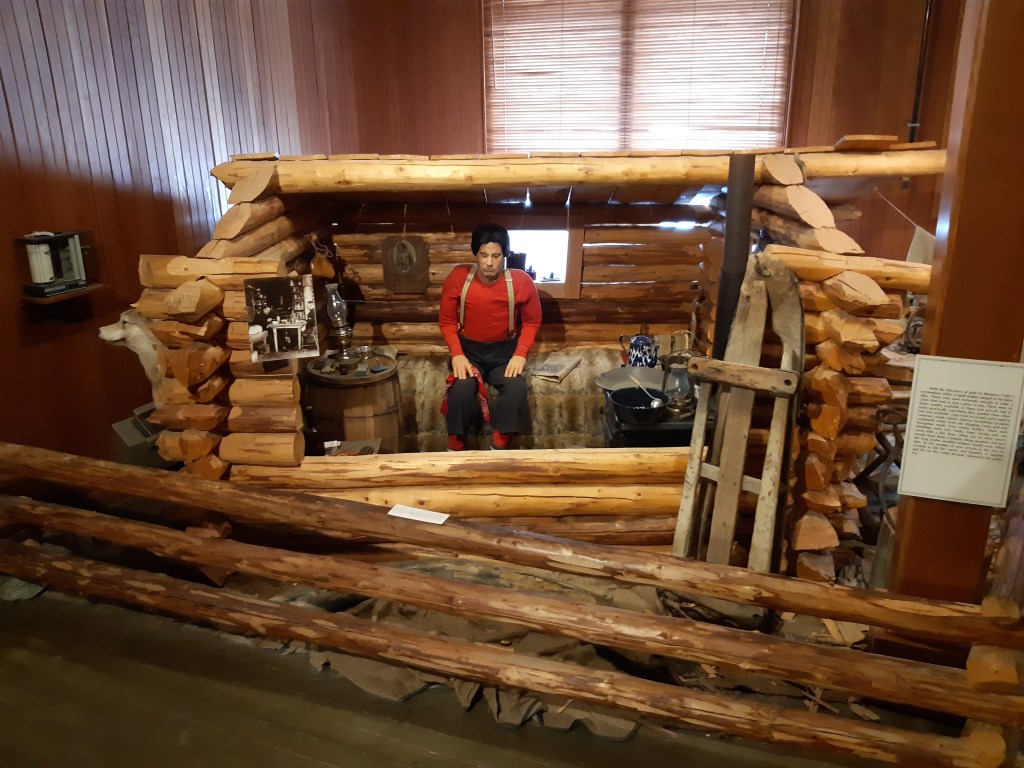
This image is of a postcard from the Dawson City Museum, showing a Miner’s Cabin. The Cabin was built as early as 1989 (see photo above).

The Museum opened a new permanent exhibition in the early 2000s, renovating part of the South Gallery. However, I do not have pictures illustrating this change. If you have any images of the “Lind Gallery,” please let me know!

In 2009 the Museum made mannequins that looked like community members. These mannequins then populated the exhibitions. Here is an example of a mannequin in the Miner’s Cabin from the photo above:

A Miner's Cabin diorama with a mannequin that looks like a community member.

Recently, the Museum opened their new exhibitions. They were created in partnership with a design team and use more contemporary methods of display. For example, information is considered thematically rather than chronologically, there are no dioramas, and some objects are behind glass.

Here are some photos of one of my favorite themes – Klondikephilia:

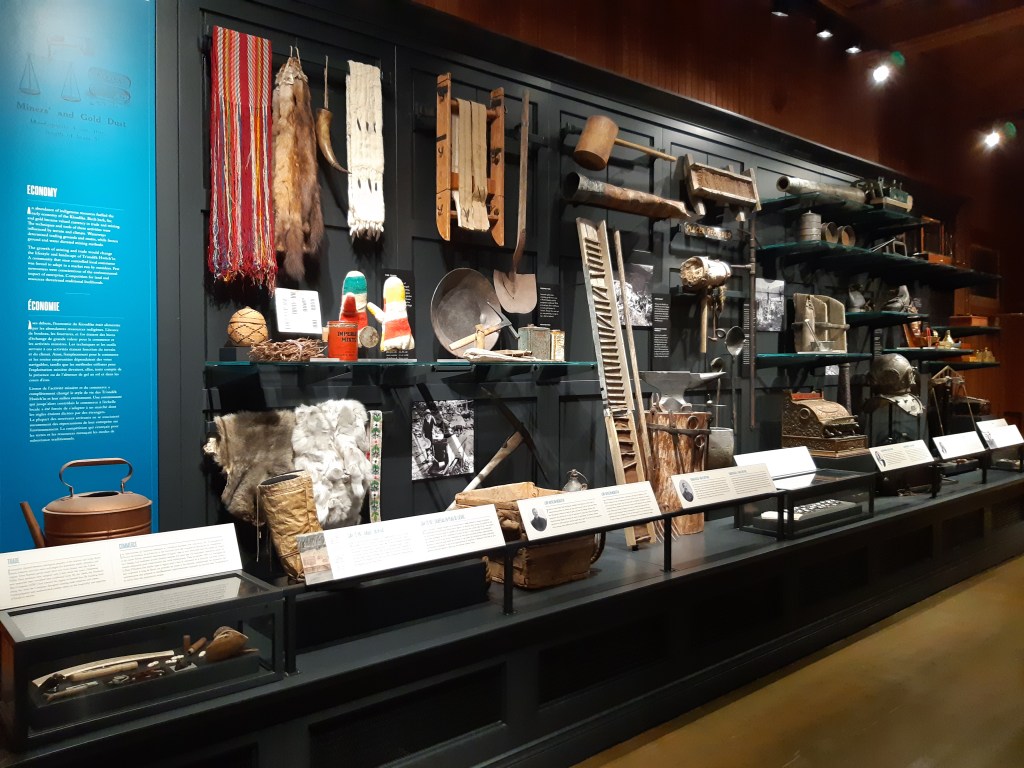
Interestingly, has kept a community museum feel with large groupings and collections of objects. There are so many artifacts on display! Here is an updated visible storage display:

What can we learn from the pictures?

The pictures demonstrate staffs’ commitment to creating professional museum displays despite limited resources. As expectations and best practices have changed, so has the Museum.

The pictures also help answer the research question – How has the Dawson City Museum developed in relation to government policy and community action?

  • Government policy: The creation of new exhibitions requires money. The Museum’s ability to update and renew the space, therefore, depends on government policy. Both the territorial and federal government have provided funding for exhibition development through programs that address museum or cultural policy goals. The Museum has also accessed funding from other programs, such as the territory’s Community Development Fund.
  • Community action: The community is reflected in the exhibitions, which tell stories about community action. Further:
    • The dioramas reflect the approach taken to exhibitions within Dawson City’s heritage community.
    • The objects displayed were donated from communities of people interested in the Klondike.
    • The mannequins are a literal reflection of the local community.
    • And, perhaps most importantly, the Museum is a vehicle through which the local community is presented to tourists. The permanent exhibitions have reflected the stories the Museum staff and board members, who are also members of the local community, feel are important to tell.

I look forward to seeing how the Museum continues to evolve over time!

Questions

What is your biggest take away from the pictures? What do you think that we can learn?

Do you agree with the connections I have made to government policy and community action?

Do you have any pictures of the Dawson City Museum’s interior that would enrich this presentation?

Archival Research: Reduced Student Positions

After a very intensive week in the Dawson City Museum (DCM) archives, I am sorting, reading, and analyzing what I found. The documents scanned are interesting and contributing to the narrative(s) about the DCM’s development. In order to help with the analysis, the “Archival Research” series considers the stories archival materials tell, looking at the items I found most exciting.  

Within this post, I consider the effects of cuts to student employment programs experienced in the early 2000s. Here is an excerpt from a letter the Dawson City Museum’s Director sent to the territorial museums advisor:

2003, August. Letter to the Museum Advisor. Correspondence. Box 39a. Dawson City Museum Archives.

Why is the letter interesting?

As I have explained elsewhere, student employment programs are incredibly significant to community museums. In 2003, the Dawson City Museum (DCM) relied heavily on both Young Canada Works (YCW) and the HRDC Summer Career Placement (SCP). However, they received:

  • fewer student positions – that is, 6 fewer positions than they applied for.
  • fewer work hours a week per student – the SCP positions were reduced to 30 hours a week.
  • fewer work weeks per student.

As a result:

  • It was more difficult to staff the museum during opening hours.
  • Students quit partway through because they were not making enough money.
  • The Museum opened later than usual.
  • The Museum needed to pay out of pocket to have students working during Discovery Days – a significant holiday in Dawson City.
  • The Museum was unable to participate in Discovery Days and, therefore, saw a significant decrease in visitor numbers.
  • The Museum had to pay for a Gift Shop assistant out of their budget.

Fearing additional cuts, the Director wrote:

I feel that the Dawson City Museum and our reputation will be adversely affected if we continue to cut back hours, activities and services because we do not have the human or financial resources to do otherwise.

2003, August. Letter to the Museum Advisor. Correspondence. Box 39a. Dawson City Museum Archives.

Is there broader relevance?

During the 1990s, the DCM was able to take advantage of multiple employment programs, contributing to an expansion of museum activities. However, they began to experience cuts in those programs in the early 2000s. In addition to cuts, other government programs intersect to make funding more challenging to access as discussed here.

As I consider the development of the Dawson City Museum, I am looking at explanatory factors for change. The Museum experienced a significant change as it moved from the 1990s to the 2000s – that is, it went from being a hub of community activity, expanding its operations and engaging in significant projects, to being a tourist attraction more narrowly with seemingly less community engagement.

It is possible that the decline in summer student employment contributed to this change. With fewer people available to staff the Museum and provide programming during its busiest season, what affect does that have on the work of the permanent staff?

Questions

What do you think? Is this a potential explanation for a decline in museum activity / community engagement experienced in the 21st century?

Archival Research: Declining Role of the Museum Advisor

After a very intensive week in the Dawson City Museum (DCM) archives, I am sorting, reading, and analyzing what I found. The documents scanned are interesting and contributing to the narrative(s) about the DCM’s development. In order to help with the analysis, the “Archival Research” series considers the stories archival materials tell, looking at the items I found most exciting.  

Within this post, I continue to examine the Museum Advisor’s role, which I started in The Importance of Presence. In particular, I consider the reduced relevance of the Museum Advisor to individual museums, like the Dawson City Museum, in the early 2000s.

As part of the consultations for the Museum Strategy in 2001, the Dawson City Museum’s Director submitted the following comments about the Museums Advisor:

The Museum Advisor currently is too overloaded with other
responsibilities to provide proper and timely services to museums. We have been waiting since April to hear word on Small Capital Grant
programme applications for summer work. It is now approaching the end
of August and there is no word yet on our success or failure. There will
not be sufficient time during the good weather remaining this fall to
complete the work contemplated. There seems to be no excuse for this
delay other than the fact that the Museum Advisor has too many other
responsibilities unrelated to museums.
Thistle, Paul. 2001, August. Response to Interview Questions. Strategy for Yukon museums. Box 29a. Dawson City Museum Archives.

Why is the submission interesting?

The submission is interesting because it outlines a change in the relationship between the Museum Advisor and individual museum workers.

In The Important of Presence, I looked at the Dawson City Museum’s Board meeting minutes to consider the assistance that both the territorial Heritage Branch Director and Museum Advisor provided to the Dawson City Museum. At the time, the Director and Advisor were physically present in the museum community and easily reachable by phone. As a result, they were able to provide assistance in response to issues.

The submission above indicates that the Museum Advisor was no longer as helpful as he once was. Historically, he had helped the Museum with their grant applications. However, in August 2001 the Museum had:

been waiting since April to hear word on Small Capital Grant programme applications for summer work.

see above

At the end of the summer, they had not heard anything from the Museum advisor. He was far less present in the Museum than he had been in the 1980s.

Is there broader relevance?

When the Museum Advisor was hired in 1984, six museums were receiving operational support. In 2001 – the date of the submission above – nine museums were receiving operational support from the territory and First Nations were beginning to develop cultural centers. At the same time, the territory had its own collections and opened the Beringia Centre.

As a result, the Museum Advisor had increasing responsibilities. In other words, he was becoming:

too overloaded with other responsibilities to provide proper and timely service to museums.

Thistle, Paul. 2001, August. Response to Interview Questions. Strategy for Yukon museums. Box 29a. Dawson City Museum Archives.

The addition of other museums, cultural centers, and territorial institutions to the Museum Advisors’ portfolio without the addition of more museum advisors provides an explanation for change. Although the articulated policy did not change, the policy changed in practice with fewer resources available to the museums through the advisor.

Questions

What do you think? Have I properly understood and explained this change in territorial policy?

References

Thistle, Paul. 2001, August. Response to Interview Questions. Strategy for Yukon museums. Box 29a. Dawson City Museum Archives.

Other Archival Research Posts

The Importance of Presence

Early Federal Influence

The Issue of Rent

The Beringia Center as Competitor

A Community of Community Museums?

Arguments Against Centralization

Community Mobilized

Too Much for One Person

Overwhelming Obstacles

Archival Research: The Importance of Presence

After a very intensive week in the Dawson City Museum (DCM) archives, I am sorting, reading, and analyzing what I found. The documents scanned are interesting and contributing to the narrative(s) about the DCM’s development. In order to help with the analysis, the “Archival Research” series considers the stories archival materials tell, looking at the items I found most exciting.   

Within this post, I am considering the importance of a person’s physical presence and availability when providing support to community museums. In particular, the Dawson City Museum’s (DCM) Board Minutes from the 1980s demonstrate that the territorial Heritage Branch’s Director and the Museum Advisor attended meetings, providing reactive support in response to issues.

Please note: unlike past archival research posts, I am not including a picture because there are a lot of names in these reports and I am respecting confidentiality.

Why are these meetings interesting?

The Minutes show tangible examples of the assistance that can be provided when government actors are physically present in a museum space to learn about problems. For example, the Heritage Branch’s Director attended a meeting in 1983 and offered the following assistance:

  • The Museum Board members were upset because the Canadian Conservation Institute (CCI) was only going to Whitehorse and would not visit Dawson. The Director agreed the Museum had a definite need and noted:

He will be seeing a woman from the CCI later this month and will see what he can do.

DCM Minutes May 3, 1983
  • He provided insider advice on how to be more successful in grant applications. The Minutes state:

It was suggested that when we apply for capital grants we should try to emphasize visible projects that will have more direct approval from politicians and the public.

DCM Minutes May 3, 1983
  • He agreed to try and send a bookkeeper to help museum staff who were struggling with bookkeeping.
  • He volunteered to help the Museum buy a second hand microfilm reader from the territory.

In 1984, the territorial Heritage Branch hired a Museum Advisor. This advisor also began attending occasional Dawson City Museum Board meetings. Examples of assistance provided include:

  • He worked with Museum staff on grant applications (DCM Meeting minutes June 12, 1984).
  • He provided unofficial information on granted amounts to help with planning (DCM Meeting minutes June 12, 1984).
  • He facilitated a better relationship with national funding agencies (DCM 1984 Annual General Meeting Minutes).

More importantly, the Minutes and the Museum’s reports indicate that he was also available by phone to regularly help Museum staff.

In short, during the 1980s both the Director of the Heritage Branch and Museum Advisor went to the Dawson City Museum (or were easily available by phone) and were able to assist the Museum in response to problems.

Is there broader relevance?

Presence facilitates support.

When the Director and/or Museum Advisor were present in the Museum, they were able to hear about problems and offer solutions. For example, in the microfilm reader example above, the Museum had already tried purchasing a used machine from government without success. As a government actor, the Heritage Branch’s Director was able to make the connections needed to be successful.

Sometimes, museum workers discuss a decline in support, but the number of advisory services remain the same. I think the change is actually in the accessibility of the government actor(s). Who is accessible? How accessible are they?

The next post will provide a contrasting example to show this difference.

Questions

What do you think? Have I fully understood the significance of presence?

Other Archival Research Posts

Early Federal Influence

The Issue of Rent

The Beringia Center as Competitor

A Community of Community Museums?

Arguments Against Centralization

Community Mobilized

Too Much for One Person

Overwhelming Obstacles