Case Study: Dawson City Museum Timeline, 1950s and earlier

Last updated: January 24, 2022

As part of the Dawson City Museum Project, I am creating timelines of the Museum’s development in relation to government policy and community action (1950s, 1960s, 1970s, 1980s, 1990s, 2000s).

Museum Operations

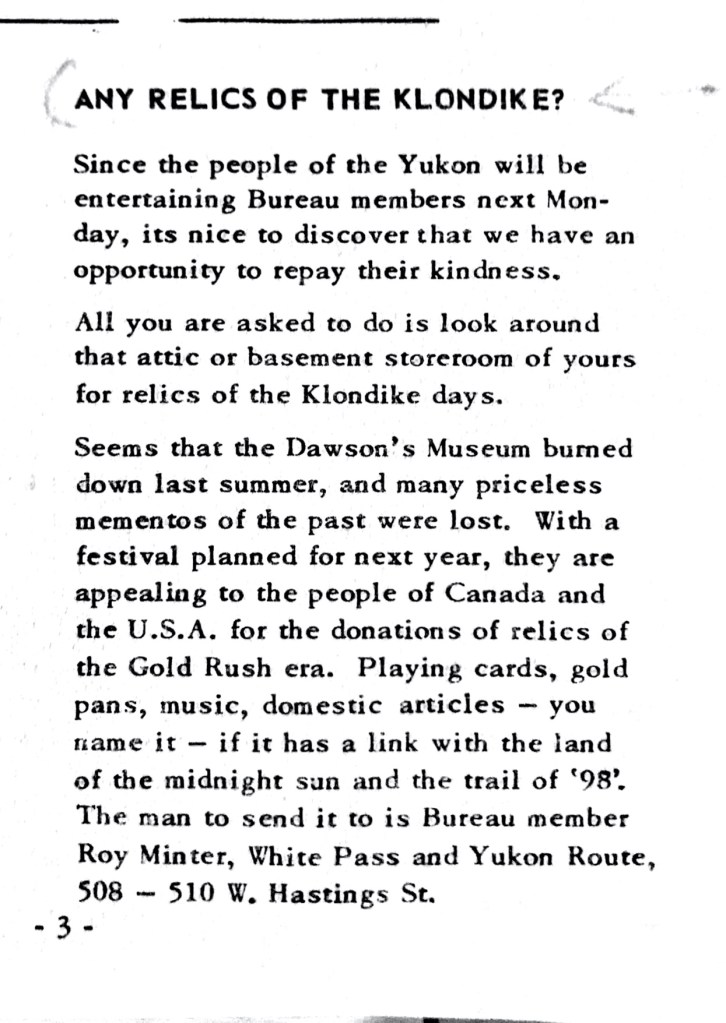
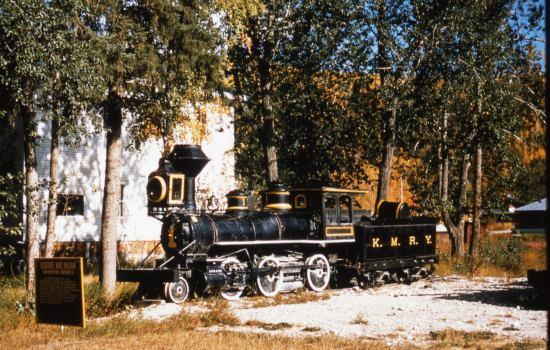
  • 1954: The Klondike Visitors Association opens the museum on June 28 in the old firehall (Doiron 2001).

  • 1957:

    Building

    The Dawson City Museum and Historical Society formed to cash a cheque for $500 from the federal government (DCM Board Minutes, October 1959).

    • The check is used to repair the old fire hall, housing the museum (DCM Board Minutes, February 25, 1961).
  • 1959:

    Governance

    The Dawson City Museum and Historical Society incorporated, creating bylaws and a constitution (DCM Board Minutes, October 1959 and November 1959).

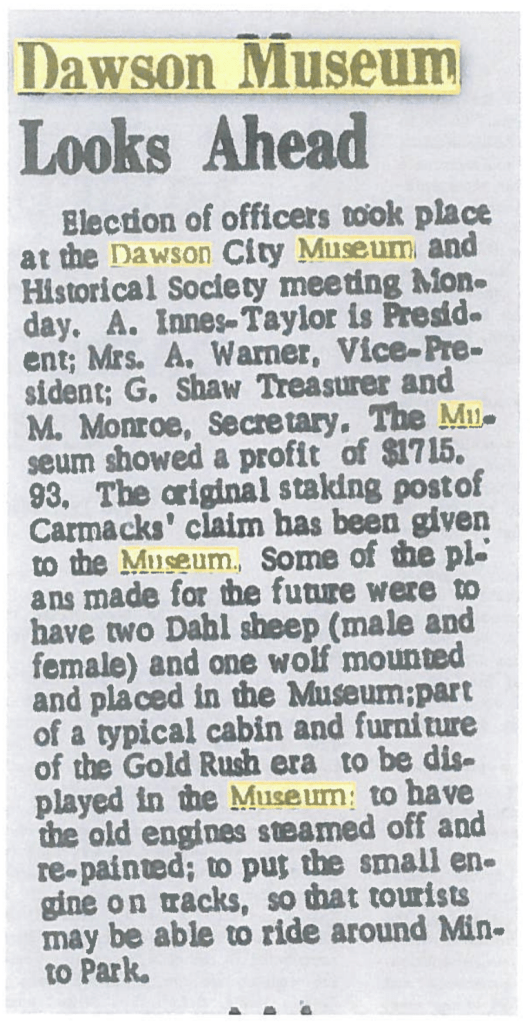
    Image of a news article about the museum's information in the Whitehorse Star on December 17, 1959.
    Whitehorse Star, Thursday, December 17, 1959, p. 6.

Government Policy

First Nation (Tr’ondëk Hwëch’in)

In the late 1800s, an increased number of people associated with the Klondike Gold Rush began settling the Tr’ochëk, displacing the Hän speaking Indigenous peoples. Chief Isaac moved his people to Moosehide.

Importantly, Chief Isaac also sent the gänhäk (dancing stick) to relatives in Tanacross village in Alaska. These relatives kept sacred songs and dances safe during a period of uncertainty for Hän speaking peoples from the Tr’ochëk (Council of Yukon First Nations; Stories North; Tr’ondëk Heritage).

  • 1950s: The population at Moosehide had declined and the Hän people return to the area now incorporated as Dawson City (Council of Yukon First Nations).

Federal

  • 1953: Historic Sites and Monuments Act

  • 1957: Provided a $1,000 grant to Yukon museums, which is split between the Dawson City Museum and MacBride Museum.

  • 1958: Prime Minister Diefenbaker was re-elected after a campaign that launched a northern vision (Norquay 2014).

  • 1959: Prime Minister Diefenbaker suggested Dawson City should be developed as a tourist attraction (Taylor 1990).

    The Historic Sites and Monuments Board of Canada recognized Dawson City (Stuart 1990).

    Due to the HSMBC recognition, Parks Canada eventually began operating the Klondike National Historic Sites in Dawson City (link)

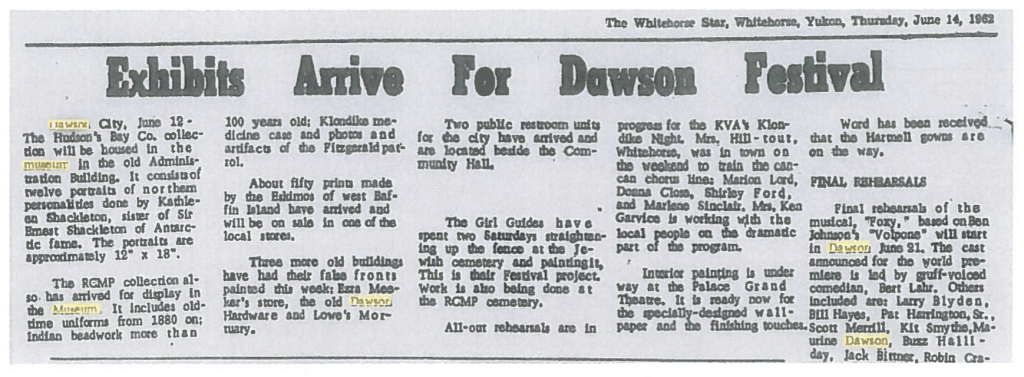
    A meeting between the Stratford Festival and Department of Norther Affairs and National resources led to a proposal for a Dawson City Festival (Stuart 1990).

Territorial

Importantly, the museum is now housed in a historic building – the Old Territorial Administration building.

Picture of the Dawson City Museum
Dawson City Museum

Designed by Thomas Fuller in 1899 and built in 1901, the site is significant because of its association with the 1896 Gold Rush and subsequent settlement in the territory. It was the site of federal and territorial action until 1953.

  • 1953: The territorial government was transferred to Whitehorse.

  • 1959: The Yukon Territorial government offered a $300 operating and maintenance grant to registered societies (DCM 1988).

Local

  • 1950: Dawson City incorporated (Lotz 1964)

  • 1951: The City obtained Diamond Tooth Gerties Gambling Hall (then the Arctic Brotherhood Hall) and began operating it as a community hall (source).

Community Action

The 1896 Gold Rush is of particular importance to the development of both Dawson City and its museum. For more information about the Klondike Gold Rush, check out this Canadian Encyclopedia article.

When Dawson City ceased to be the capital of the Yukon (due in large part to the Alaskan Highway), attention to the tourism industry increased. Members of the community felt they had to draw tourists to survive (Stuart 1990).

  • 1952: The Klondike Tourist Bureau (later, the Klondike Visitors Association) formed (English 1997).

  • 1958: The Klondike Tourist Bureau received a grant from the Yukon Visitors Association to fix up local attractions (Stuart 1990).

  • 1959: The Klondike Tourist Bureau incorporated (Stuart 1990).

    The Museum’s incorporation led to a surge in artifact donations from community members (DCM 1988).

Questions

Do you know of any important milestones that are missing?

Would any of the entries benefit from more information or links to additional resources?

References

Where possible, I have linked to sources. The following are references that are not currently available online:

Dawson City Museum & Historical Society. 1988. “1988 DCM History.” Box 14. Dawson City Museum Corporate Documents. Dawson City Museum Archives, Dawson City. 

Taylor, C.J. 1990. Negotiating the past: The making of Canada’s National Historic Parks and Sites. McGill-Queen’s University Press.

Case Study: Property Tax as Cultural Policy?

Municipal museums and related cultural institutions often have greater capacity than non-municipal museums because of the non financial supports municipal structures provide. Examples might include IT services, human resources, and lawn maintenance. Most importantly, municipal institutions are often housed in municipal buildings. As a result, they do not have to pay for utilities, maintenance and property tax.

Property tax can be a huge expense for museums and other cultural organizations (particularly non profit ones). For example, an article in the Canadian Museums Association’s Museogramme June/July 1991 issue discusses cut backs on staff, programs and hours at the Art Gallery of Hamilton. At the time, they were paying $300,000 in property taxes, leaving little for maintenance or preservation.

Within this case study post, I examine the MacBride Museum’s relationship with the City of Whitehorse to argue property tax abatement is a form of cultural policy, which has a major influence on the community museum sector. Petitioning municipalities for property tax exemptions is a significant form of cultural policy advocacy.

Whitehorse and the MacBride Museum

As part of the Dawson City Museum Project, I have been reading through the Yukon Historical and Museums Association’s (YHMA) newsletters. I talk about how useful museum association newsletters are to cultural policy research in another post (here).

As the YHMA’s Fall 2013 Newsletter, a few CBC articles (here, here, and here), and the MacBride Museum’s website describe:

  • 1950s: The MacBride Museum opens. It did not (and has never) paid property taxes.

  • Mid 1990s: The City of Whitehorse provides non profits (including museums) with tax exemptions (100%).

  • 2013: The City proposes a modification to the exemptions, planning to cover only 88% of the property tax payment.

    The YHMA began sharing concerns, opposing the proposal through the radio, television, and papers.

    The City’s proposal was voted down.

  • 2014: The City reintroduces the proposal and it passes.

  • 2015: The City passes an amendment that if the museum holds the title for their land, it would not be taxed. This exemption only applies to the MacBride Museum (and not the Transportation or Old Log Church museums).

  • 2016: The MacBride Museum begins a planned expansion and confirms the exemption would continue to apply to their larger space.

  • 2018: The City sends the MacBride Museum a bill for property tax after the assessed value of the museum’s property increased. The Museum’s annual property taxes had increased from about 30,000 to 71,000.

The City of Whitehorse argues the MacBride Museum is now ineligible for tax abatement because it has a cap of $50,000 on annual grants to a single organization. The MacBride Museum argues the 2015 amendment is not contingent on the size of the tax.

As of July 2021, property taxes and whether the MacBride is exempt seems to still be a point of contention. The MacBribe and YHMA have posted related content, showing advocacy in action.

First page of a six page Q&A sheet. The document is available here.

Other Examples

As seen in the Yukon example, provincial governments often say non profits museums and other cultural organizations (or those registered as charities) can be exempt from property taxes. They allow municipalities to impose additional requirements, indicating the exemption is simply a possibility. Here are a couple of examples:

Alberta

A guide on property tax explains the exemption for museums and other cultural organizations. Notably, municipalities may impose additional requirements:

A screenshot of a table on property tax exemptions in Alberta for arts and cultural facilities.
A screenshot of Table 3 from Property Tax Exemptions in Alberta: A Guide

British Columbia

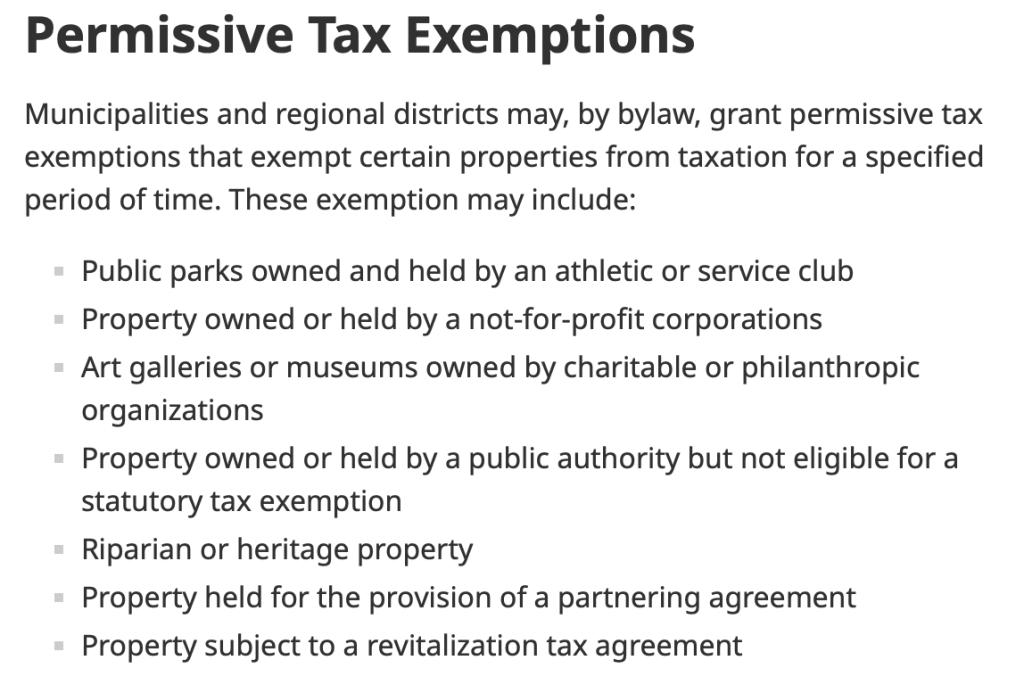
Provincial guidelines note museums owned by a charitable organization may be eligible for property tax exemption:

Screenshot from a page on “Local Government Tax Exemptions”

Saskatchewan

Under The Cities Act museums are not exempt from property taxes. However, they can be. In Saskatoon, for example, museums can apply for relief through the Culture Grant Program. They are not always successful! Click here for an example where the museum was not immediately successful but the City staff were committed to helping the organization meet requirements in the future.

Municipalities

As you can see, municipalities generally decide whether museums are exempt from property taxes in what is now known as Canada. As such, there is a lot of variance across the country. Part of the YHMA’s argument for the MacBride Museum is that most municipalities exempt museums. Here is a screenshot of their position with information on two municipalities:

PROPERTY TAX AND NON-PROFITS
Most Canadian municipalities offer property tax exemptions for non-profits. Here’s the low-down on a couple:
The Regional Municipality of Halifax offers a tiered approach to property tax exemptions for non-profits. Depending on the function of the non-profit, organi- zations may receive a 100% exemp- tion, a partial exemption, or even have property taxed at a lower, residential rate. As they provide benefits to the public, groups that operate heritage properties are generally awarded high- er exemptions.
The City of Kelowna offers tax exemp- tions for non-profits with municipal, recreational, religious, cultural or chari- table purposes. The City also adminis- ters a Heritage Building Tax Incentive Program Policy, which provides grants to property owners who have restored heritage buildings.
Screenshot from the YHMA 2013 newsletter (here)

Questions

To summarize, municipal tax exemptions are a significant form of cultural policy, requiring advocacy and attention, within what is now known as Canada. They demonstrate the important of advocacy at the municipal level (in addition to provincial / territorial, federal, and possibly First Nation).

Do you agree? Can you think of other significant examples?

Research: Newsletters

Newsletters are one of my favorite things to read when researching community museums and museum policy in what is now known as Canada.

Picture of an Ontario Historical Society Bulletin
Image of an Ontario Historical Society Bulletin from 2018 (source)
Image of a Yukon Historical and Museums Association Newsletter
Yukon Historical and Museums Association Newsletter from 2021 (source)

They are so much fun!

Pre-internet newsletters are particularly helpful. Nowadays, a lot of organizations create email notifications with lots of links and short descriptions. As a researcher, I am not a fan. There is something more interesting about a physical newsletter or a PDF document with grainy photos and long descriptions.

Screenshot of Page 10 in the YHMA Summer 2009 Newsletter

This post is going to explore:

Why are newsletter so useful in community museum policy research?

No (or few) Links! And so Much Information!

The newsletters are such rich sources of information.

Email communications often link to a website for details. Conversely, the newsletters are (or were) more self contained and describe things.

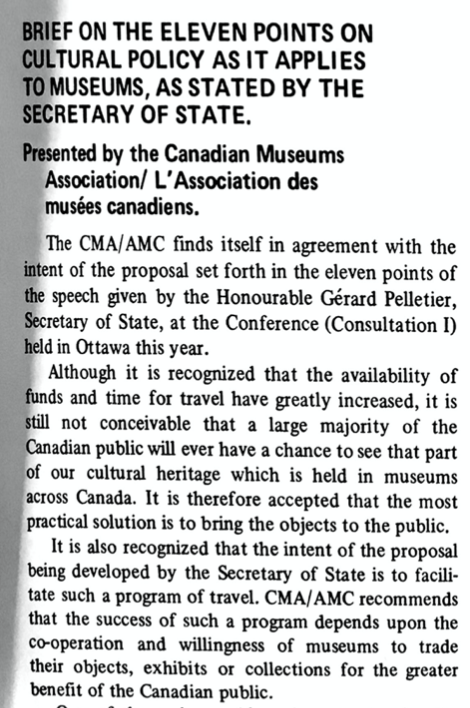
For example, they describe speeches and personal communications not documented elsewhere. Or, if they are documented in an archive, the documentation can be difficult to find. The Canadian Museums Association’s (CMA) Gazette from the early 1970s provides information about the development of the national museum policy, demonstrating how the policy changed from the Honorable Gerald Pelletier’s initial ideas in 1970/71 to 1973. Here is an excerpt from a speech he gave at a conference in 1971 and the CMA’s response:

Excerpt from the CMA's gazette in 1971 showing the beginning of a speach.
CMA Gazette, Oct. 1971, Vol. 5 No. 4, Page 4
Except from the CMA Gazette in 1971 showing the CMA's response to a proposed museum policy
CMA Gazette, Oct. 1971, Vol. 5 No. 4, Page 5

Before reading the Gazette, I did not know how much the museum policy had changed with the input of the CMA and other museum people.

Demonstrating and Simplifying Complexity

Community museums are not the designated responsibility of any one level of government in what is now known as Canada. They receive support from and are regulated by all levels. Further, the support and regulation is not limited to a singular department responsible for museums. For example, a museum may be eligible for support from economic or community development programs.

In addition to government, non profit associations provide support to community museums. And, once again, the support is not limited to associations specifically for museums. Community museums may also benefit from the work of associations connected to one of their programs or goals (e.g., a tourism association).

In relation to this complexity, newsletters do two things:

  1. They highlight the breadth of support available, demonstrating complexity.

The image below is from the Ontario Museum Association’s (OMA) newsletter – Currently – in 1983. The OMA provided information on a new organization for tourist attractions and a Ministry of Tourism and Recreation initiative related to tourism data. Articles like these demonstrate tourism related support is significant to community museums in Ontario.

Excerpt from an Ontario Museum Association Currently in 1983 on the Provincial Attractions Monitor and Attractions Ontario.
Excerpt from Currently, January 1983, Vol. 6 No. 7

2. Newsletters help define the scope of research, simplifying complexity.

In addition to demonstrating the complexity of support for museums, the example above also provides parameters for research. It shows that I should consider tourism related support AND also identifies the specific tourism related support of relevance, meaning I don’t have to research everything that the Ministry of Tourism and Recreation did that may be relevant. Presumably, the most relevant actions are already identified for me in newsletters.

The Human Component

I saved this one for last because it is my favorite part.

Newsletters demonstrate community. Through the newsletters people are (or were) able to learn about what other people are (or were) doing.

My favorite instances are “Current People News” from the OMA’s Currently, “Of People and Museums” from the CMA’s Museogramme, and any section of the OHS’s Museums Committees newsletters. Here are examples:

  • Excerpt from the OMA's Currently
  • Image of an "of People and Museums" excerpt from the CMA's museogramme
  • excerpt from the OHS's museums committee newsletter

Interestingly, the Yukon Historical and Museum Association did not have a similar section / component in their early newsletters. These newsletters do not evoke the same sense of community that I have studied elsewhere. I am interested to see how or whether the association comes up during interviews for the Dawson City Museum Project.

Questions

How about you? Do you like reading these newsletters as a practitioner or researcher? What role do they serve? Do you have a favorite example that I should consider?

Podcasts: BC Museum Portraits Project

As someone who loves studying community museums, I am often frustrated that they do not have a lot of information available about their own histories.

So I was really excited to see the BC Museum Portraits Project. The podcast mini series is a collaboration between the BC Museums Association and Spencer Stuart, which aims to provide an institutional memory of the province’s museums. The podcasts are available here.

Course Application

I am excited to use the podcasts in a module on the historical development of museums in what is now known as Canada for our museum management course.

The objective is to better understand the development of museums in order to consider the causes of contemporary issues or opportunities.

Here is my current plan:

  • Students will each have to listen to the episode of their choice as a required reading
  • At the beginning of the “activity” class, they will be given some time to review their notes and prepare a mini presentation
    • The presentation should introduce the museum and state 3 – 5 interesting things they learnt about the institution from the podcast episode they chose (and additional googling maybe?).
    • I will give the following questions as prompts: Where do/did its collections come from? When/why was it founded? Did they discuss or explain any recent changes in their practices?
  • Students will be divided into small groups. For most of the remaining time (classes are 1.5 hours), they will:
    • Take turns presenting the information to their small groups.
    • Work together to identify common themes and significant differences in the museums’ development.
  • To end the class, we will come back together and each group will be asked about the similarities / differences.

I am excited to see what common themes the students identify!

Questions

Thoughts? Do you have any suggestion on how I could modify the plan so it is more useful to students?

Have you listened to the podcast? Do you have a favorite?

Case Study: The Importance of a Marvelous Lunch

When thinking about advocacy, I generally think of major campaigns.

For example, in 2011, about two hundred people showed up at Montgomery’s Inn (Toronto) to oppose rumored cuts to the City’s museums, which would have closed the historic site. There was also a petition and social media campaign. These advocacy efforts worked. Yay. If you would like to learn more, click here for an article about the efforts.

Picture of the Montgomery's Inn plaque
Montgomery’s Inn Plaque (copyright information)

These kinds of campaigns are incredibly important because, as seen with the Toronto example, they can work! However, effective advocacy is not limited to a one day event or short term social media push. These efforts are most effective when paired with ongoing relationship building.

I have heard about the importance of relationship building at the local, provincial, and federal levels from museum professionals in Ontario and New Brunswick when researching community museum policy.

In my research for the Dawson City Museum Project, I am seeing the same thing. Ongoing relationship building with politicians is important. Fostering positive relationships can lead to more visibility and attention to museums within the legislature.

For example, after returning from a visit to Teslin in 2001, an MLA (Member of Legislative Assembly) asked the Minister of Tourism about the Museum Advisor’s recommendations to the George Johnston Museum and was able to get a commitment to fix an issue the Museum was having with their signage (Source). In this example, the Museum’s relationship building with their MLA led to concrete and immediate results.

The MacBride Museum provides a more entertaining example.

The MacBride Museum and Some Delicious Sandwiches

The MacBride Museum is located in Whitehorse – the capital of Yukon and where the Legislative Assembly sits. While there are other community museums in the area (e.g., Old Log Church Museum), the MacBride is larger, older, and has historically had better organization capacity.

MacBride Museum
The MacBride Museum in 1968 (copyright Phil Smith)

The MacBride Museum is mentioned in the Legislature minutes more than any other Yukon community museum. A search for “MacBride Museum” in Hansard yields 125 results and a search for “McBride Museum” yields another five, meaning MLAs mention the museum in at least 130 sittings (I say at least because the search function can be unreliable). In comparison, “Old Log Church Museum” yields 5 results and “Dawson City Museum” yields 44 (“Dawson Museum” yields another 22 results but there is some overlap). While the Old Log Church Museum was established more recently and is much smaller, the Dawson City Museum and MacBride were both originally established in the 50s and, until recently, received the same amount in operational funding from the territorial government.

Why do the MLAs mention the MacBride Museum so much more than other community museums?

The Simple Explanation

The simplest explanation is that the MacBride Museum is in Whitehorse and has a longer history than other Whitehorse community museums. As a result, it may be the only museum some MLAs know to mention.

The Way to an MLAs Heart = Sandwiches

There is also a more entertaining explanation.

The MacBride Museum has held events for MLAs, which get mentioned in the minutes and keep the museum’s complaints fresh in their minds. One day, an opposition member decided it was important to push for more funding to the MacBride Museum (specifically and without consideration of other community museums) after the MacBride had fed the MLAs a “marvelous lunch” and told them about their troubles between sandwich bites.

The opposition member stated:

I would like to move on to a few heritage questions. The Minister will remember the marvelous lunch that we had at the MacBride Museum around Christmastime. Between bites of our sandwiches at the legislative lunch, we learned that the MacBride Museum was interested in seeking more funding from the department. 

Source

The Minister responded that if they gave the MacBride museum increased funding, all the community museums would require more money because there was a formula.

The concern is that if you increase the funding of the MacBride Museum, you have to increase the funding of the other museums, because they are funded in a set ratio. 

Source

The opposition member was not convinced and continued to refer back to the information the MacBride provided at lunch, concluding:

I am trying to get a better appreciation of what it was about the MacBride Museum’s argument that the Ministers felt did not provide sufficient justification for additional funds. 

Source

The lunch did not lead to an immediate funding increase. However, it is indicative of the MacBride’s relationship building with MLAs, which does not include the other community museums. The MacBride is good at being remembered.

Why is this significant?

Historically, the MacBride Museum and Dawson City Museum (DCM) received the same operational grant from Yukon.

  • 1950s: As early as 1957, the federal government provided $1,000 to the territory for museums, which the MacBride and DCM split equally.

  • 1980s: While the DCM and MacBride eventually started receiving the same operating grant again, the MacBride received less operational funds than both the DCM and Old Log Church museum when the territorial program for museums began in the 80s.

    Table of museum funding from 1982 to 1986
    Table from the 1986 Lord Report

    Please note: This section was added after the post was originally published to incorporate information from the Lord report.

  • 2014: Both museums received $100,000 from the territory’s Museum Contribution Program (MCP).

    Then, the Cole Report (2014) recommended increased funding through the MCP. One option involved an additional fee for service agreement with both the MacBride and DCM.

  • 2015 and Beyond: In 2015, Yukon began a 30% increase to the museum grants.

    As a result, the DCM now receives S130,000 from the MCP. The MacBride received a much larger increase. Yukon’s 2019-2020 public statements indicate they received $232,000.

Why did the MacBride begin receiving a much a larger grant?

I don’t know for sure. There does not seem to be any public explanation.

If you know the justification that Yukon Government gave, I would love to hear it. Please comment or message me!

However, I have an idea. I think it’s because the MacBride occasionally feeds MLAs yummy sandwiches. Or, more broadly, the MacBride seems to have fostered relationships whereby they are given more visibility in the legislature. Perhaps that visibility extends to the bureaucracy as well?

Questions

What do you think? Does the explanation make sense to you or is there another one that is a better fit?

Shared Bibliography on Cultural Policy

When writing about cultural policy in what is now known as Canada, finding references about the Canadian context can be difficult.

Cultural policy is not a distinct field because “culture” is such a broad concept and, as such, the sector encompasses a lot of subsectors with their own policy concerns. Cultural policy is studied within disciplines focused on specific subsectors (e.g., museology), communications, public administration, history, and more. If I tried listing every discipline that intersects with cultural policy, I would inevitably miss some.

These different disciplines write about cultural policy differently. For example, when researching heritage commemoration policy as a kind of cultural policy, I found historians’ works document government commemorative actions without ever using the keywords “cultural policy,” “heritage policy,” or even just “policy.” After discovering the correct keywords, I found so many more examples of relevance.

In an attempt to share labour, I created a Mendeley bibliography years ago with all of my sources on Canadian cultural policy and shared it with everyone I knew studying the subject. They said thank you, but no one ever seemed to use it or contribute to the resource.

I still think it’s a good idea.

So, I have now made it a teaching resource and am working to expand the bibliography so that it reflects more than my interests. It is available to view here.

The subject librarian at MacEwan is helping me to expand the resource now and I would love to see more sources added. If you’d like to contribute, ask to join! I would love to have help and to make this something that is useful for research broadly.

Research: Interviews Part Three

Now that I am starting the interviews for the Dawson City Museum (DCM) Project, it is time to transcribe them.

Transcribing is interesting because I notice themes and intersections between interviews when paying such close attention to what people are saying. Unfortunately, transcribing is also really tedious, involving more decision-making and time then I ever thought possible.

This post explains why I am doing edited transcripts and describes some of those edits. It was originally an instruction sheet for my Research Assistant, but I think the information may be interesting to some interview participants and other students.

Background

For my Masters and PhD interviews, I did verbatim-ish transcripts. They were close to what the person said with punctuation added and sounds like “um” or “ah” removed. This is not the approach I am taking for the DCM project because:

  • People (myself included) do not like reading verbatim transcripts. The grammar is almost always awful. As a result, participants will often stop reading them or get distracted (they want to fix their grammar). For the DCM project, informed consent is incredibly important to the community partnership and related ethical concerns. I need people to read the transcripts they approve (or simply be very confident they stand by everything they said).
  • The approved transcripts will be preserved in the DCM archives (with the participants’ consent). I may have an inflated sense of self importance about my work… but I think the transcripts will be relevant in the future. For example, in 40 years it will be the DCM’s 100th anniversary and they may want to do an exhibit about themselves.

For these reasons, my Research Assistant and I will create edited transcripts. The sections below illustrate the difference.

Examples

The interview excerpt I am using is from my first interview with Alex, the current Executive Director of the Dawson City Museum. I received consent to make this post and use the audio / transcript in this way.

Verbatim Transcript

Robin: If you could start by just telling me your name and your relationship to the Dawson City Museum right now, that would be great. 

Alex: Sure. My name is Alex Somerville and, uh, right now I’m the Executive Director of the Dawson City Museum.

Robin: Great. Um, so, how did you become involved with, ah, community museums? Ah, how did you start in the museum sector?

Alex: Ah, my first job was in the community museum, was in a community museum. Uh, yeah. Yeah, my first job was in a community museum. And I guess had sort of a a first job later than a lot of people. It was in the summer between my first and second years of university. Um, and, ah, I’d never, never even, you know, beyond having a job, that first job, I had never been had any any contact or any role or any part in any community museum. 

Audio

In my opinion, Alex’s second answer is a little confusing as a written response in the verbatim transcript. If you listen to the audio, the answer is not confusing at all:

Edited Transcript

The edited transcript, I believe, better communicates what he said even though it is not verbatim. I also deleted things that I said, which do not really enhance the document. Here is what I sent to Alex for approval:

Alex: My name is Alex Somerville and right now I’m the Executive Director of the Dawson City Museum.

Robin: How did you become involved with community museums? How did you start in the museum sector?

Alex: My first job was in a community museum. I had a first job later than a lot of people. It was in the summer between my first and second years of university. And beyond having that first job, I had never had any contact or any role or any part in any community museum.

Examining the Differences

What differences do you notice between the verbatim and edited versions? Which do you prefer?

Project Guidelines

Using the example above as a starting point, I created the following guidelines for the Project’s RA (Research Assistant):

  • Remove stammering sounds (e.g., um, ah)
  • Repeating words (e.g., “a a” or “any any”) do not serve a function and can be removed unless they are emphasis words (e.g., “very very very big”).
  • After this, the editing involves more decisions and some people may make different choices. Here two choices explained:
    • In speech people often change how they are going to say something (e.g., “my first job was in the community museum, was in a community museum”). In most cases, it is more readable to transcribe what the person decided to say (e.g., “my first job was in a community museum”).
    • In speech people often overuse certain words (e.g., most conjunctions, you know, I guess, like). Sometimes, keeping these words helps preserve the person’s speech pattern. However, they can also make reading more difficult and the transcript is better without them (e.g., “Um, and, ah, I’d never,’d never even, you know, beyond having a job, that first job, I had never been had any any contact or any role or any part in any community museum.” became “And beyond having that first job, I had never had any contact or any role or any part in any community museum.)

Questions

Do you have experience transcribing interviews? If so, are there additional guidelines that you would recommend?

Research: Interviews Part Two

I did the first interview last week! Or, more accurately, I did a practice interview with my community partner.

The first interview is the most difficult for me because I get nervous, asking:

  • What if my questions are poorly written?
  • What if the recording does not work?
  • What if I come across as uninformed?
  • What if the participant feels I have wasted their time?
  • How silly am I going to sound in the recording?

Within the last post on interviews, I considered the steps leading up to the interviews. This post expands on step two, considering the prep work immediately after the interview is scheduled. More specifically I am answering:

What preparation do I do mitigate the nervousness described above?

What if my questions are poorly written?

My question guide is available here:

This is not an “if” issue. One or more of my questions are likely poorly written. However, during the first interview, problems did not arise when I read the questions as they were written. My bigger problem is that when I adjust the questions to better fit the conversation and connect to what we’re discussing, I fumble.

Other than spending time writing and editing the question guide at the beginning, I don’t know how to better prepare for this issue. Suggestions are welcome.

What if the recording does not work?

This is my nightmare: I go home, attempt to download the audio, and it is missing or corrupted.

I do not know what I would do in that situation. Cry?

So, I do my best to avoid it at all costs. In the last interviews post, I asked: How would you record phone conversations?

I am making two recordings in an attempt to avoid my nightmare and ensure at least one works:

  1. TapeACall: I did some searching and this seems to be a good app to record conversations on an iPhone with a decent paid transcription function. Before using it for an interview, I called my dad and had a random conversation about tools. It seems to work well.
  2. Speakerphone and a recorder: My backup is a regular audio recorder, which I have used in other projects for in person interviews.

With two recording methods, fingers crossed the recording will always work… I have spare batteries prepped for the recorder and everything!

What if I come across as uninformed?

As I outlined in the last interview post, some pre-research is required because it helps me ask better questions and avoid annoying people. If someone has already expressed themselves on a topic, but I want more information it helps to say something like: “In _____ you said ______. Could you expand a bit? I am not sure I understand _______.”

While research helps, the purpose of interviews is to learn from the participants so, of course, I am less informed than they are. This is a silly concern.

What if the participant feels I have wasted their time?

I am constantly worried people will feel I have wasted their time when I interview them. However, generally speaking, the museum community is extremely willing to help facilitate research about the museum community. More broadly, people like talking about themselves and believe their work is worth sharing. So, the best thing to do, is to come prepared and make sure the participants know how much I appreciate their time.

How silly am I going to sound in the recording?

Very. I am going to sound very silly in the recording. Listening to my own voice is awful. Nothing can be done.

Questions

Do you have any suggestions on how to avoid nervousness and prepare for a good interview?

Reflections: What interest groups or networks of significance exist in Yukon? What issues have they identified as significant?

As part of my pre-interview reflections for the Dawson City Museum (DCM) Project, this post considers: 

What interest groups or networks of significance exist and what issues have they identified as significant?

Like the posts on ideas and institutions, this post is a preliminary reflection that will evolved as I do interviews. In particular, I suspect there are more local networks that I have not adequately considered and/or networks of relevance related to community museums’ roles as tourist institutions in Yukon. 

I have organized this post in terms of jurisdiction.

National

Instead of considering the federal government exclusively, I have decided to incorporate the idea of nation to nation in my research. From now on, I will consider both the “Canadian government” and First Nations as national jurisdictions.

Yukon First Nations

First Nations’ Cultural Centers (such as, the Dänojà Zho Cultural Centre in what is now Dawson City) receive funding under the Yukon Government’s museum operational funding program. However, these institutions are distinct from community museums.

The differences begin with the distinct settler-based and Yukon First Nations’ conceptions of heritage. A Tr’ondëk Hwëch’in document states:

The Tr’ondëk Hwëch’in have a broad definition and perception of what heritage is and what it includes. Heritage is not something from the past, but a way of life reflected in the beliefs, values, knowledge, and practices passed from generation to generation. Heritage permeates all aspects of First Nation lives, communities, and governance. It includes much more than the material remains that are left behind. These heritage resources are understood as physical reminders of what is truly important.

Tr’ondëk Hwëch’in Heritage Department 2011, 8

I do not know how the Cultural Centers began receiving funding under the museum program (yet). However, Umbrella Final Agreement (1993) mandated a more equitable distribution of Yukon Government program dollars related to heritage resource management. The agreement states:

As the Heritage Resources of Yukon Indian People are underdeveloped relative to non-Indian Heritage Resources, priority in the allocation of Government program resources available from time to time for Yukon Heritage Resources development and management shall, where practicable, be given to the development and management of Heritage Resources of Yukon Indian People, until an equitable distribution of program resources is achieved.

13.4.1

Considering the Umbrella Agreement, I believe advocacy around heritage resource management is likely of significance to community museum policy development.

However, in a post on interest groups and advocacy, I am struggling with who and what I should consider here. I think the problem is that I should have included a section titled “First Nations – Territorial” in my post on institutions. The intersections between First Nations and the territorial government are relevant. As such, moving forward, I will more actively consider these intersections.

In terms of advocacy groups of interest to the Tr’ondëk Hwëch’in or Yukon First Nation heritage resource management more broadly, I don’t know where to look.

Are there advocacy groups at this level that I should consider? Since I am consider a settler institution, what is the relevance of advocacy to this jurisdiction? Moving forward, this is something I will be asking in interviews (when appropriate).

Federal

When I interviewed the Canadian Museums Association’s (CMA) Executive Director (now retired) as part of my PhD research in 2018, he emphasized the significance of the Association’s advocacy role.

Reflecting the importance of that role, the CMA has a webpage (very helpfully) titled “advocacy,” which draws attention to the issues they have identified as significant. These issues include:

  • Copyright legislation revisions 
  • Museums’ need for pandemic relief specifically and increased federal funding more broadly
  • National museum policy – that is, the lack of a current articulated museum policy for non-national museums. The last policy is from 1990. It is out of date, making references to a department that no longer exists and promises that were not kept. 

Advocacy for the development of a renewed national museum policy is of particular importance and has been a component of the CMA’s advocacy work for about 20 years.

National – Territorial

First Nation – Territorial

I suspect the Yukon First Nations Culture and Tourism Association will become relevant here. However, at the moment, I do not know and cannot find anything of relevance online.

Federal – Territorial

Screenshot of the YHMA logo

The territorial museum association is the Yukon Historical and Museums Association (YHMA or, confusingly, Heritage Yukon on their website). Importantly, the subnational associations are often involved in the national association’s advocacy. For example, the YHMA’s name is on a CMA news release (here) asking for a review of national museum policy, increased funding, and simplified applications for small museums.

Screenshot of the BC Museums Association logo

There is also collaboration between subnational associations. For example, the YHMA made a joint submission (here) with the BC Museums Association (BCMA) for the federal budget consultations. Their concerns included:

  • Pandemic relief
  • Increased federal funding
  • A national museums policy that complies with UNDRIP

Territorial

Yukon had its most recent territorial election in 2021. I cannot find an advocacy paper from the YHMA for the election. However, they asked the parties questions about heritage and posted the answers (here). The questions suggest that the YHMA concerns are:

  • Territorial policy. As seen at the federal level, the existing museum policy is from 89/90 and is outdated.
  • Museums’ need for pandemic relief and increased funding. 
  • Property taxes as a barrier for some museums
  • The need for government to collaborate with museums on related issues

I was a little surprised at the limited about of advocacy or training information for museums on the YHMA website. My surprise may be unfair and a function of having studied the Ontario Museum Association (OMA) so recently. The OMA is an association for a subnational region with more museums, meaning it has more capacity. 

That being said, it is also possible the YHMA functions like a historical society with a museums committee rather than a museums association. I am currently reading the YHMA newsletters from the late 70s to the 90s and these documents remind me of the Ontario Historical Society’s (OHS) work. The OHS has a museums committee and does work to support its members who are museums. However, both the YHMA and OHS have a broad focus and expend efforts on issues like cemetery preservation and circulating research on the history of the region. The broad focus means their limited capacity is not always devoted to museum issues. I am excited to learn more and expand on this idea as I do research.

Local

The Klondike Visitors Association (KVA) seems to be a significant interest group for the tourism sector at a local level. In Dawson City, heritage organizations (e.g., Parks Canada, the DCM) are extremely important members of this sector (e.g., the DCM Executive Director is also a member of the KVA Board). However, I have not yet found relevant advocacy documents to use in my analysis.

This points to broader research gaps that I hope to fill – that is, local level advocacy work and work related to museums as tourist organizations.

Summary

Museums (or, I should say, their associations) want a new museum policy at both the national and territorial level. Another common concern includes the need for more money (in normal times and covid times).

Questions

What interest groups should I consider in addition to museum associations?

My next question is part of a broader area of confusion for me. People in the cultural sector often ask for an articulated and comprehensive policy document. However, I am not convinced that policy articulations – that is, a document called “museum policy” or “cultural policy” – will actually lead to more secure or increased support for a few reasons:

  • Since the 1990s, policy articulations for culture have led to long term commitments as financial investment is needed in implementation. For example, the 1990 federal community museum policy promised increases to the Museums Assistance Program. There were cuts to the program in the mid 90s and the program offers less support now than it did in the 70s. Here is a statement from the CMA on the issue:

The Museums Assistance Program (MAP), a main funding source for Canada’s museums, has seen a consistent decline in funding since being introduced in 1972. In 1977, MAP funding reached its highest level with a program budget that was $15 million 1, valued at $63 million today when adjusted for inflation. The Program’s budget in 2016-17 was $16.2 million, 74% lower than in 1977 

source
  • In the 21st century (and the 90s to some extent), cultural policy articulations within what is now known as Canada are often pretty vague. They aim to articulate a broader direction without necessarily institutionalizing the specific actions and programs that will enact the policy. Ontario’s heritage policy review (late 80s and early 90s) and Cultural Strategy are both examples.  

In my opinion, the creation of programs and their annual budgets (cuts or increases) create more significant changes than policy documents (which, as seen in Ontario, the next party in power can ignore). Here is an example of what I mean:

  • The national museum policy from the 1970s was originally announced in a speech. Then, the policy of democratization and decentralization was articulated with a commitment to specific actions, such as:
    • Funding that continues today (though in a reduced capacity) through MAP
    • The establishment of the Canadian Conservation Institution, which still exists.
    • The establishment of the Canadian Heritage Information Network’s predecessor (the national inventory project).
  • Yukon operational funding for museums increased in 2003-2004, 2007-2008, and then over three years started in 2015. To my knowledge, the last territorial policy document was a museum strategy in 2005 and anytime funding for the program increases it has not gone down. 

So, I am genuinely curious. Why do these interest groups pursue policy articulations so persistently?

For example, museum support is historical tied to tourism funding in Yukon. Why not lean into that? I assume an increase in operational funding = the most helpful thing the Yukon government could do for community museums, which would lead to a better product that supports tourism and encourages tourists to stay in Yukon longer.

What do you think? Is arguing for a policy an effective approach? 

Reflections: What actors support and regulate community museums in Yukon?

by Robin Nelson

As part of my pre-interview reflections for the Dawson City Museum (DCM) Project, this post considers: 

What actors – in particular, formal institutions, programs, and policies – support and regulate community museums in Yukon?

Importantly, like the post on ideas, this post represents a preliminary reflection – that is, a work in progress. Ideally, as I learn from people, the answer will evolve and expand with a better understanding of the most significant components. 

I have organized my reflection into the following categories:

  • Direct Financial
    • Operational funding
    • Project funding
    • Employment
  • Indirect Financial
    • Building
    • Other
  • Direct Assistance
    • Advisory and related services 
    • Training
  • Indirect assistance
    • Research
    • Marketing
    • Advocacy
  • Regulatory activities
    • Licenses
    • Buildings
    • Other

Direct Financial

Operational Funding

Operational funding is, arguably, the most important form of support for community museums. Without support that can be used flexibly for their basic activities, museums cannot function. 

It is also a form of support that can be more difficult to get for a few reasons:

  1. Operational costs are ongoing expenses rather than a one-time investment. 
  2. Operational funding sustains activities that are less attractive to funders (e.g., cleaning, administrative work, salaries, basic maintenance) instead of exciting new projects (e.g., an exhibition, program addressing funder goals). 
  3. The costs of these activities increase over time due to things like inflation, capital projects, and increased professionalization. 

Within what is now known as Canada, operational funding for community museum comes from local or provincial/territorial governments (in addition to earned revenues).  

The territorial government seems to be the most significant funder of museum operations in Yukon. When discussing the rationale behind museum support, I outlined the development of this program (here). 

Some Yukon municipalities provide operational funding (source). While the municipality is not currently an operational funder for the DCM, it provided funding in the past and I look forward to learning more about this relationship.

Project Funding

Project funding is, as the name suggests, funding for projects. 

There are a range of programs that could be relevant from all levels of government and the nonprofit sector within different areas of activity (e.g, tourism, community development, culture). 

Although there are some persistent programs that fund projects (e.g., the federal Museums Assistance Program has existed since the 70s), there are also regular changes in the grant programs available as funder objectives change or new issues emerge. Many project grant programs are actually designed to be short-lived with a set commitment (e.g., a certain amount of money over 3-5 years). As a result, I assume this section is very incomplete.

Federal

I do not have a record of federal project support for the DCM prior to the 70s, reflecting the lack of federal investment in community museums at that time. It is possible that I will find evidence of centennial related project funding from the late 1950s until the centennial in 1967.  

The Museums Assistance Program (MAP) is the longest running federal support program for community museums. It started as part of the 1972 National Museum Policy.  

The National Museums Corporation (NMC), which is now multiple crown corporations that govern one or more of the national museums, was originally responsible for the program. When the NMC disbanded, MAP became the Department of Communication’s responsibility before the Department of Canadian Heritage was created in the early 90s. The Department has continued to facilitate MAP and additional funding programs for culture, which may become significant.

Based on my existing research and conversations with the community partner for the project, here are additional areas of action and government actors that may become relevant:

  • Funding areas:
    • Tourism
    • Multiculturalism
    • Official languages
    • Business development
    • COVID Relief
  • Agencies / Corporations
    • Canada Council
    • Parks Canada
    • Canadian Conservation Institute

I am probably missing something. Do you know of a federal initiative or institution that should be on this list?

Federal – Territorial

The Yukon Legislative Assembly minutes suggest that federal-territorial partnerships are incredibly significant to museum support (and Yukon activities more broadly). For instance, the territorial program for conservation mentioned below was possible through federal funding. As a result, I will need to pay attention to the various federal – territorial agreements. 

For the most part, I am unsure which will become significant. However, it is clear that the Tourism Industry Development Subsidiary Agreement is significant because the Canada-Yukon Tourism Agreement involved joint funding programs that the DCM accessed in the 1980s. In particular, there was funding for facilities improvements, including the DCM’s building. 

Are there other agreements that you believe I should look into?

Territorial

Currently, the territorial government provides project funding through the Special Projects Capital Assistance Program. The Program combines several projects grants that targeted community museums and changed over time. There have been programs for large and small capital initiatives, artifact acquisitions, conservation, exhibits, collections management, and security.

As seen in the sections above, project grants that community museums access include more than the grants targeting museums explicitly or exclusively. In particular, there has been tourism and community development funding of relevance to the DCM. The Community Development Fund (CDF) seems to be particularly significant, providing the DCM funding for things like like capital improvements (Doiron 2001).

Image from a Yukon Government Tweet. It says: "Yukon Nine community Projects receive more than $126,000."
Image of a tweet about the CDF program in 2019

Other areas that may be significant include:

  • non program dollars 
  • Lottery Commission grants
  • Yukon Arts Council programs

Are there other territorial programs, areas of action, or agencies that I may be missing?

Local and More

There are project grants available from Dawson City, the local government. I look forward to learning more about this local level relationship as I do not know anything yet!

Other non-governmental actors include:

  • Museum associations
  • Private organizations or foundations

I have a list of what I think are grants that have come up, but I do not know anything about them:

  • Access to the Arts (1976)
  • Historical Resources Program
  • Business Development 

What non-governmental actors providing project funding or local support programs do you think I will need to consider?

Employment

As stated above, operational funding is one of the most helpful sources of support for museums because it enables them to fund basic operations and develop capacity. Operational funding allows community museums to hire an Executive Director and other full-time staff (e.g., a curator position at the DCM). However, one person working alone (or two or three) have limited capacity to animate a site or do even the most basic museum functions. 

Due to community museums’ limited human resource capacity, I have argued elsewhere (Nelson 2019) that student employment programs are the foundation on which community museum policies are built. Since the 1970s, many (most?) community museums have an increase in employees during the summer due to employment programs.

While summer student employment programs are the most prominent within my past research, there are others of relevance. Here is a list of employment programs that have been mentioned within the research I have done thus far:

  • Canada Community Services Projects (1980s): A federal program that supported employment projects to add value to the community and help those at a competitive disadvantage in the job market. 
  • Canada Works / Section 38 (1970s – 1990s): A federal program that created jobs for unemployed people.
  • Canada/Yukon Job Development Program (mid 1980s): A joint funding program that aimed to provide work experience and training (possibly to those at a disadvantage in the job market)
  • Local Employment Opportunities Program (1980s – c. 1998): A federally funded and territorially administered program that provided funding for projects of value to the community with extensive use of local materials and employment. The program was used extensively in Dawson City (source)
  • Local Initiatives Program (1971-1977): A federal program that aimed to create jobs through grants to areas with high unemployment.
  • New Horizons: A federal program for older adults that exists today.
  • Special Employment Assistance Program (1980s): I believe the program was territorial, but am uncertain. It provided funding for student employment (source)
  • Summer Canada (1983-1985): The program aimed to provide students with meaningful experiences that also benefited their community. 
  • Summer Employment Challenge (insert year) program (1980s): A joint federal – provincial / territorial program that provided for student jobs. 
  • Summer Job Core Grants (1978): I do not know what this is.  
  • Winter Works: There have been both federal and territorial initiatives called “winter works.” The title shows up in the DCM archive file listing in the 1980s and is an area for future research.  
  • Young Canada Works (1977 – ): The federal government facilitated a YCW program from 1977-1980. At some point (I am looking for the year), the Canadian Museums Association began facilitating a similar program with the same name, but for heritage, that continues today and is one of the most significant employment programs for community museums across what is now known as Canada.

If you’re interested in learning about job programs more broadly, this article is a great source: Roy and Wong 2000

Employment programs as community museum policy is one of my broader research interests. If you have thoughts and suggestions on what I should look at, I would love to hear them! 

Indirect Financial

At times, support is evident when considering the money a museum does not have to pay rather than money it receives. Within cultural policy, tax relief is a common example of an indirect form of financial support. However, there are actions to consider.

Building

In the other jurisdictions that I have studied (ON and NB), the free use of space is a significant municipal contribution to community museums. Municipalities will allow museums to use a space (usually a building of historic significance) for free or a nominal fee. The agreement may also include free maintenance and/or utilities. The use of a municipal space also means the museum does not have to pay property tax, which can be a significant burden at some institutions. 

The Old Territorial Administration Building

Interestingly, in the DCM case, the territorial government has provided the building and maintenance. After their first location burnt down, the DCM opened in the Old Territorial Administration Building in 1962. The historic site and its use seem to be a significant factor in the museum’s relationship with the territory.

I am interested to see whether (or I expect how) the building is discussed during interviews. 

Other

I am unsure what other forms of indirect financial support are significant to the DCM. For example, their records include files on the Power Rate Relief Program, and I don’t know what that is. 

Do you have any ideas about indirect financial support that I should be considering?

Direct Assistance

Community museum policies at the national and subnational levels tend to focus on quality and standardization in the sector, which leads to initiatives providing assistance or advice rather than (ideally in addition to) money. 

Advisory and Related Services

Federal

Parks Canada (and the historical equivalent) has a significant presence in Dawson City, starting on a limited scale in the 50s and then expanding in the 60s/70s. As a result, there are personal and professional relationships between experts working for Parks Canada and DCM employees. A report from 1980 argues the DCM’s relationship to Parks Canada contributed significantly to its development:

Clearly, the museum has benefited from this arrangement, to the point where its programs are the most advanced and effective of any Yukon museum.

Johnson 1980

I look forward to learning more about this relationship and, exactly, how it influenced the DCM’s development. Information about Yukon’s conservation program suggests the relationship may have focused, at some point, on collections management and conservation. However, I imagine the relationship has evolved over time as employees change or the federal government launches new initiatives.  

The Canadian Conservation Institute (CCI) is another federal actor that historically provided free conservation and advisory services to community museums across what is now known as Canada. Considering the historical proximity of Parks Canada’s conservators to the DCM, I am unsure what (if any) significance the CCI has had on the museum’s collections. 

There are other federal agencies and departments that may become relevant (e.g., Canada Council, Department of Northern Affairs) in terms of advice or services. However, I am most interested in trying to learn about the “young cataloguer from the National Museum in Ottawa” who spent a week in Dawson in 1962 and:

scrubbed old shoes, carpenter tools, rusty lamps, and dirty pots.

Warner 1963, 14

He also introduced the museum volunteers to:

the intricacies of cataloguing every item in the place. 

Warner 1963, 14

I have never heard of a federal assistance program prior to the development of the National Museums Corporation and am so intrigued. If you can shed any light on who this person was, why they were there, and whether it was part of a larger program, please contact me!

Territorial

Yukon hired its first museums advisor in 1984 and, thanks to federal funding, it then also hired a conservator who provided related services. I do not know what the DCM’s relationship to these people has been or how Yukon’s conservation / advisory program developed. It will be fun to learn more!

Other

The DCM has historically had relationships with museum associations (e.g., YHMA, CMA, BCMA), which I will discuss under training. The DCM also has an archive and, as such, has presumably had a relationship to archival nonprofit organizations. These associations provide kinds of advisory services.

In particular, I am currently reading through the Yukon Historical and Museums Association (YHMA) newsletter and have previously read various Canadian Museums Association (CMA) content. I will do a post at some point about the role of newsletters for these museum associations prior to the development of the internet. They are interesting and were important sources of advice for museums.

Do you know any other non-governmental actors providing advice or assistance that I should be considering?

Training

The Canadian Museums Association (CMA) developed training programs in the 60s but then regulated the responsibility to provincial / territorial associations, like the YHMA. As early as 1977, DCM employees went to BC Museum Association events for training. Other relevant training sources may include:

  • The territorial museum advisor and conservator
  • Parks Canada
  • The Canadian Conservation Institute
  • Heritage Yukon 

Tangentially, there are also actors funding training, such as the CMA, Yukon Heritage Training Fund, the NMC, and (likely) more.

Are there any other low or no cost training programs that you believe will be relevant? How about funders for the training that I have missed?

Indirect Assistance

Indirect assistance refers to services that benefit community museums as a collective without targeting an individual museum.

Research

A significant take away from my PhD interviews was the importance of data for community museums as a collective and individually. It is important to have research supported arguments when advocating or planning.

There are various federal-level reports and initiatives that may become relevant, but these are too numerous to name before I have talked to people in order to narrow it down. The Nielsen Task Force, for example, involved a review of federal programs. It discussed the objects within national collections, which were displaced from Yukon and argued they should be returned. Their Report influenced the development of territorial support for community museums (source).

On a more local scale, the Yukon Territorial Government is a significant funder of research relating to Yukon community museums. They have hired consultants to conduct research and write reports when considering changes to their own programs in the 1980s, 2000s, and 2010s. They have also funded research commissioned by the YHMA, such as a report on the economic impact of museums (source).  

Do you have an example of research that is or was significant to Yukon community museums, which I should considered?

Marketing

Picture of the cover of my passport
Picture of my passport

Within some jurisdictions, marketing support for community museums is a significant means of helping them generate increased earned revenue. 

Within Yukon, the government began the Yukon Gold Explorers Passport program in 1992, giving visitors a chance to win a piece of Klondike gold after getting stamps at different museums, First Nation Cultural Centers, and visitor centers. The program is seen as beneficial to museums:

The program was particularly beneficial to museums, which generally reported a significant increase in visitation. 

Source

Relatedly, highway sign policies were significant in my research on Ontario. The Yukon legislative assembly minutes suggest they may also be important to Yukon community museums.

Broader tourism policies and initiatives at all levels of government is another marketing related area that I will pay attention to. 

Do you think I am missing something in terms of significant marketed support for community museums in Yukon?

Advocacy

Interestingly, the MacBride Museum is discussed a fair bit in the legislative assembly minutes, which mention individual advocacy efforts. However, in other research projects, I have found collective advocacy initiatives through a museum association more significant to the development of subnational community museum policies. In Yukon, the Yukon Historical and Museums Association (YHMA) is mentioned in legislative assembly minutes discussing consultations and decision making. I am excited to learn more about their role.

If you are interested in learning more about the role of associations, I have published two pieces related to Ontario’s associations: Nelson 2021a and Nelson 2021b.

How significant are associations to advocacy in your opinion? Are there advocacy related actors I should consider in addition to the museum itself and the YHMA?

Regulatory

Licenses

As part of their fundraising practices the DCM has had to get lottery licenses. So, I expect regulations around these licenses will become significant.

Are there other licenses of significance to Yukon community museums?

Building

The DCM is in a historic building. In my past research, I have been told about the challenges of following things like fire code and accessibility legislation in a historic site. Within the Yukon legislative assembly minutes there is some discussion around the challenges of installing a sprinkler system in a way that is sympathetic to the historic site’s original design at the DCM (Source). So, I think fire code legislation will become significant, but I do not believe Yukon has accessibility legislation. 

Are there other building related regulations that you believe I will have to pay attention to?

Other

Yukon does not have museum standards attached to funding (that I am aware of). However, Cole & Associates (2014) mention a standards committee being formed in 2013. I am curious about the development of museum standards (or lack thereof) in Yukon.

Since the DCM is a nonprofit organization and registered charity, I expect there is related legislation (e.g., the Societies Act) of relevance. The Museum also has paid staff, meaning there is employment legislation of relevance. I look forward to learning what people connected to the DCM believe I should be considering.

How about you? Are there additional regulatory activities that you think will become important?

Questions

I do not have a specific question to end the post on because I have placed questions throughout.

As I start interviews, the outline I have developed will evolve. I hope that posting about it will help that evolution and strengthen my consideration. If you have ideas, let me know! I look forward to learning from you. 

Bibliography

Most sources used include an embedded link. The following sources do not have a public digital copy.

Catherine C. Cole & Associates. 2014, June.  Funding Allocation for Yukon Museums and First Nation Cultural / Heritage Centres Options Paper. Cultural Service Branch, Department of Tourism and Culture, Yukon Government. 

Warner, I. (1963). “A Museum for Dawson City.” North 10(4): 13-16.